
 Argentina
  Brazil
  Mexico
  Colombia
Every CTO knows the moment: you’re about to greenlight a new build (or a major rebuild), deadlines are tight, stakeholders want confidence, and the team is pushing for choices that will determine the next 2–5 years of delivery. You’re trying to balance speed-to-market with scalability, stability, security, and—now—AI readiness. The pressure is real because the cost of getting the tech stack wrong isn’t theoretical. It shows up as missed milestones, hiring bottlenecks, ballooning infrastructure bills, and architecture that can’t evolve without painful rewrites.
Moreover, AI is becoming embedded across products and engineering workflows. Stack choices increasingly need to support not just traditional application delivery but also an AI tech stack layer. The truth is that the “perfect” tech stack doesn’t exist. But the right one for your context does—based on your product goals, your constraints, your team composition, and how fast you expect to scale.
In this practical guide, we’ll map out a decision framework to help you choose – or evaluate – a tech stack with an eye toward innovation and operational efficiency.
Aligning Technology with Business Strategy
A tech stack is a means to an end, not the end itself. Before debating frameworks, define what success looks like for the product and the organization building it. That includes:
- The expected product lifespan,
- Target users,
- Performance requirements,
- Compliance constraints, and
- How often you anticipate pivots.
The “right stack” for a two-quarter MVP is rarely the same as the “right stack” for an enterprise platform that must scale globally with strict uptime and security requirements.
A practical way to start is to answer three questions in plain language: What are we building, for whom, and what must never fail?
The MVP vs. Scale dilemma
Most CTOs face the tension between shipping quickly and building for long-term scale. The mistake is treating this as a binary choice. You don’t want to “overbuild” an MVP with complexity that slows learning, but you also don’t want a foundation so fragile that every new feature becomes a refactor.
The smarter approach is staged architecture: choose a stack that supports fast iteration and has a credible path to scale. For many teams, that means starting with a well-supported, widely adopted stack, keeping architecture modular, and making early choices that reduce future lock-in (clean APIs, clear boundaries, infrastructure-as-code, and consistent CI/CD).
This is also where AI changes the equation. Even if you’re not launching AI features immediately, you may want the option to integrate AI-assisted experiences later (support bots, personalization, smart search, analytics).
Cost efficiency & ROI: think Total Cost of Ownership
Stack decisions aren’t just about developer velocity; they’re financial decisions. Total Cost of Ownership (TCO) should include infrastructure and licensing, but also maintenance, security, incident response, and—often the biggest driver—people costs.
Independent analysis commonly emphasizes that ongoing “keep the lights on” work can dominate software TCO, and that maintainability and technical debt have a major cost impact over time. That’s why stack choices that reduce complexity can outperform “fancier” stacks that look efficient on paper but require constant specialized attention.
Hiring is part of TCO too. If your stack requires niche experts, you may pay more, wait longer to hire, and incur higher delivery risk. To make stack decisions with financial clarity, calculate the full cost of hiring a developer in LATAM using real market data before finalizing your architecture roadmap.
Core Components of a Modern Tech Stack
A modern tech stack still follows the familiar layers, but how you combine them—and how “cloud-native” you go—matters more than ever.
Frontend & backend synergy
At a high level, most stacks include:
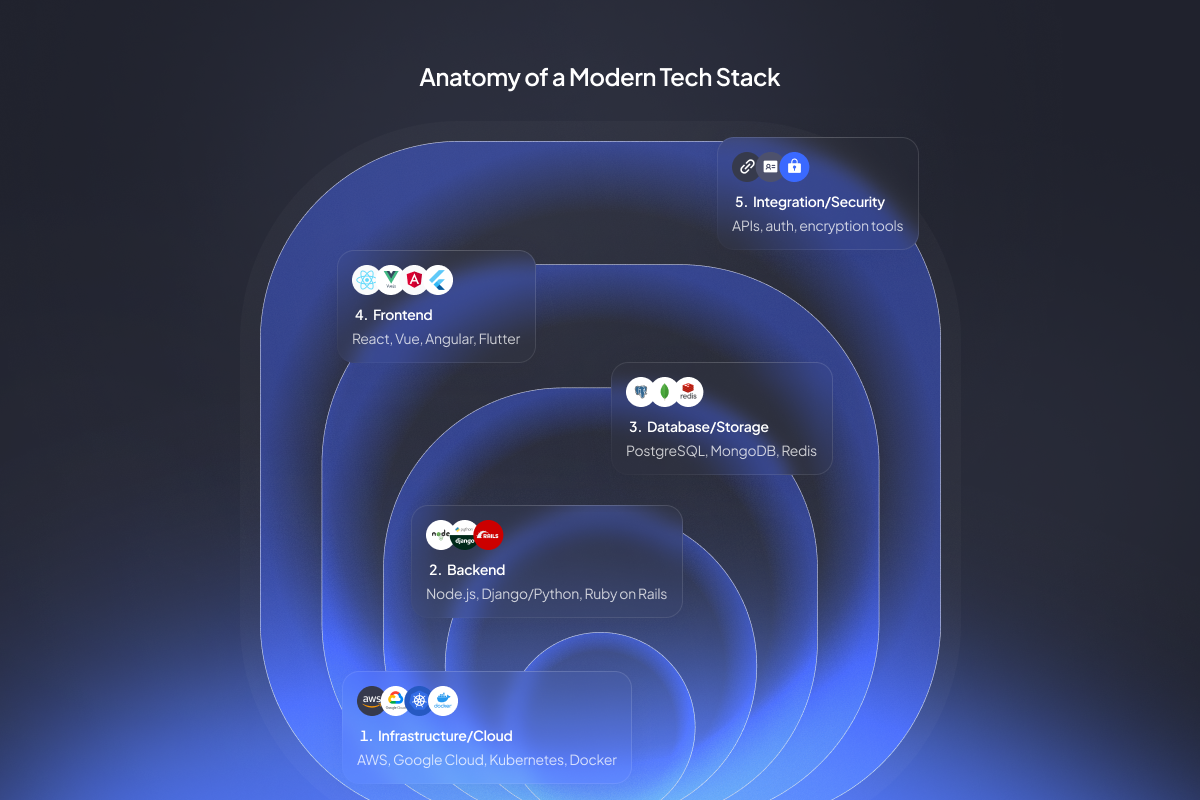
- Infrastructure/Cloud: (eg: AWS, Google Cloud, Kubernetes, Docker) – the underlying servers, networks, and containers.
- Backend: (eg: Node.js, Django/Python, Ruby on Rails) – server-side frameworks, APIs, business logic.
- Database/Storage: (eg: PostgreSQL, MongoDB, Redis) – where your data lives.
- Frontend: (eg: React, Vue, Angular, Flutter) – user interfaces and client-side code.
- Integration/Security: (APIs, authentication, encryption tools) – middleware, auth services, and compliance tools.
In other words, it’s the combination of programming languages, libraries, frameworks, databases, and services that are “stacked” together to create your application. Each component you choose impacts what features you can build, how fast your team can ship, and how easily you can maintain the product.
The key is cohesion. You want technologies that integrate smoothly and don’t create unnecessary translation layers or operational overhead. For example, if your backend choice forces awkward patterns for real-time features or scales poorly with concurrency, your frontend team will feel it immediately. Similarly, if your frontend tooling is complex but your product needs only simple UI flows, you’re buying unnecessary build overhead.
A clear way to understand your stack is with a technology stack diagram. This visual blueprint breaks down your system into layers:
Popular Combinations and When to Use Them
While some teams choose to build a custom tech stack from scratch, most prefer starting with well-established combinations. These stacks offer speed, reliability, and ease of hiring—all essential for product teams that need to move quickly without sacrificing long-term scalability.
Below are some of the most trusted tech stack combinations used today, each with its strengths and ideal use cases.
MERN Stack (MongoDB + Express.js + React + Node.js)
The MERN stack is a JavaScript-based setup ideal for building responsive single-page applications and rapid prototypes. It combines:
- React for building dynamic UIs
- Express.js + Node.js for backend logic and API handling
- MongoDB for flexible, schema-less data storage
Because all layers use JavaScript, onboarding is fast, and context switching is minimal. It’s a solid choice for startups or small teams that need to ship quickly without deep backend complexity.
Best for: Lightweight apps, MVPs, and teams already familiar with JavaScript
Django + React + PostgreSQL
This full-stack combo blends development speed with backend robustness:
- Django offers a batteries-included Python backend with built-in auth, admin, ORM, and routing
- PostgreSQL handles structured, relational data with high reliability
- React powers the UI with a flexible component system
This stack is a go-to for internal tools, dashboards, and operational platforms where data integrity and reporting are critical.
Best for: Data-driven apps, admin panels, internal platforms.
Next.js + Node.js + PostgreSQL or MongoDB
Built on React, Next.js streamlines both frontend and backend development by supporting:
- Server-side rendering (SSR)
- Static site generation (SSG)
- Built-in API routes
When paired with Node.js, this setup simplifies the full-stack runtime. Choose PostgreSQL for structured, transactional data—or MongoDB if flexibility and nested schemas are more important.
Best for: SEO-sensitive web apps, hybrid SaaS products, marketing sites with dynamic content.
Ruby on Rails + Hotwire + PostgreSQL
Rails has long been a favorite for rapid development, and the modern combination with Hotwire adds reactivity without a complex frontend:
- Rails offers conventions and integrated tooling for fast backend development
- Hotwire enables reactive UI updates without heavy JavaScript
- PostgreSQL provides a solid foundation for relational data
This stack keeps frontend and backend tightly coupled, reducing decision fatigue and enabling fast iteration.
Best for: Productivity-first teams, fast iteration cycles, full-stack developers.
Spring Boot + Angular + MySQL/PostgreSQL
This enterprise-ready stack is favored in regulated industries and large organizations:
- Spring Boot offers a modular, scalable backend with strong support for APIs and security
- Angular enables structured, maintainable frontends with built-in typing and dependency injection
- MySQL or PostgreSQL ensure stable, ACID-compliant data persistence
This stack is known for its resilience and scalability in complex, high-compliance environments.
Best for: Enterprise apps, fintech, healthcare, logistics
Serverless Stack (React + AWS Lambda + DynamoDB)
For teams seeking scalability without managing infrastructure, serverless is a compelling option:
- React handles the frontend
- AWS Lambda runs backend code on demand
- DynamoDB manages data storage with near-infinite scalability
There are no servers to provision or maintain. Costs are usage-based, and development is focused purely on application logic.
Best for: Event-driven apps, cost-sensitive products, variable traffic workloads.

Common Pitfalls CTOs Should Avoid
Even experienced engineering leaders can make costly missteps when choosing a tech stack. Here are the most common traps—and how to avoid them:
1. Following Trends Without Strategy
Just because a framework is trending doesn’t mean it’s the right fit. Many hyped technologies lack maturity, ecosystem support, or long-term stability. Relying on what’s popular today—without evaluating how it will scale or who will maintain it—can create future roadblocks, especially if key team members leave.
2. Letting Current Skills Dictate Long-Term Strategy
It’s natural to favor familiar tools, but doing so can limit growth. A stack that matches today’s skills may fall short when new requirements emerge. Build for where your product is headed, not just where your team is today. Investing early in scalable, strategic tools can prevent talent bottlenecks and costly rework.
3. Overlooking Long-Term Maintenance
It’s easy to take shortcuts to get an MVP out the door. But if your stack isn’t built with maintainability in mind, technical debt will accumulate—outdated libraries, security vulnerabilities, and brittle integrations will slow you down. Prioritize tools with clear upgrade paths and strong community support, and budget for regular refactoring.
4. Switching Stacks Mid-Project Without a Migration Plan
Sometimes, changing your stack mid-development is necessary—but doing so without a clear roadmap can derail timelines and budgets. Stack migrations should be deliberate, phased, and well-documented. Otherwise, your team risks rebuilding from scratch under pressure.
5. Ignoring Security and Compliance
Security can’t be an afterthought. Whether you’re handling user data, processing payments, or storing internal metrics, your stack must support encryption, authentication, access control, and audit logging from the start. Skipping this step can lead to data breaches, fines, and reputational damage.
6. Making Decisions Solely Based on Budget
Choosing tools based purely on cost often results in expensive workarounds down the line. Free tools and low-code platforms have their place, but they’re not always built for scale. Evaluate total cost of ownership, not just upfront savings—and don’t be afraid to invest in robust solutions if they support your long-term goals.
Overall, don’t build your stack for where you are today—build for where you’re going. Stack decisions should serve your vision for the next three to five years, not just your MVP launch. Scalability, maintainability, and flexibility should always outweigh short-term convenience.