

I’ve spent over a decade in the trenches of technical recruiting, operating at the intersection of insatiable U.S. demand and the surging talent pool of Latin America.
My day-to-day involves advising CTOs at startups that just closed their Series B and engineering leaders at Fortune 500 companies who are watching their roadmaps freeze because they can’t find true senior talent.
Over the years, I’ve observed an undeniable pattern: the difference between a team that scales successfully and one that collapses under the weight of technical debt isn’t the programming language. It’s the depth of the vetting, cultural alignment, and strategic talent management.
Latin America has solidified its position as the global epicenter of nearshoring. This shift goes far beyond simple geographic proximity; it is driven by a rigorous academic engineering foundation, AI-first specialization, and a mastery of modern architectures.
This guide is dedicated to CTOs, VPs and Tech Leads looking to scale their teams in this crazy 2026 landscape. I will break down exactly how to structure a world-class hiring process for Latin American software developers.
I’ll cover:
- The strategic edge: Why U.S. companies are prioritizing Latin American developers in 2026.
- The regional landscape: The best LatAm countries for your specific hiring needs.
- The bottom line: Total cost analysis by country for software engineers in the region.
- The playbook: A step-by-step guide to hiring top performers on time and under budget.
Why do U.S. companies hire Latin American developers?
Hiring in Latin America provides access to top-rated Latin American engineers with operational savings ranging from 20% to 60%, all while working in the same time zone. However, the true competitive advantage lies in operational synchronicity. In a typical distributed team’s workday, communication latency is the primary productivity killer.
By hiring LATAM developers, companies gain three strategic assets:
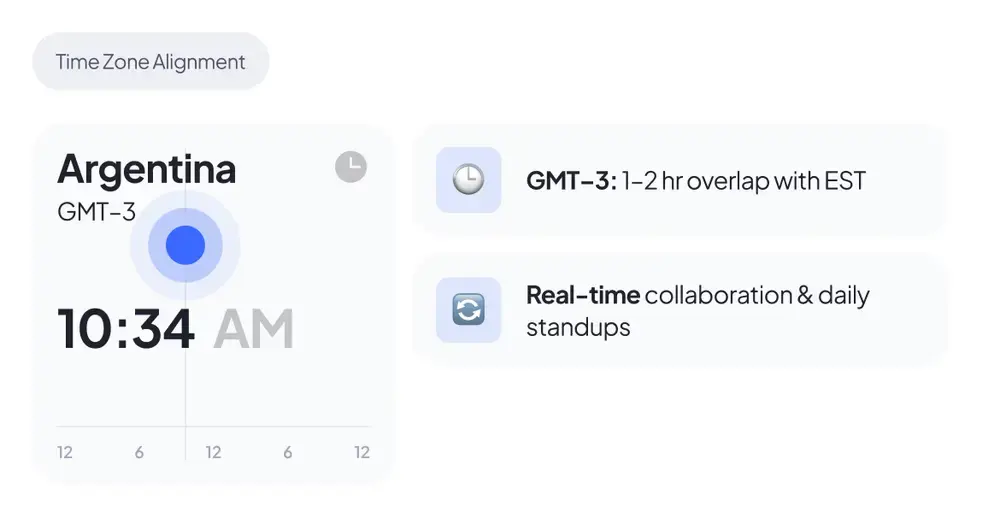
- Real-time collaboration: Tech hubs in the region operate between UTC-3 and UTC-6, guaranteeing up to 8 hours of overlapping work time. If a developer in Buenos Aires hits a critical blocker at 10:00 AM, their counterpart in New York or San Francisco is available to resolve it instantly. This eliminates the 24-hour waiting cycle typical of outsourcing to India or Eastern Europe.
- Cultural affinity and product ownership: The LATAM work culture is highly compatible with the U.S. “product ownership” model. Regional engineers don’t just execute tickets; they have the autonomy and training to challenge requirements if they detect technical inefficiencies or User Experience (UX) flaws.
- Resilience and adaptability: A large percentage of global organizations already outsource functions to access specialized talent unavailable locally. LATAM developers are “change natives,” accustomed to working in dynamic economies that demand constant adaptation.
Best of all, hiring managers don’t need to search with a magnifying glass: the talent is already there.
The LATAM tech talent ecosystem: 2.2 million developers and their impact
Latin America boasts a critical mass of 2.2 million software developers. Brazil leads the pack with 760,000 professionals, followed by Mexico with 560,000 and Argentina with 170,000. However, the key metric is the renewal rate: the region graduates over 220,000 STEM students annually.
This talent pipeline feeds specialized global hubs:
- Medellín (Colombia): Transformed into a massive export services center focusing on cloud architecture and SaaS.
- Guadalajara (Mexico): Known as the “Mexican Silicon Valley,” specializing in complex systems and development for the financial sector.
- Montevideo (Uruguay): A highly specialized node for mission-critical software, boasting one of the highest software export rates per capita in the world.
- São Paulo (Brazil): The engine behind some of the world’s largest Fintechs, processing data volumes that rival those of Wall Street.
Best countries to hire developers in Latin America: Choosing your strategy
There is no single “best” country to hire Latin American developers. Your choice depends on your strategic priorities. Argentina excels in leadership and technical architecture. Brazil is the undisputed leader for massive scalability. Mexico offers the best legal integration and time zone alignment with the U.S. Colombia stands out for adaptability and cost efficiency.
Here is a deep dive into each market.
Argentina: Leadership, communication, and architecture
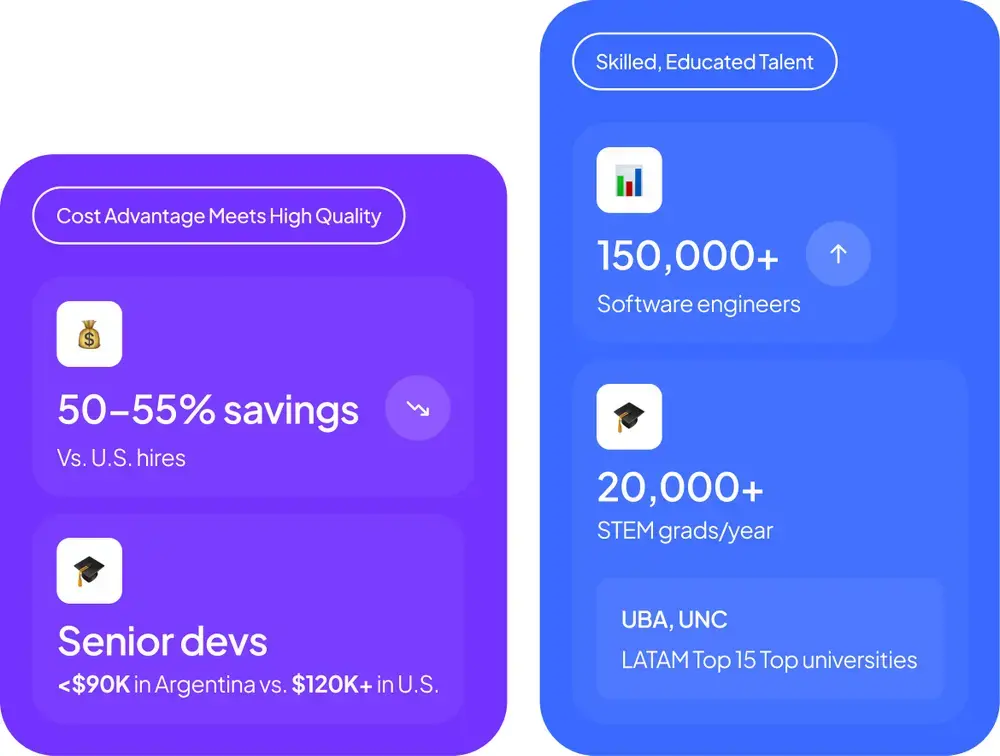
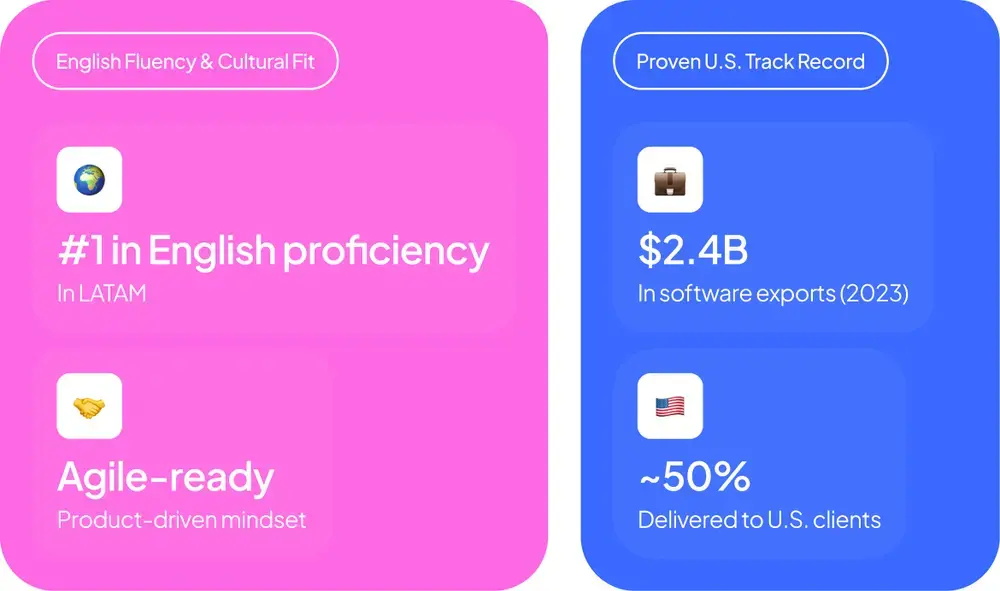
Argentina is the regional leader in English proficiency (ranked 26th globally). It also boasts advanced skills in AI and Python. The ecosystem is mature, fueled by local unicorns like Mercado Libre. It features a pool of over 160,000 developers and 20,000 annual STEM graduates.
- Ideal profiles: U.S. companies choosing staff augmentation in Argentina typically seek Tech Leads and Solutions Architects. These professionals offer high autonomy and the ability to engage in technical debates with C-level executives.
- Senior salary range: $64,000 – $104,700 USD per year.
- Key insight: This country offers the strongest cultural affinity and a knack for solving complex problems in distributed environments.
Brazil: Massive scale and financial maturity
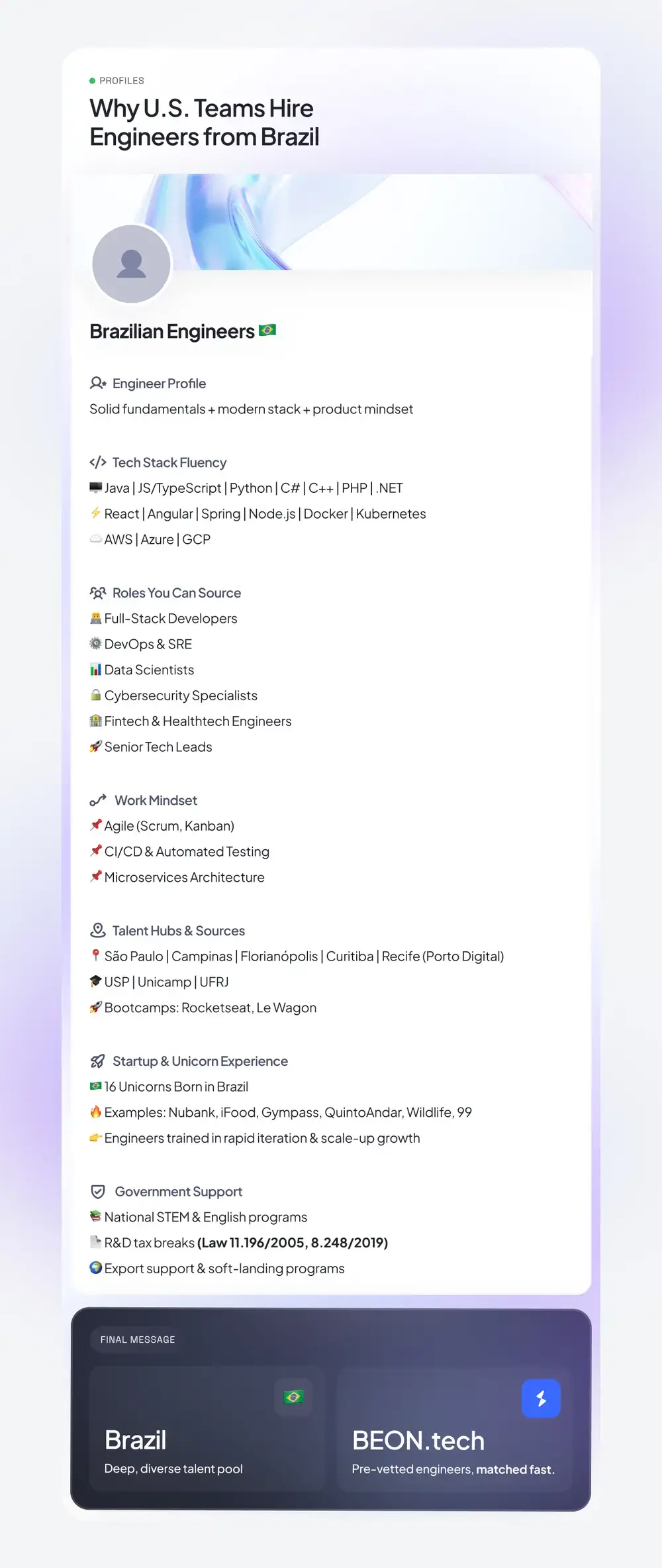
Brazil is Latin America’s largest tech market. It features a pool of over 630,000 engineers and 12,500 IT service companies. The ecosystem specializes in Cloud Computing, Big Data, and global-scale financial systems.
- Ideal profiles: Companies opting for Brazilian staff augmentation usually look for large senior backend teams. They are perfect for distributed architectures and high-volume transactional processing.
- Senior salary range: $70,000 – $100,000 USD per year.
- Key insight: Big infrastructure investment and over 100,000 annual STEM graduates make Brazil the go-to option for scaling teams fast.
Mexico: Total alignment with the West Coast
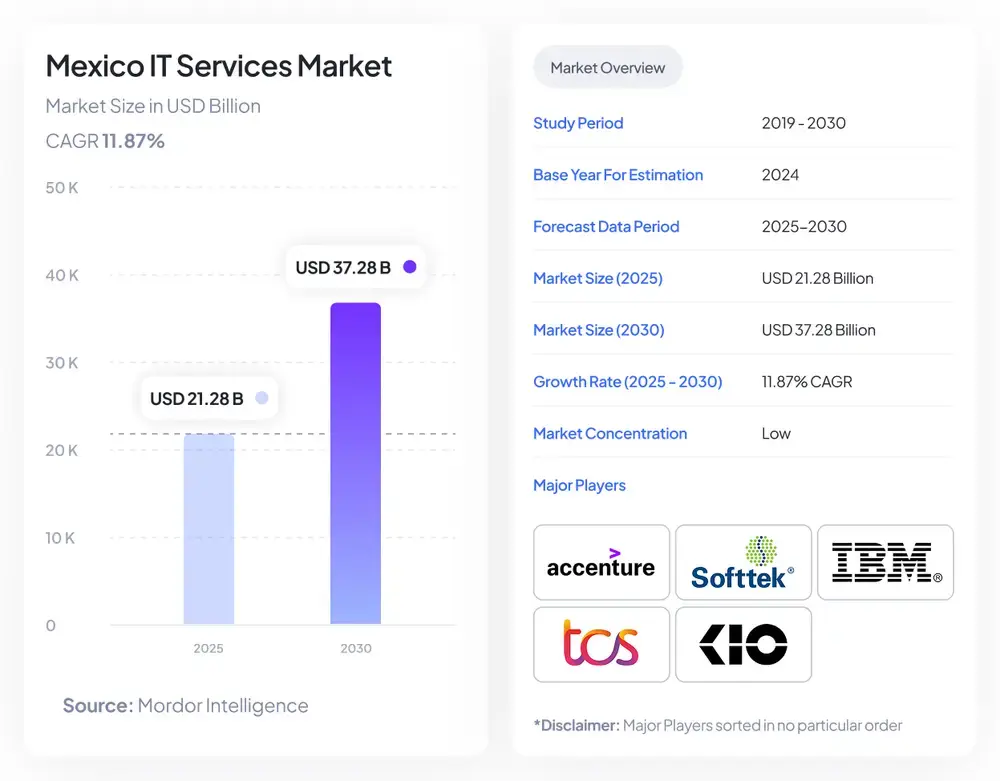
Mexico is the “Silicon Valley” of LATAM. Its IT services market is projected to reach $19 billion by 2025. Its main advantages are perfect time zone alignment (PST/CST) and strong Intellectual Property protection under the USMCA.
- Ideal profiles: U.S. firms expanding with Mexican talent usually need Full Stack Developers specialized in E-commerce and Fintech (React, Java, .NET).
- Senior salary range: $70,000 – $90,000 USD per year.
- Key insight: With 800,000 tech professionals and cutting-edge hubs like Guadalajara, Mexico is the natural partner for companies in San Francisco or Seattle.
Colombia: Adaptability and work ethic
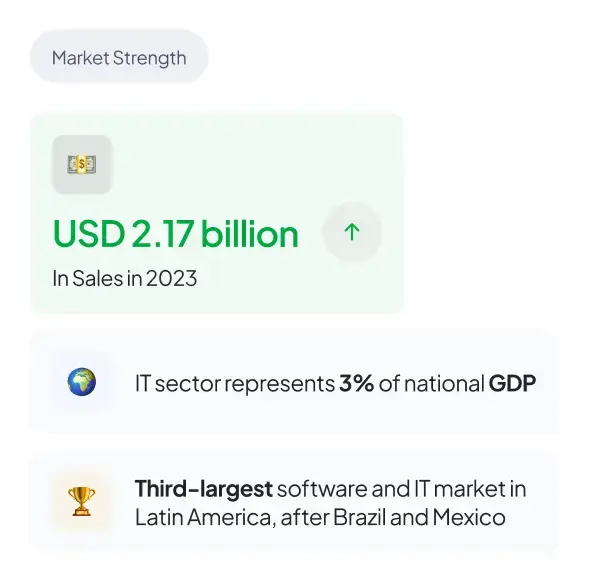
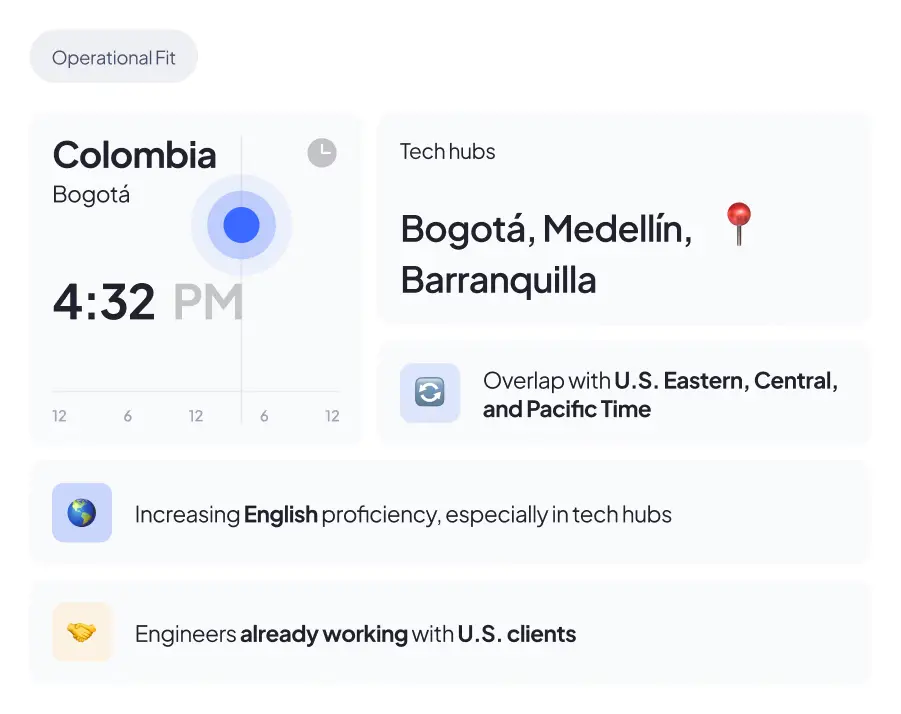
Colombia is the region’s “rising star.” Vibrant hubs in Bogotá and Medellín house over 150,000 professionals. The country is known for a service-oriented culture, high proactivity, and strong government tax incentives for tech firms.
- Ideal profiles: Companies adding Colombian talent to their in-house teams often look for Full Stack Web Engineers, Mobile Specialists (Flutter/iOS), and DevOps.
- Senior salary range: $70,000 – $90,000 USD per year (offering up to 50% savings compared to U.S. salaries).
- Key insight: Colombia provides an excellent cost-benefit ratio. Its time zone is almost identical to the U.S. East Coast (EST), making real-time collaboration effortless.

What is the real cost of hiring a LATAM software engineer? TCO analysis
The cost of hiring a senior developer in Latin America starts between $60,000 and $90,000 USD. These professionals usually have over 6 years of experience and English proficiency. Choosing talent from this region represents a savings of 60% to 65% compared to an equivalent U.S. profile.
Hiring tech talent in LATAM offers a competitive advantage in cost and talent quality. The Total Cost of Ownership (TCO) varies based on the hiring model. You can choose between contractors, freelancers, or an Employer of Record (EOR).
TCO analysis: Senior software engineer in LATAM (2026)
In Latin America, the TCO is conditioned by the legal architecture and the chosen operating model. Unlike the U.S., where costs are relatively homogeneous, regional regulations play a significant role.
1. The anatomy of the ideal profile
Imagine you need a Senior Frontend Developer with over 5 years of experience and AI specialization. You need near-native English and a 6-hour time zone overlap with your U.S. team.
The current market value for this elite talent in LATAM is $60,000 USD annually. The savings compared to a $180,000 USD salary in San Francisco are clear. However, you must also consider hidden costs.
2. The maze of hidden costs (EOR model)
Hiring through an Employer of Record (EOR) ensures full compliance but adds a cost structure beyond the net salary. You should consider an increase of 30% to 50% for total compliance.
- Employer Taxes: These vary by country, from 15% in Mexico to 33% in Brazil or Colombia.
- Legal Benefits: These include the 13th-month salary, vacation bonuses, and social security.
- Management Fees: EOR platforms charge between $400 and $800 USD monthly per employee.
3. The efficient alternative: Staff Augmentation
Staff augmentation is often more agile and cost-effective than the EOR model. In this scheme, a specialized agency absorbs the operational complexity to give you peace of mind.
- Integral Management: The agency handles paperwork, fees, and talent development.
- No Local Entities: You access talent without the cost of establishing a legal entity in each country.
- Substitution Guarantee: If a developer does not meet expectations, the agency manages the replacement without legal friction.
EOR vs Staff Augmentation: Annual TCO of a LATAM Senior Software Engineer
| Concept | EOR | Staff Augmentation |
| Base Compensation | $60,000 | $72,000 (Includes agency fee) |
| Social Charges / Bonuses | $18,000 (approx. 30%) | $0 (Covered by agency) |
| EOR Fees / Management | $7,200 ($600/month) | $0 (Included in the fee) |
| Equipment / Logistics | $4,000 | $0 (Included in the fee) |
| TOTAL TCO YEAR 1 | $89,200 USD | $76,000 USD |
4. Recruitment and onboarding: The logistical factor
Entrance costs in the region are a key factor in your strategy. Traditional headhunting agencies charge between 15% and 35% of the annual salary.
Logistics like shipping hardware to countries with complex customs can add up to $5,000 USD. It is best to manage these through local providers to avoid import duties.
Key considerations by country
- Brazil: The most expensive market due to its complex CLT legal system.
- Mexico: Offers the best balance of time zone (CST) and moderate costs.
- Argentina: Highest technical depth per dollar, though volatility requires contracts in USD.
- Colombia: A consolidated service hub with competitive salaries and high real-time collaboration.
How to hire Latin American developers: A step-by-step process
To successfully hire Latin American developers in 2026, companies should execute a talent acquisition process that prioritizes technical quality and operational security.
The most efficient path is integrating a Staff Augmentation model into your growth strategy. This allows U.S. companies to scale teams using three key pillars: identifying Product Engineers with solid academic backgrounds, applying advanced vetting with anti-deepfake protocols and AI certification, and delegating legal and payment logistics to an expert partner to eliminate administrative friction.
PHASE 1: Sourcing strategy and profile definition
The first mistake is publishing a generic “Job Description.” The LATAM software engineer market is highly competitive; the best candidates receive 5 to 10 offers per week.
1.1. Direct sourcing vs. staffing partner
- Direct Sourcing: Requires an internal team that understands local labor laws in each country (Argentina, Brazil, Mexico, etc.). It is ideal if you plan to open your own legal entity.
- Staffing Partner: This is the most efficient option for scaling. The partner handles compliance, payments in local currency/dollars, and, most importantly, the pre-vetting. In 2026, a good partner must deliver engineers already certified in IA (AI Path) to guarantee immediate productivity.
1.2. The “Product Engineer” profile
Do not look for a “React Developer.” Look for a Product Engineer. In Latin America, the combination of rigorous formal education (5-6 year degrees) and a highly resilient work culture produces a specific type of professional.
These engineers are characterized by:
- Systems thinking: Thanks to their solid academic foundations, they don’t just solve tickets; they understand how a change in the frontend affects the database and the overall scalability of the system.
- Experience in complex environments: Most senior LATAM developers have built their careers working for global scale-ups or in high-volatility markets. This has trained them to navigate technical debt and complex architectures with agility.
In short, they don’t just ask “how to build it,” but “why are we building it this way?” This proactivity is what allows a remote team to function as a true extension of your in-house product team.
PHASE 2: The vetting process (the “how” to filter)
A modern vetting process in 2026 must have 4 critical stages. If you skip one, you risk hiring technical debt or, worse, falling victim to identity fraud.
Stage 1: Initial screening and identity validation (anti-deepfake protocol)
A few years ago, the challenge for teams hiring remote developers from LATAM was avoiding overemployment. At BEON.tech, we developed specific techniques to identify that candidates were telling the truth. Today, the situation has gone further: the emergence of deepfakes.
I recommend you:
- Digital Validation: Before the call, analyze their footprint on GitHub and LinkedIn. Look for historical consistency.
- Spontaneity Test: During the video call, ask unexpected “soft” questions. Conversational AIs or deepfakes usually have micro-delays in response when taken off the technical script.
- Visual Modification: Ask the candidate to perform a simple physical action (e.g., “tilt your head to the left”). Current video deepfakes often fail to render extreme side angles or handle rapid changes in perspective.
Stage 2: AI maturity evaluation (AI Path)
Productivity in 2026 is not measured in lines of code, but in the ability to integrate AI to accelerate the SDLC. Gartner predicts that by 2028, 75% of engineers will use AI assistants.
In this stage, the candidate must demonstrate how they use tools like Claude Code for:
- Architecture acceleration: Rapid prototyping of microservices.
- SDLC optimization: Automation of repetitive tasks (boilerplate, unit tests).
- Hallucination audit: Evaluating their ability to detect security flaws and logical errors in code suggested by LLMs.
In BEON.tech, we have established the AI Path as a mandatory requirement. What some of our LATAM engineers said about the program:
“I went from viewing AI as a black box to actually building agents that reason and make decisions.” — Jose Brotons, Frontend Engineer.
“The best part is that I am using this knowledge in my current role.” — Gilvanei Gregório, Backend Engineer.
Stage 3: Cultural vetting and asynchronous communication
Success with LATAM engineers depends on the ability for written synthesis and clarity in English communication.
- The documentation test: We ask the candidate to write a README or technical summary. If an engineer cannot communicate complex ideas concisely in writing, they become a synchronous bottleneck.
- Business english: Maintaining 80% of the interview in English is the minimum standard. However, in 2026 the requirement has evolved: colloquial or reading English is no longer enough. This is why at BEON.tech we evaluate argumentation capacity and real-context English (small talk).
- The “Owner Mindset”: We look for engineers who feel part of the product, not simple external contractors. At BEON.tech, we evaluate cultural proactivity: the ability to raise a hand regarding an inefficient process and the radical honesty to admit mistakes early. In a remote team, trust is the only currency that accelerates the development cycle.
Stage 4: Real-context technical test
Forget “LeetCode” type algorithm puzzles. The best way to hire in LATAM is Contextual Live Coding:
- Present a real bug or a small feature from your current repository.
- Observe how they navigate the code, how they ask about the business context, and how they structure their solution.
- Frontend focus: If it is a frontend profile, evaluate their knowledge in Micro-frontends and Next.js. Ask specifically about rendering strategies (SSR vs. SSG) and how they optimize Core Web Vitals.
Stage 5: Fluid onboarding and importance of retention
“How to hire” does not end with the contract signature. Retention is what guarantees ROI. The cost of replacing a senior developer can exceed $50,000.
At BEON.tech, we prioritize a 30-day onboarding that contains these characteristics:
- Day 1-7: Total focus on culture and tools. Access to Slack, Jira, GitHub.
- Day 8-15: First “Small Win.” A small task that reaches production quickly to generate confidence.
- Day 16-30: Assignment of a local “Buddy” or mentor who understands the nuances of communication between the U.S. and LATAM.
Talent Experience Management: How to hire and keep the best LATAM engineers
Retention in the first 90 days is the most critical indicator of hiring success. Many processes fail because developers feel like disposable external contractors.
Our Talent Experience Management Framework™ solves this through three pillars:
- High-impact onboarding: We integrate the developer into your culture and processes from day one. Each engineer is supported by a Talent Experience Manager. This partner aligns expectations and maintains fluid communication. It’s not just about granting access; it’s about aligning their goals with your product roadmap.
- Continuous career pathing: Senior developers stay where they can keep learning. We offer ongoing mentorship and technical updates through our AI Path.
- Performance monitoring: Monthly evaluations detect technical blockers or signs of burnout before they lead to a resignation. This ensures team stability that freelancer platforms cannot match.
Our clients value this focus on the talent experience. It translates directly into higher productivity and that “extra mile” mindset. If you plan to scale with Latin American remote developers, you need a retention framework.
The reason is simple: Hiring Latin American developers is only the first step. Retention is where the ROI is realized.
Checklist for hiring in LATAM
Checklist for Hiring in LATAM
- Define the legal model: Direct contractor or Employer of Record (EOR)?
- Verify identity: Apply an anti-deepfake protocol during the first video call.
- AI proficiency: Make sure candidates use generative tools to optimize the SDLC.
- Communication test: Evaluate asynchronous writing skills as much as coding ability.
- Time zone alignment: Prioritize countries within a 3-hour difference from your core team.
- Trusted partner: If you’re hiring more than 3 people, consider a staff augmentation partner like BEON.tech.
Mastering the local landscape of Latin American developers
Hiring top-tier talent in Latin America is a nuanced journey that goes beyond finding the right skills. Each country, from the emerging tech hubs in Colombia to the established engineering powerhouses in Argentina and Brazil, operates under its own legal, cultural, and economic framework.
To help you navigate these complexities with confidence, we’ve developed a specialized library of resources. Gain a deeper understanding of regional compensation standards, labor regulations, and local tech ecosystems by exploring our complete LATAM hiring guides. Knowledge is your greatest competitive edge in 2026; ensure your expansion is backed by the right regional intelligence.