
 Argentina
  Brazil
  Mexico
  Colombia

There’s a specific frustration that engineering managers don’t talk about enough: the moment you realize that the best candidate for your open role lives four time zones away, speaks English fluently, has exactly the stack experience you need, and you have no practical path to hire them quickly.
The recruiting cycle is too slow. A full offshore engagement means handing off control. An EOR adds tax and legal complexity you didn’t budget for. And nobody on your leadership team wants to open the “should we hire offshore?” conversation again after the last one went sideways.
Nearshore staff augmentation exists precisely at this intersection. It combines both offshore cost savings and onshore alignment, without the operational trade-offs that make most distributed hiring strategies painful in practice.
This guide will explain:
- What is nearshore staff augmentation
- How nearshore staff augmentation compares to onshore augmentation
- When it delivers real value, and what to watch out for before you sign anything.
What is Nearshore Staff Augmentation?
Nearshore staff augmentation is a hiring model where US companies bring in specialists from countries in neighbouring time zones. These professionals then work directly under the client’s management, following the client’s processes and sprint cadence. Nearshore staff is:
- Close enough in time zone that your standup isn’t a scheduling negotiation
- Culturally aligned enough that communication doesn’t require a glossary
- Cost-structured differently than a U.S. hire without sacrificing the seniority level you actually need.
For US-based engineering teams, nearshore practically means Latin America. Countries like Colombia, Mexico, Argentina, Brazil, Chile, and Peru operate between UTC-3 and UTC-6. You’ll have to worry, at most, about three hours of difference with US time zones. A team in Bogotá and a team in New York share the same business day. They can pair-program, run a sprint review, or review a PR without anyone having to rearrange their schedule around an asynchronous handoff.
Nearshore vs. Offshore vs. Onshore: A Real Comparison
The word nearshore does specific work here. It draws a clear line between models. Offshore brings in talent from distant time zones such as Asia or Eastern Europe. Onshore relies on US-based contractors.
Most comparisons of these three models treat them as a spectrum from expensive-and-close to cheap-and-far. That’s the wrong frame. The more useful comparison is operational: what does each model actually require from your team to function?
Onshore Staff Augmentation
Gives you maximum overlap and cultural alignment. The contractors are in your time zone, often in the same city, and sometimes available for in-person collaboration. The trade-off is cost: senior US-based contract developers typically run $100–$150/hour, or $15,000–$24,000 per month. For teams with the budget, it works. For teams trying to extend engineering capacity without expanding burn rate proportionally, the math usually doesn’t.
Offshore Staff Augmentation
Offers the lowest rates, senior engineers in some offshore markets run $40–$60/hour all-in, but it comes with operational friction that compounds over time. A 9–12 hour time difference means your offshore engineer’s workday begins when yours ends. PR feedback takes 24 hours to become a dialogue. Agile ceremonies become async approximations of themselves.
Teams that run tight sprint cycles with frequent pivots find that offshore augmentation creates coordination expenses that erode the cost savings.
Nearshore Staff Augmentation
Sits at a different point on the map. The cost advantage is meaningful: senior engineers from Latin America, through a quality provider, run $7,500–$9,000/month all-in. But the defining advantage isn’t cost. It’s that the operational model doesn’t require you to redesign how your team works.
The nearshore engineer joins your Slack, attends your standup at 10 am Eastern, reviews your PRs in real time, and participates in your sprint planning the same way a U.S.-based team member would. The hiring model changes. The engineering workflow doesn’t.
| Factor | Onshore | Nearshore (LATAM) | Offshore (Asia/E. Europe) |
| Time zone overlap with the U.S. | Full | 5–8 hours/day | 0–3 hours/day |
| Senior engineer cost/month | $15K–$24K | $7.5K–$9K | $5K–$7K |
| Real-time collaboration | Yes | Yes | Limited |
| Agile/sprint compatibility | High | High | Low–Medium |
| Cultural alignment | High | High | Variable |
| Travel feasibility | Easy | Viable | Difficult |
| English proficiency (senior level) | Native | High | Variable |
The table above reflects averages. You may find excellent offshore engineers with great communication and flexible hours to accommodate your US teams. Some nearshore providers may not vet rigorously enough. It’s key to understand the best option for your specific case.
Why Time Zone is an Engineering Problem, Not Just a Logistics Problem
This is a key point, and it deserves more than a checkbox in a comparison table. Let’s dig deeper.
Agile development, the way almost every US product team actually works, depends on tight feedback loops. A question asked in the morning should get an answer that morning. A blocker surfaced in a standup should be unblocked before the next standup.
When your team operates in a 12-hour time gap, none of those loops close in a single day. You ask a question at 9 am ET, and it reaches Bangalore at 9 pm IST. The answer comes back 9 am IST, which is 9 pm ET. What should have been a two-hour conversation became a two-day exchange. This slows down individual tasks, and worse, it compounds.
Nearshore teams from Latin America operate within the same business day as US teams. Colombia (UTC-5) is effectively the same time zone as US Eastern. Mexico City (UTC-6) aligns with Central Time. Even Argentina (UTC-3), on the furthest end, provides six or more hours of workday overlap with US West Coast teams. The specific country matters less than the fact that collaboration happens in real time, not through recorded messages and async threads.
This is why nearshore augmentation is particularly well-suited to Agile teams. The model doesn’t require you to restructure your sprints or build elaborate handoff documentation just to keep a distributed engineer productive. They’re on the call.
The 7 Core Benefits of Nearshore Staff Augmentation Services
Nearshore staff augmentation services deliver their value at the operating level; the benefits aren’t abstract. These are the seven core advantages that consistently drive outcomes.
Real-Time Collaboration Without Structural Redesign
The operational case for nearshore starts here. You don’t have to change how your team works to integrate a nearshore engineer. They join the standup. They attend sprint planning. They participate in architecture discussions as they happen. If your tech lead needs to walk through a decision, they call, not record a Loom, and wait 18 hours for a response. This is what seamless integration actually means in practice, not a marketing abstraction.
Access to a Deep, Pre-Vetted Talent Pool
Latin America has built one of the strongest engineering talent ecosystems for US-aligned product development in the world. The region’s major tech markets collectively produce tens of thousands of software engineers annually. Many of whom have been educated in US technologies, work in English fluently, and have direct experience supporting US product teams.
Keeping talent searches open across the LATAM region dramatically expands what’s accessible. A provider with a deep regional network can typically place fifteen to twenty engineers per month when searches stay geographically flexible.
Meaningful Cost Efficiency Without a Quality Compromise
We’ve already mentioned that a senior LATAM engineer through a quality nearshore provider typically runs $7,500–$9,000. But how does it compare to a US direct hire? For context: the fully-loaded cost of a comparable US direct hire lands between $170,000 and $185,000 per year, or roughly $14,000–$15,400 per month.
That gap of approximately $5,000–$7,000 per engineer per month is meaningful at scale. For a team adding four engineers, the annual difference runs $240,000–$336,000. And unlike a US hire, the nearshore engagement includes replacement coverage: if an engineer leaves, the provider replaces them at no additional cost. The US equivalent is a $25,000+ recruiting fee and a sixty-day vacancy.
Control Over the Work
This is the distinction separating nearshore augmentation from outsourcing. You manage the backlog. You set priorities. You direct the technical work. The provider manages employment, payroll, HR, benefits, and local compliance. That’s the division of responsibility.
If your product direction shifts mid-sprint, you update the backlog. No change orders. No vendor negotiation. No renegotiating scope.
Cultural and Professional Alignment
LATAM engineers working with US product teams typically bring familiarity with US business culture. This isn’t universal, vetting matters, but it’s structurally more common in LATAM than in many offshore markets, where different business cultures, communication norms, and professional hierarchies require active adjustment.
The best nearshore providers don’t just vet for technical skills. They filter for engineers who have demonstrably worked in distributed, US-timezone-aligned environments and can integrate without hand-holding.
Retaining Institutional Knowledge and Technical IP
Unlike project-based outsourcing, where technical expertise leaves with the vendor, staff augmentation keeps institutional knowledge within your company. Since augmented engineers work directly in your systems and participate in your code reviews, all architectural insights and logic stay embedded in your codebase. This ensures that even when an engagement ends, your internal team retains full ownership of the intellectual property and the “how-to” behind your product.
Scalability That Matches Product Cycles, Not Headcount Plans
Engineering demand doesn’t scale linearly with product plans. It surges during launches, when delivery pressure is highest. It stabilizes once the product is live and issues are under control. It ramps up again when a new initiative starts. Then it tapers off as features ship and maintenance becomes a lower priority.
Nearshore augmentation accommodates that natural variance. You scale up for a product push, wind down when the scope contracts, and restart when the next initiative requires capacity, without carrying underutilized headcount through the valleys.
When to Use Nearshore Staff Augmentation (and When Not To)
Nearshore staff augmentation can be a great fit for you, but it’s important to remember that it’s a situational tool. It works best when speed, alignment, and continuity matter more than building from scratch. Think product deadlines, capacity gaps, or hard-to-fill roles that can’t wait.
But it’s not a fit for every scenario. Some problems need deep internal ownership. Others need a clean slate outsource, not embedded talent. Knowing the difference is where most teams get it wrong.
Here you can find some scenarios to use as guidelines.
Good Fit Scenarios
- Your team runs Agile and needs engineers who can both participate and execute. If your process depends on daily standups, sprint ceremonies, and real-time unblocking, nearshore is operationally compatible. Offshore is not.
- You need to scale quickly without running a full recruiting cycle. A quality nearshore provider can place a vetted senior engineer in three to four weeks. A domestic recruiting process for the same profile typically takes eight to fourteen weeks, including offer acceptance and notice period.
- The engagement is project-scoped or time-bounded. Staff augmentation is excellent for product launches, platform migrations, and capacity surges. It performs best when there’s a clear start, a clear outcome, and a predictable ramp-down.
- You have internal technical leadership who can direct the work. Nearshore augmentation amplifies your existing team but doesn’t replace direction. If your engineering management is stretched to capacity, you’re not adding capacity; you’re adding coordination overhead.
Poor Fit Scenarios
- You need to hand off a project entirely. If you don’t want to manage the work, you may want to use managed services or outsourcing, not augmentation. The nearshore model requires an engaged client-side technical lead. If you lack the time or senior leadership to guide them day to day, the model breaks down, and you’re better off with a vendor that takes full responsibility for outcomes.
- The engagement is shorter than three months. Ramp-up time for any engineer, regardless of how experienced, typically runs two to four weeks. Within three months, onboarding costs erode a significant portion of the value delivered.
- The role is fundamentally strategic and long-term. If you know this position will be critical to your organization in the coming years, you could think about hiring them. The flexibility premium built into augmentation is only worth paying when flexibility is actually needed. Still, it’s worth noting that some nearshore augmentation services do offer long-term engagements. Here, picking the right provider will make a difference.
- Your compliance environment restricts external contractor access. Some industries may have legal or contractual constraints that limit which systems external engineers can access; A common occurrence in the defense sector or healthcare providers. This is solvable with proper structuring, but the compliance overhead can negate the operational benefit.
Nearshore Staff Augmentation vs. Full Outsourcing
The clearest distinction: augmentation is about people, outsourcing is about deliverables.
When you outsource, you buy an outcome. A vendor takes responsibility for delivering something (a feature, a system, a running service) and manages the execution internally. You review the output, not the process. The engineering decisions happen inside the vendor’s organization. If requirements evolve, you’re reopening a contract.
When you augment with nearshore engineers, you buy capacity. Engineers integrate into your team, follow your technical direction, and contribute to your codebase under your management. The scope can change every sprint because you’re running the sprint.
Neither model is universally superior. Outsourcing is the better choice when the scope is fixed and well-defined, when you don’t want to manage execution, and when the work is non-core enough that process ownership doesn’t matter strategically. Augmentation is the better choice when you need to stay in control of technical decisions, when scope evolves iteratively, and when team integration and knowledge continuity matter to the outcome.
Many mature engineering organizations use both: outsourcing for bounded, non-core workstreams like infrastructure monitoring or QA automation, and augmenting for core product development where daily alignment matters.
How to Evaluate a Nearshore Staff Augmentation Company?
Not all providers operate at the same level, and you should compare and contrast them. How? Evaluate them based on how reliably they can supply qualified talent that integrates quickly into your team, communicates in real time, and performs to your delivery standards under your management model.
Some key factors to consider are:
- A rigorous vetting process.
- A strong guarantee structure.
- Good retention infrastructure.
- A clear contract.
Let’s break them down.
What Rigorous Technical Vetting Actually Looks Like
A strong nearshore provider starts with a good screening process. It’s not enough to screen your candidates with a resume review and a quick call. Look for programs that run live technical assessments: coding sessions with senior engineers, not automated tests, and maintain documented approval rates.
Check approval rates. High approval rates often mean undiscriminating screening. An approval rate around 33% or lower on presented candidates (meaning roughly one in three people who enter the pipeline actually get placed) suggests the provider is selecting, not just matching.
Understand the Guarantee Structure
Unexpected things happen, and you may be forced to replace a member of your nearshore team. Replacement guarantees vary in scope. You’ll find that some providers offer partial coverage. For example, if the engineer leaves or doesn’t work out in the first three months, they will be replaced at no cost.
Others offer full-engagement coverage, meaning if an engineer departs at month fourteen, the provider replaces them under the same terms. Full-engagement coverage is significantly more valuable and signals a provider who is confident in their ability to retain talent long-term. Ask specifically: what triggers the guarantee, what is the replacement timeline commitment, and what conditions void it.
Retention Infrastructure Matters More Than You’d Expect
Engineer attrition is one of the most frequently underestimated risks in nearshore partnerships. An active retention infrastructure is a must for a good augmentation provider. Look for career development frameworks, ongoing engagement with the engineers they’ve placed, and proactive compensation review.
Providers who invest in talent experience management tend to show meaningfully lower attrition rates. Ask prospective providers what their engineering attrition rate is for engagements beyond twelve months. If they don’t have the data, that’s the answer.
The Contract Structure Signals Provider Confidence
Termination terms should be thirty days, with no financial penalty. An all-inclusive monthly rate with no separate fees for onboarding, replacement, or administrative overhead indicates a provider who has fully absorbed those costs into the model. IP and NDA clauses should be explicit, bilateral (flowing down to the individual engineer through the provider’s local agreements), and should assign all work product to you at creation, not delivery.
How Nearshore Augmentation Works in Practice: The Engagement Lifecycle
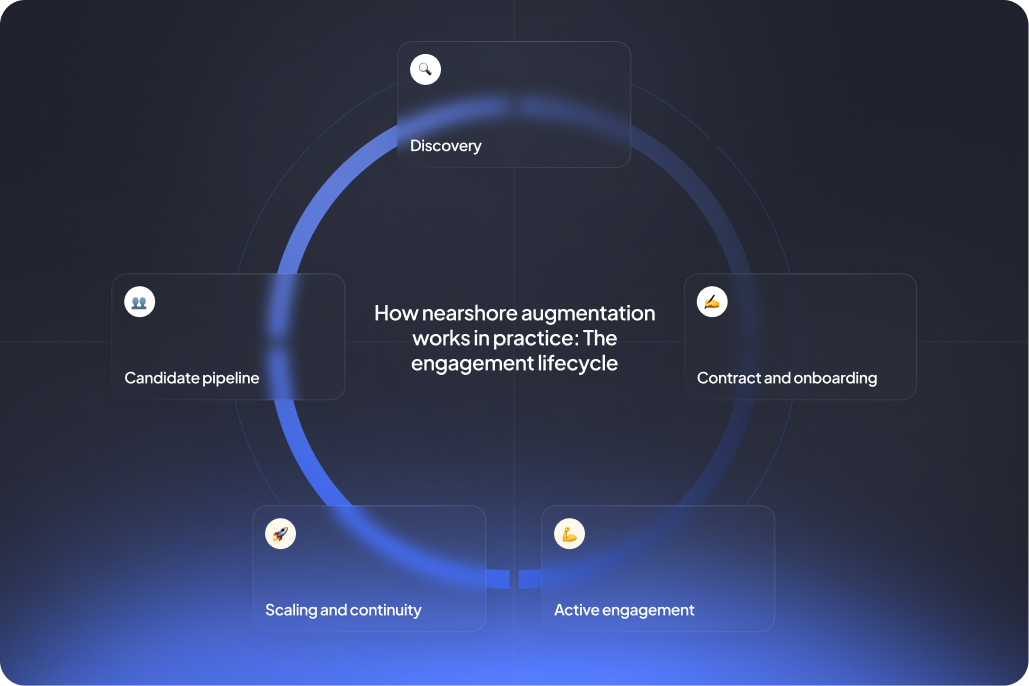
In practice, nearshore staff augmentation follows a structured, front-loaded process designed to reduce hiring risk and accelerate time to impact. Each phase is optimized to ensure the engineer can contribute quickly and operate as a true extension of your team.
We call this sequence the engagement lifecycle. Understanding the operational sequence helps set realistic expectations about timeline, quality control, and integration. We will break it into five sections.
- Discovery. A well-run provider starts by understanding the role technically. It always starts with the job title and the desired tech stack, but it goes further. Architecture context, team dynamics, working style preferences, and the expected ramp-up curve are all key components a good provider will have in mind. This conversation determines the quality of candidates they surface.
- Candidate pipeline. After technical vetting by the provider’s internal engineers, you typically receive two to five candidate profiles. These should include assessments of both technical skills and communication and collaboration capacity. Now, you’ll conduct your own interviews and make the selection. The provider should not push you toward a candidate; they should give you enough signals for you to decide clearly.
- Contract and onboarding. MSA, NDA, and IP assignments are finalized before the engineer starts. A structured onboarding process will compress the time it takes for your new hires to make meaningful contributions.
- Active engagement. The engineer works inside your team. Your technical leads direct the work. The provider handles payroll, benefits, and HR. Account management from the provider typically involves periodic check-ins to ensure engagement health on both sides.
- Scaling and continuity. Good augmentation relationships extend over 12–24+ months. Engineers who stay long-term develop domain knowledge, architectural context, and team trust that makes them increasingly valuable. Treat them accordingly.
Choosing the Right Nearshore Staff Augmentation Company: What to Ask
The due diligence process separates providers who can deliver consistently from those who can deliver once and lose the engineer three months later.
Ask prospective providers:
- What is your technical approval rate on candidates who enter your pipeline?
- What does your internal vetting process look like, who conducts it, and what does it assess?
- What is your engineering attrition rate for engagements beyond twelve months?
- What does your replacement guarantee cover specifically, and what conditions trigger or void it?
- How do you support engineer retention over the life of an engagement?
Providers who answer these questions specifically and confidently with data, not generalities, are the ones worth engaging seriously. “We have a rigorous process” is not an answer. “We run live coding sessions conducted by senior engineers on our team, and our placement approval rate is around 33%” is an answer.
The Bottom Line
Nearshore staff augmentation solves a specific problem: you need senior engineering talent that integrates into your team the way a US-based hire would, at a cost structure that doesn’t require you to choose between velocity and financial sustainability.
That’s where a partner like BEON comes in. We focus on:
- Pre-vetted, top-tier Latin American engineers who can integrate quickly into your workflows, while maintaining real-time collaboration through time zone alignment and strong communication standards.
- Our candidates are surfaced in days, onboarding is compressed, and long-term engagement is supported through structured retention programs and ongoing account management.
- We operate as an embedded talent partner that handles the entire engagement lifecycle so your team can stay focused on delivery.
If you’re looking to scale your team without slowing down your roadmap, it’s worth evaluating a partner that can deliver on all three fronts. Book a call today.