
 Argentina
  Brazil
  Mexico
  Colombia
Most people have heard of Salesforce. Far fewer can explain what it actually does — let alone what it’s become in the last two years.
If you’ve searched “what is Salesforce” expecting a simple answer, here’s the honest version: it started as a CRM in 1999 and became the operational backbone of more than 150,000 companies. But what Salesforce is today — an agentic AI platform — is a different story than what it was even two years ago.
This article breaks down what Salesforce is, what agentic AI means in practice, how Agentforce works under the hood, and why the engineers who understand this stack are some of the hardest people to hire right now.
What Is Salesforce?
Salesforce is a cloud-based customer relationship management (CRM) platform. More than 150,000 companies — from early-stage startups to every corner of the Fortune 500 — use it to manage sales pipelines, run customer service operations, execute marketing campaigns, and unify their data.
That’s the textbook answer. But if you visit Salesforce’s homepage today, the first thing you’ll read is that they’re “the #1 Agentic AI CRM.” Not just a CRM anymore.
What is Salesforce used for?
In practical terms, Salesforce CRM lets companies do a lot from one place:
- Sales: track deals, automate follow-ups, forecast revenue with AI-driven insights.
- Service: manage support tickets, resolve issues around the clock, escalate complex cases to humans.
- Marketing: segment audiences, run multi-channel campaigns, measure what’s actually working.
- Data: pull information from dozens of sources into a single customer profile — what Salesforce calls Customer 360.
- Agentic AI: deploy autonomous agents that handle multi-step business tasks without constant human input.
What makes Salesforce different from other enterprise platforms isn’t any single feature. It’s that all of these things live in one ecosystem, sharing the same data. That integration is what makes the AI layer actually useful.
What Is Agentic AI?
Before getting into Agentforce specifically, it’s worth getting the terminology straight. People use “AI” to mean a lot of different things, and in this case, the distinctions matter.
- Traditional AI predicts and classifies. Feed it data, get a forecast or a label back.
- Generative AI creates. Give it a prompt, get text, images, or code in return.
- Agentic AI does something different. It plans, decides, acts, and learns — on its own — to reach a specific business goal. It doesn’t wait for you to tell it what to do at every step.
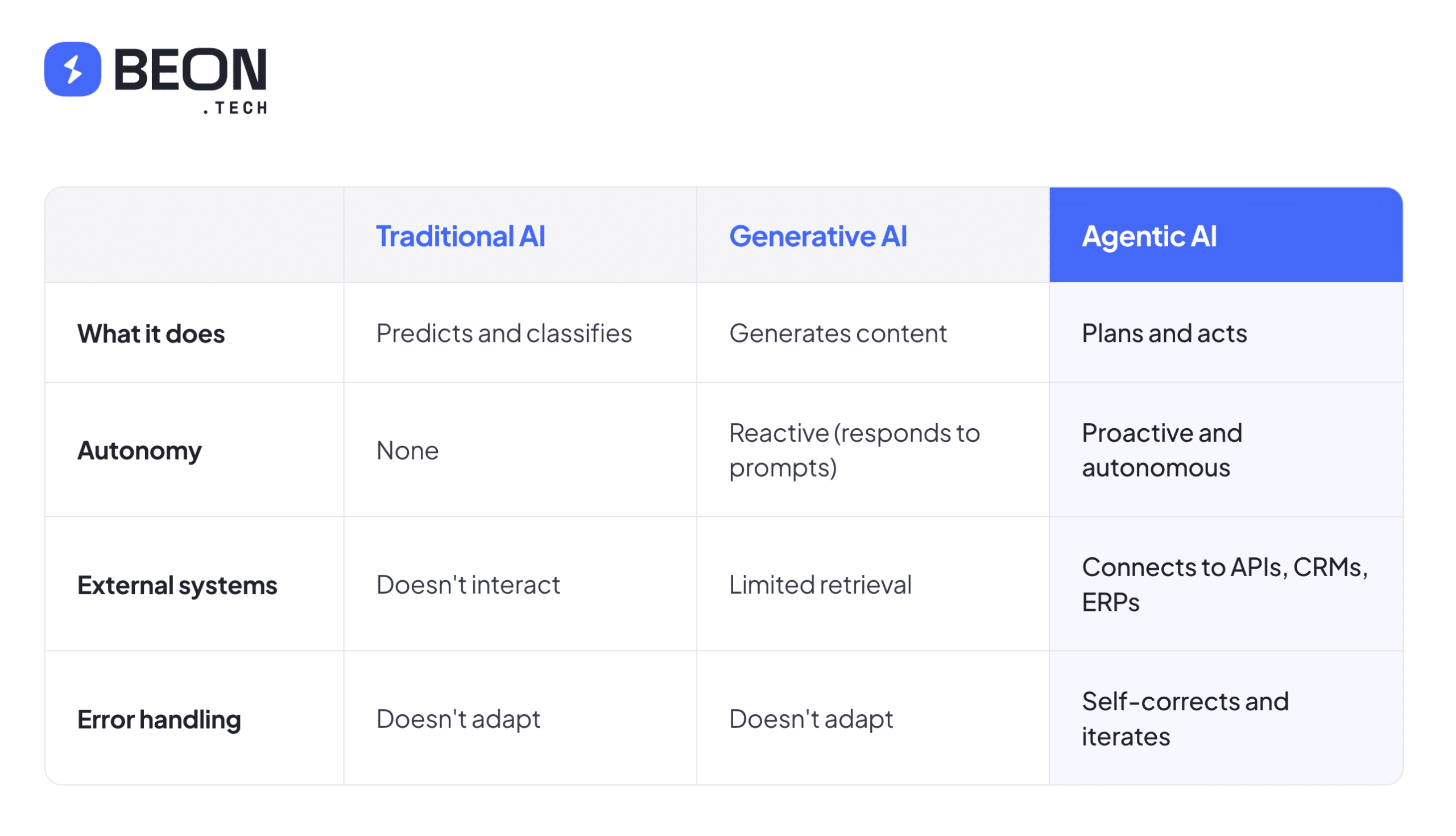
Think about what that last example means in practice. A customer files a complaint. An agentic AI agent reads it, pulls the order history from the CRM, checks the warranty terms, drafts a resolution email, updates the case status, and notifies the warehouse — all without a human touching it.
That’s not a chatbot. That’s a system that works.
The 3 defining traits of agentic AI:
- Autonomy. Agents act without step-by-step supervision. They assess a situation and choose the best path forward.
- Adaptability. They learn from what happens. If an action doesn’t move the needle, they adjust.
- Goal orientation. Give them a high-level objective and they figure out how to break it into executable steps. They’re not waiting for a script.
What Is Agentforce?
Agentforce is Salesforce’s platform for building and deploying agentic AI. It launched in October 2024, replacing Einstein Copilot, and it marked a fundamental change in what Salesforce is selling: not just an assistant that helps users do things, but an autonomous system that does things on its own.
Companies can build Agentforce agents with low- or no-code tools, deploy them across any channel, and have them operate within the security guardrails Salesforce already enforces. No data gets used to train external models. No customer information leaves the platform.
How Does Agentforce Work?
The agent operates in a continuous loop — five stages, over and over, until the task is done.
1. Perceive. The agent reads its environment. A new support ticket. An event in the CRM. A form submission. It identifies the goal and the current state of things.
2. Reason. This is where the Atlas Reasoning Engine kicks in. It interprets the situation, picks the right tools for the job, and builds a plan. The large language model (LLM) is the brain here.
3. Act. The agent connects to external systems through APIs and executes. It can update CRM records, send emails, generate quotes, schedule appointments — whatever the plan calls for.
4. Learn. It observes the result. Did that action move closer to the goal? If not, why not?
5. Iterate. It adjusts the plan and goes again. In multi-agent setups, it can hand off to specialized agents or coordinate across several at once.
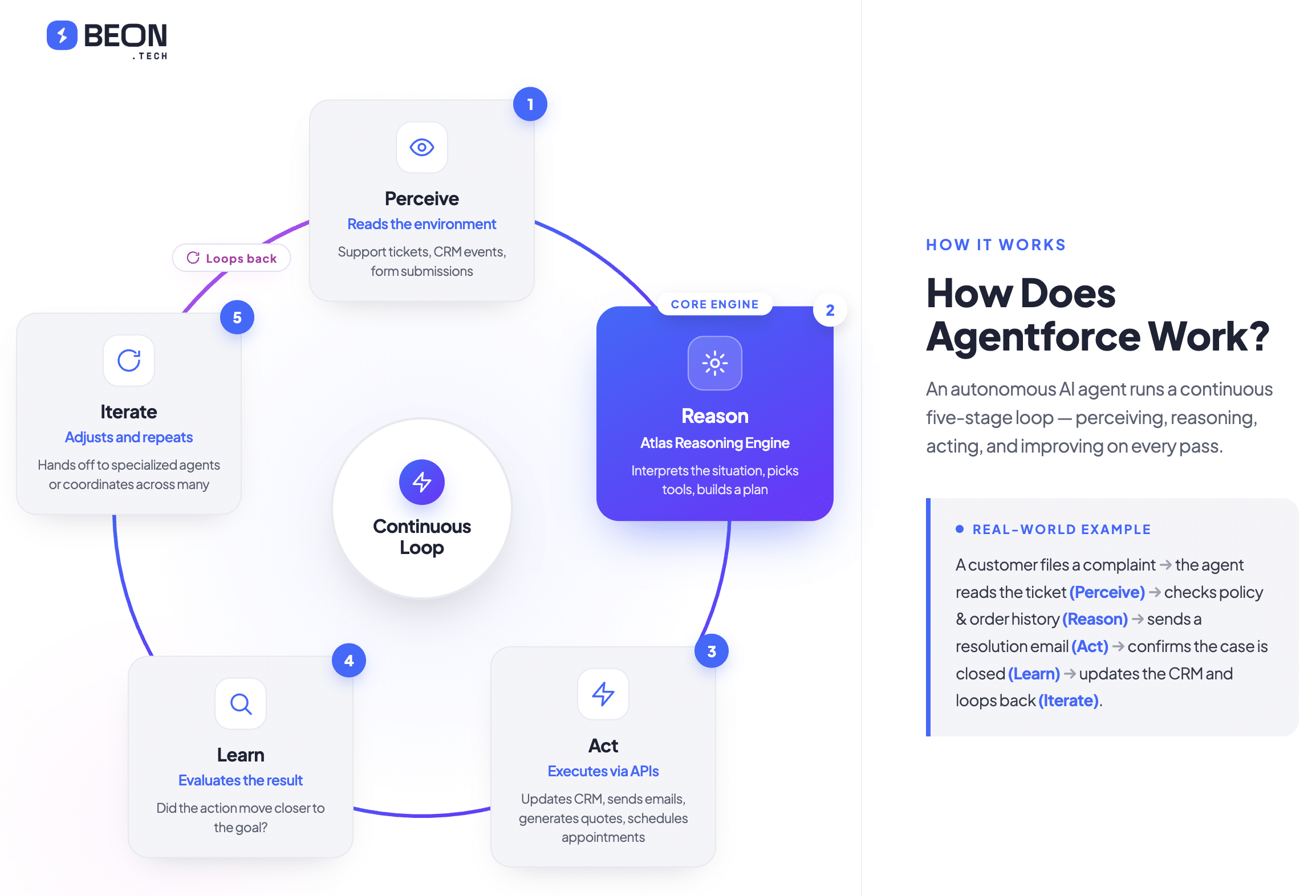
Five technical components make this loop possible: Planning, Reasoning, Tool Use, Memory (both short-term context and long-term learned behavior), and Reflection (the mechanism for self-correction). Strip any one of those out and you don’t have agentic AI anymore — you have a fancy workflow.
Salesforce Agentforce Use Cases: What It Looks Like in Production
Customer service
This is where most companies start with Agentforce, and for good reason. An agent can handle a support ticket from first contact to resolution: classify the issue, check the customer’s history, apply the right policy, send a response, update the record, and loop in a human if things get complicated.
The 24/7 coverage alone is a major unlock for teams stretched thin.
Sales and revenue operations
Salesforce AI agents in sales do the work reps hate most. Qualifying inbound leads after hours. Answering product questions. Configuring quotes using CPQ logic. Booking meetings. Reps show up to calls with the context already built.
Field service
Agentforce checks technician availability and skill sets, confirms the right parts are ready before dispatch, and generates job documentation in real time. Less coordination overhead, fewer wasted trips.
Software development
Give an agent a user story. It writes the code, runs the tests, debugs the failures, and opens a pull request for human review. Salesforce reported 151% year-over-year growth in engineering output after adopting this model internally.
The pattern holds across the market. The IBM IBV’s 2025-2026 Salesforce study found that agentic AI is gaining the most traction in IT and security management (32% of organizations), service (31%), and sales (24%) — exactly the workflows where Agentforce’s autonomous loop adds the most measurable value.
Why Salesforce Went All-In on Agentic AI
The move didn’t come out of nowhere. Salesforce has been building toward this for years — Einstein for predictive analytics, Einstein Copilot for generative assistance, and now Agentforce for full autonomy. Each step was additive.
The vision they’re selling now is the “Agentic Enterprise”: an organization where humans and AI agents work together, with intelligence running continuously across every workflow. Not a chatbot bolted onto a CRM. An operating model.
The data backs the direction. Full AI implementation in enterprise jumped from 11% to 42% year-over-year — a 282% increase. AI budgets nearly doubled, with 30% of that spending now dedicated specifically to agentic AI.
Agentforce is already on version 3 (released June 2025), with a unified Command Center for observability, native support for the Model Context Protocol, and an expanding library of industry-specific agent skills.
This isn’t a pilot program anymore. Companies are running it in production.
But optimism and execution are two different things. According to the IBM Institute for Business Value’s State of Salesforce 2025-2026 report — a survey of 1,200+ Salesforce customers across 23 countries — only 33% of AI initiatives are currently meeting ROI targets. Nearly three in four have failed to scale across business units, and one in five stalled or was abandoned entirely. The gap between what Agentforce can do and what organizations are actually delivering with it comes down to one variable: the people building it.
The Salesforce Engineer Boom: Who Builds All This?
None of this happens without people who know how to build it. And right now, those people are very hard to find.
Salesforce job postings went from roughly 14,000 in May 2024 to 31,200 by September 2025. That’s 120% growth in 18 months. But the talent supply didn’t keep up. Software Architects — the people who design the complex stuff — make up just 1% of the global Salesforce talent pool. Demand for that role grew 27%. Supply grew 4%.
The gap is structural, not cyclical. And Salesforce’s own specialization makes it harder: the ecosystem now spans Marketing Cloud architects, Data Cloud engineers, and Experience Cloud consultants — each a distinct profile. A generalist Salesforce hire won’t cut it for Agentforce implementations.
How the Salesforce engineering profile has changed
Five years ago, a great Salesforce admin configured flows and customized objects. That was enough. Today, the profiles companies are competing for look very different.
Core technical stack:
- Apex, SOQL, Lightning Web Components (LWC)
- Salesforce Flow
- REST/SOAP integrations and API management
Agentic stack — the 2026 differentiator:
- Agentforce Builder and agent configuration
- Data Cloud (formerly Salesforce Data Cloud 360)
- Prompt engineering and instruction design
- Model Context Protocol (MCP)
- AI governance and the Einstein Trust Layer
Business fluency:
- Translating business problems into agentic architectures
- Systems thinking across multi-cloud implementations
- Managing agent lifecycles in production
Salesforce saw the skills gap coming. In 2025, they made AI Specialist certifications free to encourage upskilling across the ecosystem. The message was clear: get ahead of this or get left behind.
How to Hire the Right Salesforce Developers
Knowing what to look for matters more than the job post you write.
The organizations getting this right are pulling ahead fast. IBM IBV identified a group of enterprises successfully scaling agentic AI — those that optimized ROI, built governance frameworks, and connected their data across systems. They report 60% greater operational efficiency and more than twice the pipeline expansion of their peers. What separates them isn’t the platform. It’s the team.
In the evaluation process, skip the generic whiteboard questions. Ask candidates to walk you through a real Agentforce or Data Cloud project — what they designed, what broke, how they fixed it. The ones who have actually built things will tell you a different kind of story than the ones who’ve only studied for certifications.
Look for the Agentforce Specialist and AI Specialist certs. They signal active upskilling, not just experience from three years ago.
For sourcing, the Trailhead community and Salesforce User Groups surface talent that doesn’t always show up on LinkedIn. These are people deep in the ecosystem, not just Salesforce-adjacent.
And if you need to scale fast — or want to close the cost gap — LATAM nearshoring is one of the most effective options in the market right now. The talent is certified, the time zones work for North American teams, and rates run 40–60% below U.S. market. It’s not a compromise. Senior Salesforce engineers from Latin America are building some of the most complex Agentforce implementations in production today.
One distinction worth making when evaluating partners: not all nearshore firms vet to the same standard. The most reliable ones use senior engineers — not recruiters — to run technical interviews, and present three highly curated profiles per role rather than a volume shortlist. That’s the vetting model that actually separates production-ready talent from credentialed candidates who haven’t shipped anything real.
The scarcity isn’t going away. Companies that build strong Salesforce engineering teams now, with genuine agentic skills, will be ahead when Agentforce adoption hits the next wave.
Looking for Salesforce engineers with genuine agentic skills? At BEON.tech, we connect U.S. companies with elite Latin American engineers — rigorously vetted, fully certified, and ready to integrate into your team from day one. Explore our nearshore staff augmentation services.
FAQ
Salesforce is the world’s #1 cloud CRM platform, used by more than 150,000 companies to manage sales, customer service, marketing, and data. It’s also the leading enterprise platform for agentic AI, through its Agentforce product.
Agentforce is Salesforce’s platform for building and deploying autonomous AI agents. Launched in 2024, it lets companies create agents that plan, reason, and execute multi-step business tasks — without constant human oversight — fully integrated with the Salesforce ecosystem.
Agentforce operates through a five-step loop: Perceive (read the environment), Reason (build a plan), Act (execute via APIs), Learn (evaluate the result), and Iterate (adjust and repeat). The Atlas Reasoning Engine coordinates this process, using an LLM as the decision-making core.
Generative AI produces content in response to a prompt. Agentic AI uses that content as one tool inside a broader action plan — it sets goals, interacts with external systems, self-corrects, and keeps going until the task is done.
Look for Agentforce Specialist and AI Specialist certifications, real project experience with Data Cloud, and strong architectural thinking — not just execution skills. The Trailhead community is the best sourcing channel. For scaling quickly with competitive costs, LATAM nearshoring offers senior certified talent at 40–60% below U.S. market rates — provided the partner vets using senior engineers and curated shortlists, not volume pipelines.