

Hiring software engineers in the US has never been more expensive, and the gap with nearshore alternatives has never been wider. If you’re researching nearshore software development rates for 2026, chances are you’ve already typed “how much does it cost to hire a software developer” into Google more than once, only to land on vague “30–50% cheaper” claims with no real numbers behind them.
The pressure isn’t easing, either. The US Bureau of Labor Statistics projects software developer employment to grow 15% from 2024 to 2034. Faster than the average for all occupations. Combine that with US salaries sitting near all-time highs and a rapidly expanding LATAM talent pool, and it’s clear why nearshore rates vary more than most guides let on, by seniority, role, country, and how the engagement is structured.
This guide breaks down what you’ll actually pay in 2026, with no rounding up the savings.
What Drives Nearshore Software Development Rates in 2026
Nearshore software development is the practice of building remote engineering teams in countries that share similar time zones and stronger cultural and business alignment, such as Mexico or Brazil. Companies often choose this model to access a broader talent pool while maintaining real-time collaboration and reducing operational complexity compared with more distant outsourcing arrangements.
But one of the first surprises for companies exploring nearshore software development cost is that two “full-stack developers” can carry annual rates that differ by $40,000 or more. That difference usually has less to do with geography alone and more to do with the conditions behind the engagement.
Experience Level: Junior, Mid-Level, and Senior
Seniority is the single biggest cost driver.
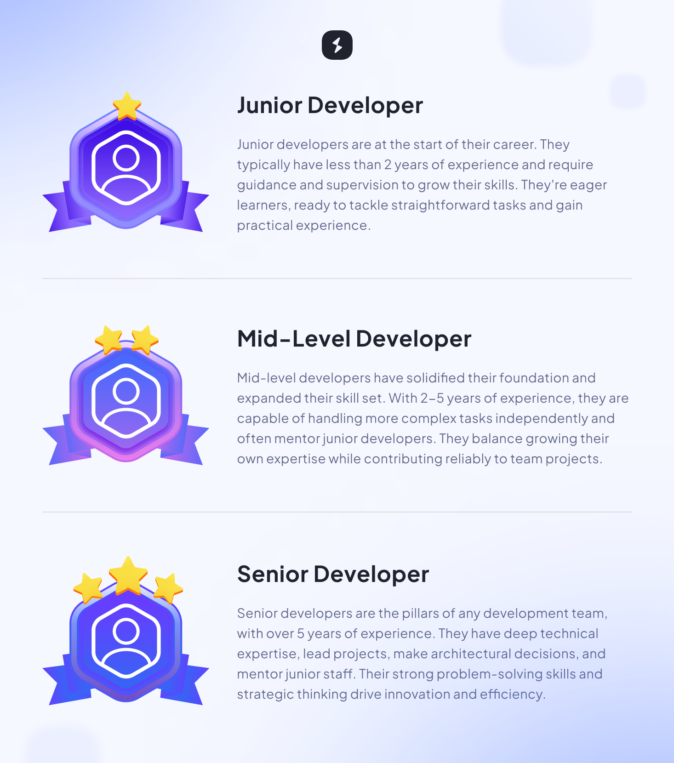
- A junior developer (0–2 years) is still building fundamentals and needs supervision. It is useful for well-scoped tasks, but not someone you’d hand architecture decisions to.
- A mid-level developer (2–5 years) can own features independently and start mentoring others.
- A senior developer (5+ years) leads technical direction, makes architecture calls, and gets projects to production faster. It is often where the real savings show up, even at a higher rate.
Technical Specialization and In-Demand Stacks
Not all tech stacks are priced equally. A backend developer working in a common framework will typically cost less than a data/ML engineer building production AI pipelines, or a DevOps engineer managing multi-cloud infrastructure across AWS, GCP, and Azure.
Niche, high-demand specializations command a premium because the supply of qualified developers hasn’t caught up with demand. And this dynamic is only intensifying as more US companies compete for the same talent pool.
Project Scope and Complexity
A simple internal tool and a HIPAA-compliant SaaS platform with AI features and enterprise security requirements are not the same hiring problem. Larger-scope projects typically require a broader team:
- Engineers,
- Product designers and
- UX specialists.
They also need more extensive testing and feedback cycles. More moving parts and more compliance requirements mean more billable hours, regardless of where the team is based.
Geographic Location Within LATAM
One of the most common misconceptions when researching LATAM software developer salary benchmarks is treating Latin America as a single pricing market. In reality, rates can vary significantly from country to country, even for developers with similar experience levels and technical capabilities.
Several factors influence those differences, such as:
- Cost of living plays a role
- Local salary benchmarks
- Competition for engineering talent
- English proficiency
- Availability of senior professionals
- The maturity of each country’s technology ecosystem
For example, more established tech markets such as Argentina and Brazil often command higher rates due to:
- Deeper talent pools,
- Stronger startup and enterprise demand, and
- Greater competition for experienced engineers.
Meanwhile, emerging markets in Central America may offer more cost-efficient access to talent while maintaining proximity and time-zone alignment for North American teams.
Engagement Model: Staff Augmentation, Dedicated Teams, and EOR
This is the factor most pricing guides skip, and it can swing your effective rate by 15–20%.
- With staff augmentation, companies add individual developers to their existing internal team. The external partner typically handles sourcing, hiring, and administrative support, while day-to-day priorities and delivery remain under the client’s management. Pricing usually comes as a monthly or hourly rate that includes both compensation and the provider’s operational fee. This model is often chosen when companies already have engineering leadership and need to scale quickly without increasing internal recruiting capacity.
- A dedicated team model expands beyond individual hires and provides an assembled team that may include engineers, QA specialists, designers, or delivery roles working toward shared outcomes. Costs are generally structured as a recurring monthly investment rather than individual rates. This approach is commonly used for longer-term initiatives where continuity, team cohesion, and predictable delivery matter more than filling isolated roles.
- An Employer of Record (EOR) model shifts the economics again. In this structure, the company effectively selects and manages the developer directly, while the EOR acts as the legal employer in the local market. Payroll, benefits, taxes, contracts, and compliance are handled externally. Instead of paying a markup embedded in developer rates, companies typically pay compensation plus a separate service fee per employee.
None of these models is universally cheaper. Staff augmentation can accelerate scaling, dedicated teams can improve delivery efficiency, and EOR can create long-term cost advantages when building distributed teams. The right choice depends less on hourly rates and more on how much ownership, flexibility, and operational support your organization needs.
Nearshore Software Development Rates in 2026 (by Seniority)
| Seniority Level | LATAM Annual Rate | US Annual Rate | Savings |
| Junior (0–2 yrs) | $30,000 – $50,000 | $90,000 – $130,000 | ~55–65% |
| Mid-level (2–5 yrs) | $55,000 – $80,000 | $130,000 – $180,000 | ~45–55% |
| Senior (5+ yrs) | $80,000 – $120,000 | $170,000 – $280,000 | ~40–55% |
The pattern holds across every level: nearshore developer rates run roughly 40–65% below US equivalents, with the largest percentage savings at the junior level and the largest absolute dollar savings at the senior level.
To put the US side in perspective, the median total compensation for a Senior Software Engineer in the US is $242,500, and frequently exceeds $300K in hubs like San Francisco and New York. More broadly, the median annual wage for US computer and IT occupations was $105,990 in May 2024, well above the national median of $49,500.
For a hiring manager building a budget, the takeaway is straightforward: a single senior LATAM hire can cost less than a single junior US hire, while bringing 5+ years of production experience to the table. That’s the math that makes nearshore worth a serious look, not “cheaper,” but cheaper and more experienced for the same line item.
Nearshore Software Development Rates by Role
Seniority isn’t the only variable, role matters too. Here’s what nearshore developer rates look like for senior-level talent across LATAM by specialization:
| Role | LATAM Annual Rate (Senior) | Notes |
| Full-Stack Engineer | $85,000 – $115,000 | Most in-demand role in LATAM |
| Backend Engineer | $80,000 – $110,000 | Node.js, Python, Java most common |
| Frontend Engineer | $75,000 – $105,000 | React, Vue, Angular |
| Mobile Engineer (iOS/Android) | $80,000 – $115,000 | Swift/Kotlin specialists at higher end |
| Data / ML Engineer | $85,000 – $120,000 | Fast-growing profile in LATAM |
| DevOps / Cloud Engineer | $85,000 – $120,000 | AWS/GCP/Azure; strong demand |
| QA / Automation Engineer | $60,000 – $90,000 | Often overlooked but high ROI |
A few patterns stand out. Full-stack, data/ML, and DevOps roles sit at the top of the range, given how much demand has grown for AI-adjacent and cloud-native skills. QA and automation engineers, on the other hand, remain comparatively affordable relative to the impact they have: a strong automation engineer can catch issues that would otherwise turn into expensive production fixes, making this one of the highest ROI hires on the list. If you’re building a full team rather than a single hire, blending roles, say, two backend engineers and one QA specialist instead of three generalists, often gets you further than hiring for seniority alone.
Nearshore vs. Offshore vs. Onshore: The Real Cost Comparison
When companies research software development outsourcing rates, they’re usually comparing three regions. Here’s how LATAM stacks up:
| Region | Annual Rate (Senior) | Time Zone vs. US | Key Trade-offs |
| LATAM (Nearshore) | $80K – $120K | 0–3 hrs difference | Best balance: cost, quality, collaboration |
| Eastern Europe | $70K – $110K | 6–9 hrs difference | Strong talent, but async-heavy workflow |
| India (Offshore) | $30K – $70K | 9–12 hrs difference | Lower cost, higher communication overhead |
| US (Onshore) | $170K – $280K+ | Same | Full real-time collaboration, highest total cost |
Understanding nearshore vs. offshore development cost requires looking beyond the rate table. On paper, offshore options like India look like the cheapest route. In practice, the math is more complicated. A 9–12 hour time zone gap means daily standups, code reviews, and sprint planning either happen asynchronously or require someone on your team to work odd hours, both of which slow down delivery.
Communication friction also tends to surface later, in the form of rework: requirements get misunderstood, feedback loops stretch from hours to days, and “lower cost per hour” quietly turns into “more hours billed.” LATAM’s 0–3 hour overlap with US time zones means your nearshore team can:
- Join the same standups,
- Respond to Slack messages in real time, and
- Iterate on feedback the same day.
Which is often the difference between a project that ships on schedule and one that doesn’t.
The Hidden Costs Most Guides Skip
Every rate table above shows salary, but salary is rarely the full nearshore software development cost. Here’s what tends to get left out of the budget:
- Benefits and payroll taxes. Depending on the country, employer-side payroll taxes, health insurance, paid time off, and statutory bonuses can add a meaningful percentage on top of base salary. This is one reason “salary-only” comparisons between countries can be misleading. A fully-loaded cost picture looks different.
- Onboarding and ramp time. Even a strong senior hire takes weeks to become fully productive: learning your codebase, your tools, your team’s workflows. That ramp period is paid time with below-peak output, and it applies whether the hire is local or nearshore.
- Turnover cost. This is the big one. According to the US Department of Labor, a bad hire can cost up to 30% of that employee’s first-year salary in replacement and lost productivity. For a senior engineer earning $100,000, that’s a potential $30,000 hit, on top of the cost of restarting the search, re-onboarding, and the project delays in between.
- Management overhead. Someone has to source candidates, run interviews, handle contracts and compliance, manage payroll across borders, and step in if a working relationship isn’t working out. That’s real time pulled from your engineering leadership, time that has its own cost even if it doesn’t show up on an invoice.
This is where the “sticker price” comparison breaks down. A fully-managed nearshore model where sourcing, vetting, onboarding, payroll, compliance, and retention are handled for you doesn’t just reduce the headline rate. It reduces the hidden costs that rarely make it into a budget spreadsheet until they’ve already happened.
Calculate Your Specific Cost with BEON
Every business’s hiring math is different: team size, roles, seniority mix, and country all change the final number. Rather than estimate from averages, you can get a number specific to your situation with our Developer Cost Calculator. It factors in role, seniority, and location to give you a realistic annual cost range, including the elements most calculators leave out.
At BEON.tech, we help US companies build high-performing engineering teams across Latin America without the overhead and uncertainty that often comes with international hiring.
When you partner with BEON.tech, you get:
- Access to the top 1% of LATAM developers, carefully vetted through a rigorous technical and cultural evaluation process.
- English-fluent engineers who can collaborate seamlessly with US-based teams and stakeholders.
- Fast hiring timelines, helping you fill critical engineering positions in weeks instead of months.
- End-to-end recruiting and onboarding, from sourcing and screening to hiring and retention support.
- Time zone-aligned collaboration that enables real-time communication and faster decision-making.
- Local payroll, compliance, and employment expertise, eliminating the complexity of cross-border hiring.
- Industry-leading retention, helping you build stable, long-term engineering teams.
Whether you’re looking for a single developer or an entire engineering team, BEON.tech helps you hire faster, scale smarter, and maximize the return on your talent investment. Calculate your exact hiring cost.
FAQs
What are nearshore software development rates in 2026?
In 2026, nearshore software developer rates from Latin America typically range from $30,000–$50,000/year for junior developers, $55,000–$80,000 for mid-level, and $80,000–$120,000 for senior developers. By comparison, equivalent US salaries run $90,000–$130,000, $130,000–$180,000, and $170,000–$280,000 respectively, meaning LATAM rates land roughly 40–65% lower across the board.
How much does nearshore software development cost?
Cost depends heavily on seniority, role, and country, but as a general benchmark, a senior LATAM developer costs $80,000–$120,000 per year compared to $170,000–$280,000+ for an equivalent US hire. The exact figure also shifts based on the engagement model (staff augmentation, dedicated team, or EOR), which can change the effective rate by 15–20%.
What are typical nearshore developer rates?
Rates vary by role as much as by seniority. For senior-level talent, full-stack engineers run $85,000–$115,000, backend engineers $80,000–$110,000, frontend engineers $75,000–$105,000, mobile engineers $80,000–$115,000, data/ML engineers $85,000–$120,000, DevOps/cloud engineers $85,000–$120,000, and QA/automation engineers $60,000–$90,000.
What is the average salary for a software developer in Latin America?
For senior developers, LATAM salaries generally range from $80,000–$120,000 annually, though this varies by country due to differences in cost of living. Countries like Argentina and Brazil tend to sit toward the higher end, while others fall closer to the lower end of the range.
What are typical software development outsourcing rates?
Outsourcing rates depend on which region you’re comparing. LATAM senior developers run $80K–$120K/year, Eastern Europe runs $70K–$110K, and India (offshore) runs $30K–$70K. However, lower offshore rates often come with trade-offs in time zone alignment and communication overhead that can offset the apparent savings.
How does the cost of nearshore development compare to offshore development?
Nearshore (LATAM) rates of $80K–$120K are somewhat higher than offshore options like India ($30K–$70K), but the time zone overlap (0–3 hours vs. 9–12 hours) means real-time collaboration, faster feedback loops, and less rework, which often closes or even reverses the apparent cost gap once total project costs are factored in.
How much does it cost to hire a software developer?
It depends heavily on where you hire from. In the US, a senior software engineer costs $170,000–$280,000+ in total compensation (often exceeding $300K in major tech hubs). Hiring the same seniority level from Latin America typically costs $80,000–$120,000, a 40–55% reduction without sacrificing experience level.
How much does it cost to hire a software developer in Latin America?
For a senior developer, expect to pay between $80,000 and $120,000 per year, though this varies by role and country. Full-stack and data/ML roles tend toward the higher end ($85K–$120K), while QA and automation roles are more affordable ($60K–$90K).
What are staff augmentation rates in 2026?
Staff augmentation typically involves an hourly or monthly rate that includes the partner’s sourcing and management fee on top of the developer’s salary. This model can affect your effective cost by 15–20% compared to other engagement models like dedicated teams or an Employer of Record (EOR) setup, where you pay salary plus a smaller per-employee administrative fee.
How much does a senior software engineer cost per hour?
While rates are usually quoted annually, a US senior software engineer’s $170,000–$280,000+ salary works out to roughly $80–$135+ per hour (based on a standard work year), whereas a senior LATAM developer at $80,000–$120,000 works out to roughly $38–$58 per hour, before accounting for benefits, taxes, and overhead on either side.