
 Argentina
  Brazil
  Mexico
  Colombia
A staff augmentation contract is the agreement between your company and a staffing provider that sets the terms for adding external engineers to your team. It is usually a master services agreement (MSA) plus a statement of work (SOW) for each engineer or role. A solid contract covers scope, duration, rates and payment terms, IP ownership, confidentiality, replacement guarantees, performance expectations, termination, and non-solicitation. The checklist near the end of this guide lists every clause to review before you sign.
Scaling an engineering team is rarely a straightforward decision. Hiring takes too long, costs too much, and the local talent market for senior roles isn’t getting easier to navigate. Nearshore staff augmentation has become a practical response to that reality, a way to add senior engineers quickly, in your time zone, without the overhead of traditional hiring. But the model is only as good as the contract behind it.
A well-structured staff augmentation services contract is what separates a high-performing engagement from an expensive lesson. Defining who owns the code, who handles compliance, how the engagement scales, and what happens when it ends.
This article breaks down everything you need to know before you sign one.
A Refresher on Staff Augmentation
Before diving into contract structure, a quick refresher on the model itself. The contract only makes sense in the context of how the engagement actually works.
Nearshore staff augmentation means adding engineers from a neighboring region (typically Latin America for US companies). They work within your time zone, integrate directly into your existing team, and are managed by you daily. The provider handles sourcing, vetting, payroll, and local compliance. You handle direction and delivery. It’s a fundamentally different arrangement from outsourcing, where a vendor owns the delivery. Here, you own the work.
The model has some clear advantages. But it also creates a set of contractual questions that don’t exist in a domestic staffing arrangement. Who owns the IP? How should underperformance be handled? Which obligations apply if the engagement ends early? What legal framework governs a dispute? The staff augmentation services contract is what answers those questions.
What is a Staff Augmentation Contract and its Types
A staff augmentation contract is the legal agreement between your company and the provider supplying your engineers. It covers the essential aspects of the engagement, ensuring both sides are aligned on responsibilities and expectations from day one.
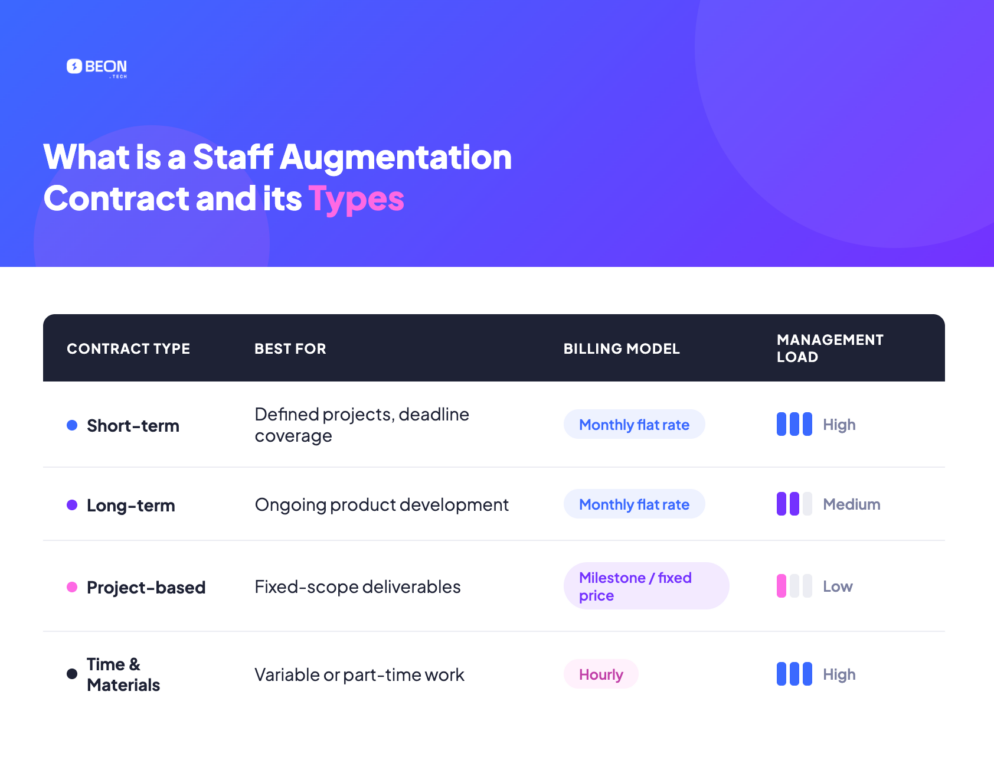
Not all staff augmentation contracts are structured the same way. The right contract type depends on your timeline, your budget model, and the level of management involvement your team can absorb.
Here’s how the main types break down.
Short Term Contracts
Short-term staff augmentation engagements may last four to six months. These are ideal for managing short-scope projects or unexpected shifts in workload. They give you the flexibility to scale without long-term commitments. But there’s a tradeoff: onboarding investment.
Think of a four-month contract that necessitates a two-to-four week ramp-up. That represents a meaningful percentage of the total engagement. For short-term contracts to deliver real value, the engineer needs to be senior enough to get up to speed fast, and the work needs to be well-scoped before they start.
Long Term Contracts
Long-term agreements usually take more than twelve months, providing a fully integrated team throughout the entire software development lifecycle. This model closely resembles a full-time hire in practice; the engineer becomes embedded in your codebase, your processes, and your team culture.
It’s also where the contract-to-hire option becomes worth structuring explicitly into the contract from the start.
Project Based Contracts
A project-based contract is structured around delivering a specific, complete outcome. It may be anything, from building a mobile app to executing a platform migration. The agreement is tied to the final output and ends once the project is completed and accepted. The key distinction from pure staff augmentation is the focus on a defined deliverable rather than ongoing capacity. It can be either a short or long project, but just one.
Payment structures in project-based engagements typically follow milestone-based or fixed-price arrangements. You pay for completed deliverables rather than hours worked. This transfers execution risk to the external provider. This model works best when requirements are stable and well-documented upfront. When scope shifts mid-engagement, fixed-price contracts create friction fast.
Hourly Contracts
A straightforward time and materials contract bills for the exact number of hours worked at a set rate. It provides maximum flexibility, allowing you to scale work up or down as needed, and you only pay for productive time.
This is the most common model for variable or part-time augmentation. The downside is that it requires tighter tracking and approval workflows on the client side, and budget predictability is lower than a fixed monthly rate.
What a Staff Augmentation Contract Contains
A complete staff augmentation contract requires ten core components:
- Scope of work
- Contract duration
- Billings and payment
- Intellectual property terms
- Confidentiality and NDA
- Staff selection and replacement
- SLAs and performance metrics
- Termination clauses
- Legal compliance
- Non-compete and non-solicitation clauses
Here’s what each one covers and a small example to get you better situated.
Scope of Work
The scope of work details the intricacies of the services provided. That means defining what the engineer will work on, what the engagement is expected to deliver, and how success will be measured when it’s done. It’s the most referenced document in any contractual dispute and the one most likely to be written too loosely.
Example: “The provider will supply one senior React/Node full-stack engineer to support the development of a B2B SaaS dashboard, including front-end component development, API integration, and code review participation. Work is scoped to 40 hours per week, Monday through Friday, within EST business hours.”
Contract Duration and Availability
The contract should pin down exactly when each engineer starts, when the engagement ends, and what the renewal path looks like if the work continues. Vague duration terms are a common source of friction, particularly when a project outlasts its original timeline.
Example: “Engagement begins October 1, 2025 and runs through March 31, 2026, with a 30-day mutual extension option. Standard availability is 9am–6pm CST. Any deviation from standard hours requires written approval from both parties.”
Payment Terms
Rates, billing cycles, and performance incentives all belong in the payment clause. With enough specificity that neither side has room to interpret it differently.Thirty days from invoice receipt is the standard payment window. For ongoing augmentation, fixed monthly rates per engineer offer the most budget predictability.
Example: “The provider will invoice monthly at a fixed rate of $X per engineer. Invoices are issued on the first business day of each month. Payment is due within 30 days of receipt. Overtime hours require pre-approval and are billed at 1.25x the standard rate.”
Intellectual Property Ownership
All developments, inventions, or innovations created by the augmented staff during the engagement’s course should remain the exclusive property of the client. This includes rights to source code, designs, and all other creative output, with IP transfer upon completion of the project. For stronger protection, the assignment should trigger upon creation, not upon payment, and should cover derivative works, not just primary deliverables.
Example: “All code, architecture documentation, and technical assets produced by augmented personnel during this engagement are the sole and exclusive property of the client upon creation. This includes derivative works, modifications, and any components extracted or reused from work produced under this agreement.”
Confidentiality and NDA
A Non-Disclosure Agreement legally binds both the provider and their staff to protect sensitive information, trade secrets, customer data, proprietary code, and unreleased product logic. It’s a critical safeguard that ensures compliance and prevents data leaks throughout the engagement. The contract should also clearly distinguish between confidential and non-confidential information, set a timeframe for how long confidentiality obligations extend after the engagement ends, and outline penalties for any breach.
Example: “All personnel assigned to this engagement are required to sign individual NDAs prior to access being granted to any client systems, repositories, or internal documentation. Confidentiality obligations extend 24 months beyond the termination of this agreement. Breach triggers immediate termination and exposes the breaching party to liquidated damages.”
Staff Selection and Replacement Guarantees
The contract should define the experience and skills required for assigned personnel. As well as the candidate evaluation and approval process, and the client’s right to approve or reject candidates proposed by the provider. Equally important, and frequently omitted, is the replacement clause. Replacement guarantees should define the maximum timeline for sourcing a replacement (no more than 10 business days is a reasonable standard), quality criteria for the replacement, and that the first replacement should be at zero cost to the client.
Example: “All assigned engineers must have a minimum of five years of production experience in the specified stack. The client reserves the right to conduct a technical interview before approving any candidate. If a placed engineer underperforms or exits, the provider will source a qualified replacement within 10 business days at no additional cost.”
Performance Metrics and SLAs
KPIs should be mutually agreed upon and reflect the goals and objectives of the project. These can include software engineering metrics related to code quality, sprint velocity, ticket resolution, and on-time delivery. Regular tracking and evaluation of KPIs provides insights into the effectiveness of the augmented resources and supports data-driven decisions.
Example: “Augmented engineers are expected to maintain a PR review turnaround of no more than 24 business hours, achieve a minimum sprint commitment completion rate of 85%, and participate in all scheduled standups, retros, and planning sessions. Performance will be reviewed quarterly.”
Termination Conditions and Exit Protocols
The contract should clearly separate termination for convenience, typically 30 days written notice, no penalty. And termination for cause, which covers material breach, security incidents, IP theft, or criminal conduct, and allows for immediate exit. The termination clause should also cover transition support and knowledge transfer requirements to ensure business continuity when the engagement ends.
Example: “Either party may terminate this agreement with 30 days written notice. Termination for cause, including security breaches, IP theft, or deliberate misrepresentation, takes effect immediately upon written notification. Upon termination, the provider’s personnel must complete a structured knowledge transfer covering all active work, documentation, and repository access within five business days.”
Legal Compliance Governing Law and Liability
The contract must align with labor laws, tax regulations, and data protection standards in both the client’s and provider’s jurisdictions. For cross-border engagements, this includes GDPR, HIPAA, or CCPA compliance, depending on the industry, as well as indemnification terms and liability caps. Liability is typically capped at the total contract value. Uncapped liability in either direction is a red flag worth flagging before signing.
Example: “This agreement is governed by the laws of the State of Delaware. Each party’s total liability under this agreement is capped at the total fees paid in the 12 months preceding the claim. The provider indemnifies the client against third-party claims arising from IP infringement or breach of confidentiality by augmented personnel.”
Non-solicitation and Non-compete
Non-solicitation clauses prevent either party from poaching the other’s employees for a set period after the contract ends. Non-compete clauses restrict the vendor or augmented staff from working with the client’s direct competitors, though enforceability varies significantly by jurisdiction. From a practical standpoint, the non-solicitation clause matters more: it protects the provider’s investment in sourcing and vetting, and protects the client from mid-engagement poaching by the provider.
Example: “Neither party shall solicit or hire the other’s employees or contractors for a period of 12 months following the termination of this agreement. This applies to direct employment, independent contracting, or referral to third parties.”
IT Staff Augmentation Contract Quick Checklist
Before you sign an IT staff augmentation agreement, confirm these five things are explicitly addressed in the contract:
- IP assignment is automatic upon creation and covers all work product created by augmented engineers on your systems.
- The NDA and IP clauses flow down to each engineer through the provider’s local agreements.
- The replacement guarantee applies throughout the full engagement, not just the first 90 days.
- Termination requires 30 days’ notice with no financial penalty.
- Conversion to full-time employment is explicitly permitted after a defined tenure, with fee terms stated upfront.
None of these requires a lawyer to verify. They require reading the contract before signing it, which, in the rush to start an engagement, more teams skip than they should.
The Bottom Line
A well-structured staff augmentation contract requires attention in the right places. Clear IP ownership, explicit termination conditions, NDAs that cover both the provider and the engineers, and payment terms that don’t leave room for interpretation. Get those right, and the engagement has a solid foundation. Get them wrong, and the problems surface at the worst possible time.
The other variable is the provider. Contract structure protects you on paper. The right partner protects you in practice:
- rigorous technical vetting,
- engineers who understand how U.S. product teams operate
- a nearshore model built for real-time collaboration, not async workarounds.
That’s what BEON is built for: senior LATAM engineers, vetted for technical depth and communication fit, working in your time zone and integrated into your team from day one. You get the talent without entity setup, compliance overhead, or uncertainty around quality.
If you’re ready to build the right way, book a call today.
FAQs
What’s the difference between an MSA and a Statement of Work in a staff augmentation contract?
These are two distinct documents that work together. The Master Services Agreement (MSA) covers the overarching terms governing the relationship. Things like confidentiality, IP ownership, indemnification, governing law, and dispute resolution. The Statement of Work (SOW) sits underneath it and defines the specifics of each engagement. It governs roles, deliverables, timelines, and performance expectations. The MSA is signed once; SOWs are issued per engagement or per hire. If you’re working with a provider on multiple engineers or over a long period, having a solid MSA in place before the first SOW is signed is non-negotiable.
Who owns the code and IP created by augmented engineers?
Under US copyright law, a “work made for hire” assigns authorship and ownership to the commissioning party rather than the creator. Without this language in a signed agreement, the developer holds copyright by default. To eliminate any uncertainty, the contract should clearly state that the client retains full ownership of all code, innovations, and deliverables created by the augmented team.
Does the NDA need to be signed by the provider or by each engineer?
Both. NDAs need to be signed by both the supplier and the staff individually. A provider-level NDA covers the company’s obligations, but it doesn’t directly bind the engineers working in your codebase. Individual NDAs close that gap and are particularly important for senior engineers with access to proprietary systems, unreleased product logic, or customer data.
What is a conversion fee?
A conversion fee is what you pay the provider if you hire an augmented engineer as a full-time employee. If you’re using augmentation partly as a vetting mechanism, negotiate a clear, reasonable conversion path at the start.
How should payment terms be structured?
The payment clause should detail how and when payments will be made, including the fee structure, billing terms, and any bonuses or penalties associated with performance. This may cover hourly rates or a flat monthly rate, with payment schedules specified and a net-30 payment window from invoice receipt being the standard. Fixed monthly rates per engineer are the most common model for ongoing staff augmentation and make budgeting more predictable. Hourly billing works better for variable or part-time engagements but requires tighter tracking and approval workflows.
What’s a non-solicitation clause, and how does it differ from a non-compete clause?
Non-solicitation clauses prohibit the client from hiring augmented staff directly within a specified period. Non-compete clauses restrict the vendor or staff from working with competitors. Their enforceability varies across jurisdictions, but they still act as an effective mechanism against misappropriation of confidential information. From the client’s side, the practical concern is straightforward: you don’t want a provider placing an engineer on your team and then pulling them mid-engagement for a higher-paying client. Make sure the clause addresses both directions.
What data protection requirements should the contract address?
This depends on your industry, but the baseline applies everywhere. The contract should include strong confidentiality and data protection clauses. There may be specific data privacy regulations, such as GDPR, CCPA, or HIPAA, depending on the jurisdiction. For high-risk industries like finance or healthcare, the contract should also include cybersecurity obligations and breach notification provisions. If your augmented engineers will have access to production systems or customer data, define access levels explicitly and include protocols for revoking access at offboarding.
What should the exit and knowledge transfer clause cover?
At a minimum, the exit clause should cover knowledge transfer and documentation of any processes or systems the augmented staff worked on. It should ensure a smooth transition and protect the operations of both parties when the contract concludes. In practice, this means requiring documentation to be kept current throughout the engagement.