
 Argentina
  Brazil
  Mexico
  Colombia
Is there a software engineer shortage in 2026? Yes, but not across the board. Junior and mid-level candidates are easy to find. The shortage is in senior engineers who can run AI, cloud, and security systems in production. Demand keeps growing: the US Bureau of Labor Statistics projects jobs for software developers, QA analysts, and testers to grow 10% from 2025 to 2035, with about 106,100 openings a year.
Key Takeaways
- The real shortage isn’t developers in general — it’s senior, production-ready engineers who can operate AI in production, own complex systems, and make sound architectural decisions. Junior and mid-level supply has never been higher.
- The tech layoffs of 2023–2024 reshaped the market but didn’t solve the senior gap. Core engineering demand for AI/ML, cloud, and security roles remained persistently high throughout the correction.
- AI tools amplify the output of strong engineers — they don’t replace the judgment, architecture skills, or production ownership that senior engineers provide. In fact, AI raises the bar for what “senior” means.
- Tightening H-1B policies have further constrained the domestic pipeline for senior tech talent, strengthening the case for nearshore strategies.
- High-growth U.S. companies are increasingly turning to nearshore staff augmentation in Latin America to access vetted senior talent within compatible time zones — at 30–50% lower cost than equivalent U.S. hires.
The Real Picture Heading Into 2026: A Polarized Market, Not a Simple Shortage
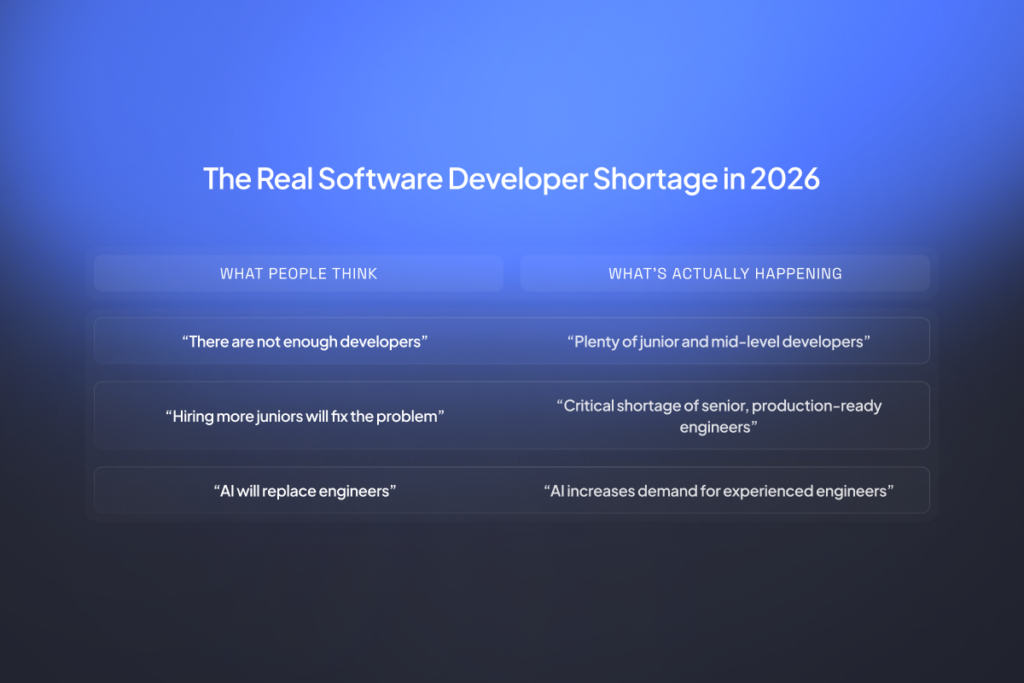
The tech talent narrative has gotten sloppy. Headlines oscillate between “there’s a crisis” and “layoffs fixed everything.” Neither is accurate.
The 2023–2024 tech correction was real: over 260,000 tech workers were laid off across major U.S. companies in 2023 alone, and hiring slowed significantly across frontend, mobile, and general software engineering. For many mid-level roles, the market actually became more competitive: more candidates, fewer open positions.
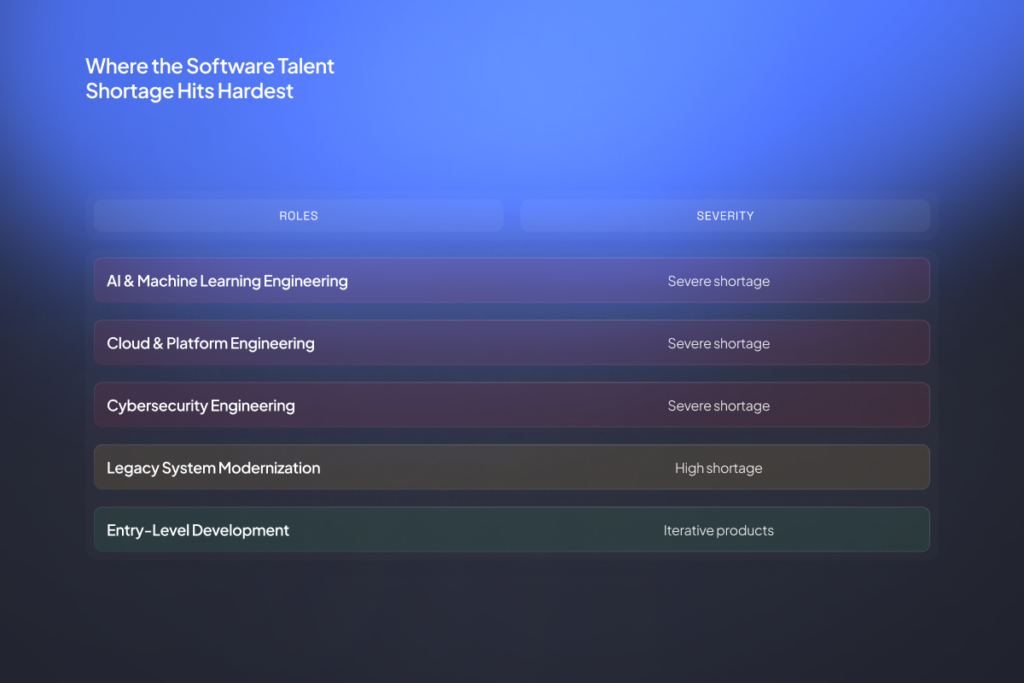
But that correction did not resolve the structural shortage where it actually matters. Throughout the layoff cycle, job openings for senior engineers in AI/ML, cloud infrastructure, cybersecurity, and legacy modernization remained persistently high. Companies weren’t cutting those roles — they were cutting adjacent and support positions while doubling down on core engineering capability.
The result is a polarized market: an oversupply of junior and generalist developers competing for fewer entry-level positions, alongside a genuine and growing scarcity of senior engineers who can operate complex systems in production. That’s the shortage you need to plan around in 2026.
Why the Senior Gap Will Intensify Through 2026
The shortage of senior engineers is structural. It can’t be fixed by bootcamps, hiring surges, or productivity tools alone. Several converging forces are making it worse:
Digital Transformation Is Non-Negotiable
Finance, healthcare, logistics, and government are all modernizing legacy systems, building customer-facing platforms, and integrating data pipelines. This isn’t discretionary spending — it’s operational survival. And it requires engineers who understand both modern stacks and the constraints of existing infrastructure.
AI Is Moving to Production
The 2023–2025 window was AI experimentation. In 2026, companies are moving AI to production — and that requires a different skill set. GPU orchestration, model serving, MLOps, LLM integration into existing products, monitoring for model drift: these are engineering problems, not data science problems. AI-related job postings have grown counter-cyclically even during the layoffs, because this demand is additive, not substitutional.
Cybersecurity Demand Outpaces Supply
According to the ISC2 2024 Cybersecurity Workforce Study, the global cybersecurity workforce gap reached about 4.8 million people, up 19% from 2023. Stricter regulations — the EU AI Act, updated SEC disclosure requirements, new NIST frameworks — are forcing companies to build security into the development lifecycle rather than bolt it on afterward.
Legacy Modernization Is Unavoidable
Replacing COBOL, on-prem monoliths, and aging stacks with modern architectures is not a greenfield exercise. It requires senior engineers comfortable with incremental refactoring, risk management, and the discipline to modernize without breaking production systems. This work can’t be handed to juniors or automated away.
Immigration Constraints Tighten Supply
H-1B caps were already restrictive. The current administration’s immigration posture in 2025 has made the pathway for bringing senior international tech talent onshore even more constrained — a material operational problem for companies that previously relied on visa pathways, and a direct argument for building nearshore capability instead.
The Numbers Worth Citing in 2026
Not all shortage statistics hold up equally. Here’s what does:
- The U.S. Bureau of Labor Statistics projects employment of software developers, QA analysts, and testers to grow 10% from 2025 to 2035, much faster than the average for all occupations, with about 106,100 openings a year. This is a demand projection based on current occupational data, not a pre-correction extrapolation.
- Forrester’s 2025 software development outlook notes that close to half of developers are already using — or expect to adopt — AI coding assistants as part of their workflow. While AI is becoming embedded in coding and testing tasks, the move from experimentation to production-grade implementation continues to depend heavily on senior engineers who can architect systems, review AI output critically, and govern secure deployment at scale.
- BLS also projects about 280,000 openings a year across all computer and IT occupations in the U.S. from 2025 to 2035. Even accounting for the hiring slowdown of 2023–2024, core engineering openings — particularly in the roles above — remained persistently above available qualified candidate pools.
- A note on widely-cited projections: Figures like “85 million global tech worker shortage by 2030” or “$8.4 trillion in unrealized revenue” originate from pre-2020 research — before the AI productivity shift, the tech correction, and current labor dynamics. Citing them uncontextualized in 2026 invites credibility problems with informed technical readers. The structural shortage is real; it doesn’t need inflated statistics to make the case.
The Core Problem: You Don’t Lack Resumes. You Lack Production Engineers.
Most companies’ applicant pipelines are full of candidates. What’s missing is engineers who can reliably own complex systems in production.
The difference is not incremental:
- Senior engineers make architecture decisions that scale. They own SLAs and understand the business cost of a 2 AM outage.
- They mentor others and manage trade-offs between technical debt and feature velocity — understanding how their work affects outcomes, not just tickets.
- They can’t be fast-tracked. These skills only develop through years of real production experience. No bootcamp or two-year career window gets you there.
This is why “more graduates” doesn’t solve the 2026 problem. Training timelines are long, mentorship capacity is limited, and most teams are already stretched trying to level up their existing junior hires.
The hidden cost of under-hiring at the senior level is substantial:
- Longer time-to-market,
- Higher defect and security vulnerability rates without experienced code review,
- Architectural decisions that create expensive technical debt, and
- Burnout among the senior engineers who remain as they absorb disproportionate load.
High-growth companies are addressing this by combining a lean core of onshore senior engineers with distributed senior talent via nearshore staff augmentation — rather than padding headcount with juniors who need years to reach independent contribution.
Will AI Solve the Tech Talent Shortage? A Nuanced Answer.
The short answer is no — but the reasoning matters, and the picture is more complicated than most shortage articles acknowledge.
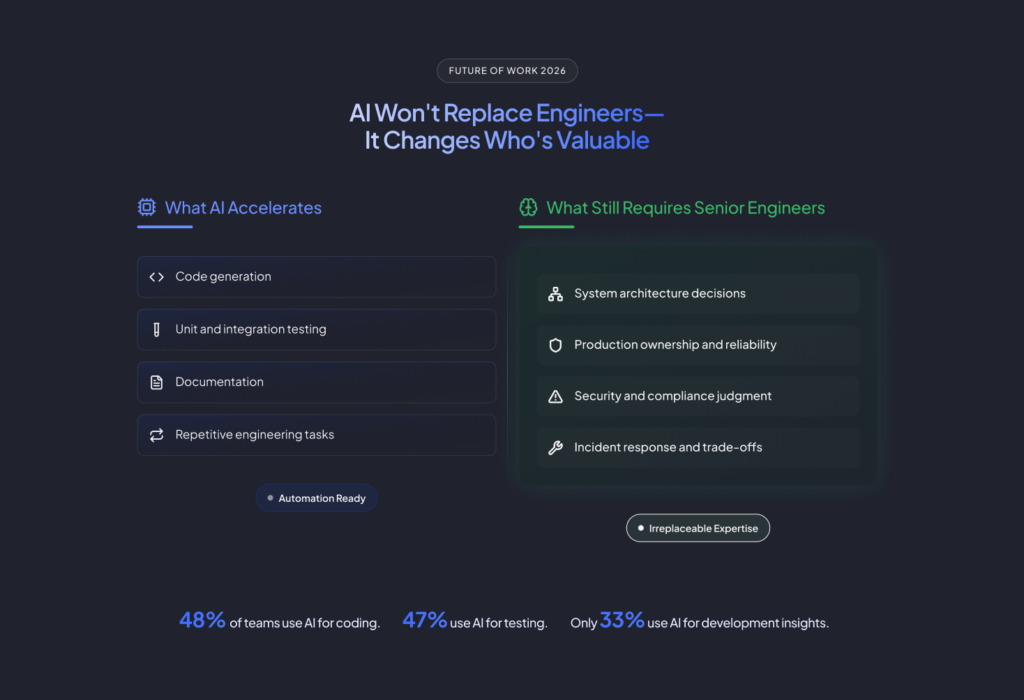
- What AI genuinely accelerates: Tools like GitHub Copilot, Cursor, and Claude Code meaningfully boost individual productivity on repetitive coding tasks, boilerplate generation, documentation, and unit test scaffolding. Forrester’s data confirms near-half adoption for coding and testing use cases. These gains are real.
- What AI can’t replace in 2026: system design, requirements clarification, production incident response, architectural trade-off decisions, security and compliance judgment, and ownership of complex distributed systems. These remain the domain of experienced human engineers.
The critical nuance most shortage articles miss: AI is changing who is most valuable, not eliminating the need for engineering talent. Senior engineers who can leverage AI tools effectively — understanding their limitations, reviewing output critically, integrating them into secure workflows — become exponentially more productive. Industry evidence suggests AI acts as a 2–3x productivity multiplier for strong engineers. For weaker engineers, it can actually accelerate the rate at which mistakes reach production.
The vibe coding reality check. By 2026, AI-assisted development has advanced beyond prototypes and internal tools. Production features are being generated with AI assistance at companies with mature practices. This doesn’t reduce demand for senior engineers — it changes their function. The engineer who can architect what the AI builds, review what it produces, and catch what it misses is more valuable than ever.
There’s also a regulatory and IP dimension. In finance, healthcare, and other regulated industries, AI-generated code introduces compliance, data governance, and IP ownership questions that require experienced engineering judgment to navigate — amplifying demand for senior engineers who understand secure coding, not junior engineers who can prompt effectively.
AI should be part of your talent strategy — specifically in training your engineers to use it well. It is not a substitute for senior headcount in 2026.
The Cost, Speed, and Risk Math
Cost
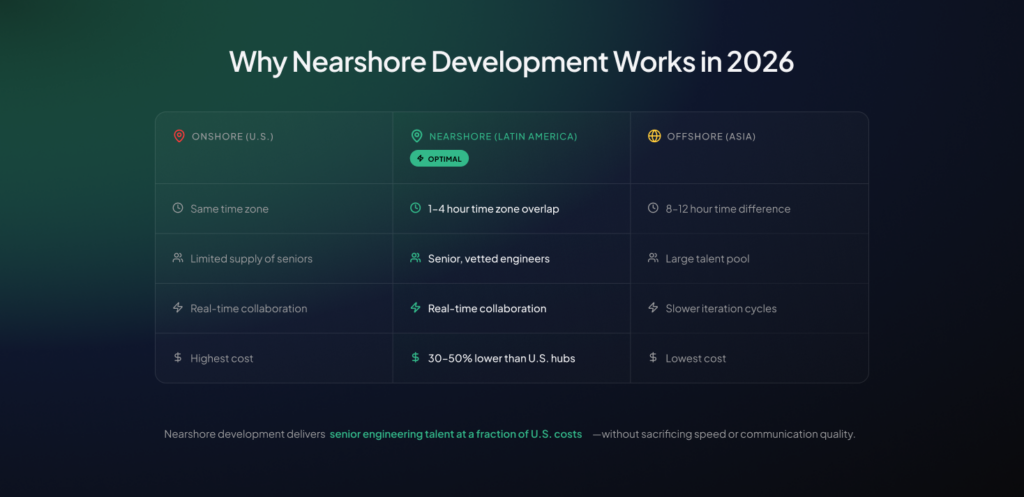
The fully loaded annual cost of a senior engineer in major US hubs — salary, benefits, taxes, equity, overhead — typically exceeds $250,000–$350,000. That ceiling continues rising for AI/ML, security, and cloud roles. Latin American senior engineers typically cost 30–50% less with comparable technical skills, allowing you to fund more senior headcount within a fixed budget.
Ramp-up Time
Growing a junior into a semi-independent contributor takes 6–12 months under ideal mentorship conditions — longer on complex systems. A senior nearshore developer who has already worked with U.S. teams on similar stacks can submit a meaningful pull request within the first week and reach full context within 2–4 sprints.
Delivery Risk
Under-staffed senior roles produce brittle architectures, missed deadlines, and burnout among the engineers who remain. Distributing senior expertise through nearshore augmentation reduces key-person risk and prevents the “hero engineer” bottleneck that stalls teams and creates retention crises.
Nearshore Development in Latin America: A Strategic Lever, Not a Cost Play
Nearshore staff augmentation is distinct from traditional project outsourcing. In outsourcing, an external vendor owns deliverables and operates through hand-off models. In staff augmentation, the engineer joins your team: your tools, your rituals, your codebase, your standards.
Why Latin America Specifically For US Companies:
- Time zone compatibility is the operational foundation. Working with engineers in São Paulo, Buenos Aires, Mexico City, Bogotá, or Montevideo means 1–4 hours of offset from U.S. time zones. Same-day standups. Real-time pair programming. Immediate incident response. This is categorically different from async-heavy offshore models with 8–12 hour gaps.
- Talent maturity in the region has grown significantly. Major LatAm engineering communities now include engineers with 7–12+ years of experience, strong English proficiency, and production histories with US clients across distributed systems, data platforms, and cloud-native applications.
- Cultural alignment matters operationally. Engineers in this region are generally familiar with Agile practices, direct communication styles, and the US expectation of ownership and accountability. Onboarding friction is primarily about product context — not working style fundamentals.
What nearshore augmentation preserves: architecture ownership, product strategy, and IP control remain with your onshore team. You’re expanding execution capacity — not delegating decision-making to an external entity.
How High-Performing Companies Are Hiring Despite the Shortage
The companies that continue to ship in this environment share recognizable patterns:
- Hybrid team models. A core onshore team handles product strategy, architecture, and stakeholder management. Nearshore engineers in Latin America execute feature delivery, platform work, and long-tail initiatives. Strategic control stays close; execution capacity expands where needed.
- Staff augmentation as an ongoing capability, not emergency hiring. Rather than scrambling when a project is already delayed, high-performing companies maintain a nearshore pipeline. When a new product bet materializes, they can staff it within weeks instead of months.
- Blended resourcing. FTEs, nearshore staff augmentation, and specialized consultancies — for security audits, compliance work, niche data science — are combined deliberately. This avoids over-committing permanent headcount in areas of uncertain long-term demand.
- Retention over throughput. Long-term relationships with nearshore engineers preserve system knowledge, reduce re-onboarding costs, and build the domain expertise that makes engineers increasingly valuable over time. The best nearshore strategies look more like team-building than vendor management.
- Full integration, not tiered teams. The most successful implementations include nearshore engineers fully in sprint ceremonies, performance cycles, code review ownership, and career development conversations. “Second class” dynamics — where nearshore developers receive tickets rather than participate in design — produce worse outcomes and drive attrition among exactly the engineers you want to retain.
Real-World Pattern: Scaling Before a Critical Launch
A US SaaS company preparing for a major 2026 release needs to add 5–8 senior full-stack and platform engineers in under 90 days to hit a launch milestone — a volume the local market can’t deliver in time.
They engage a nearshore tech talent partner with a pre-vetted senior bench. Those engineers integrate into existing squads within the first two sprints, participate in architecture discussions, and start shipping production code quickly. The launch happens on schedule.
More importantly, several of those nearshore engineers stay on, becoming long-term team members with deep product knowledge. That’s the pattern that works: a strong internal core combined with nearshore staff augmentation that treats engineers as permanent contributors, not contractors on loan.
The variables that determine success: seniority of the nearshore talent, quality of onboarding documentation, clarity of ownership boundaries, and whether nearshore engineers are treated as full team members from day one.
Preparing Your Engineering Organization for 2026
The senior talent gap isn’t resolving on its own. Here’s what to act on now:
- Build a three-year hiring and capability roadmap that accounts for AI integration, cloud modernization, and security hardening — not just backfilling current headcount. Anticipate where new technology bets and business growth will create demand before the demand arrives.
- Invest in your current team’s AI proficiency. Engineers who can direct, review, and govern AI output will be worth 2–3x their previous productivity. This is the highest-ROI upskilling investment available in 2026 — but it requires protecting time for it. AI proficiency doesn’t develop in the margins.
- Define your nearshore strategy deliberately. Not every role is equally suited for distributed work. Backend, Full Stack, QA automation, DevOps, and data engineering roles integrate smoothly into distributed workflows. Roles with heavy in-person stakeholder requirements or highly regulated data access need additional governance design before distributing them. Learn which roles work best for nearshoring.
- Standardize remote-friendly practices first. If your internal team struggles with documentation, async communication, and clear ownership, adding nearshore engineers amplifies those problems. Fix the operating model before you scale it.
- Track signals early. Time-to-hire, offer acceptance rate, senior/junior ratio, and cost per shipped feature are leading indicators that the talent shortage is compressing your delivery capacity. Watch them and adjust before problems compound.
- Move before you’re in crisis. The companies that will win the talent competition in 2026 started building nearshore relationships and distributed team capabilities in 2024–2025. Reactive hiring during a delivery crunch is expensive and slow — and the engineers you hire under pressure are rarely the engineers you’d hire with time to be selective.
Conclusion: Building Resilient Engineering Capacity in a Polarized Market
The 2026 software talent market isn’t simply a shortage. It’s a structural polarization: more junior candidates than ever competing for fewer entry-level slots, and a genuine, widening scarcity of senior engineers who can operate AI in production, own complex systems, and deliver reliably under pressure.
AI tools help — but they amplify the output of strong engineers, not weak ones. The engineers who can leverage AI effectively while maintaining the architectural judgment and production ownership that complex systems require are becoming more valuable, not less necessary.
Tighter immigration policy has narrowed the domestic pipeline further. The companies navigating this best are building strategic nearshore partnerships in Latin America, where senior engineers with genuine technical depth, cultural alignment, and time zone compatibility integrate as full team members — not contractors at arm’s length.
At BEON.tech, we specialize in helping high-growth U.S. companies do exactly that. We focus on senior and staff-level engineers, rigorous technical vetting, and long-term team stability — not short-term staffing fixes. Our model is designed to reduce hiring risk, protect your roadmap, and give engineering leaders confidence as they plan for 2026 and beyond.
If you’re thinking about how to build resilient engineering capacity in a tight market, schedule a call with us to explore how nearshore senior talent can strengthen your team — without lowering the bar.
FAQs
How do I decide which roles are best suited for nearshore developers?
Start with backend, Full Stack, QA automation, DevOps, and data engineering roles that have clear deliverables and well-defined interfaces. These integrate smoothly into distributed workflows and benefit from time zone overlap without requiring constant in-person stakeholder interaction. Roles involving heavy customer-facing work or highly regulated data access require additional compliance design before distributing them.
What are the biggest risks of working with nearshore teams, and how do we mitigate them?
The primary risks are security, IP protection, and cultural misalignment. Mitigation starts with thorough vetting of individual engineers and the nearshore partner’s security practices. Clear contracts covering IP ownership, data handling, and compliance are non-negotiable. Process integration — ensuring nearshore engineers follow the same code review, testing, and security practices as onshore staff — closes most quality and security gaps.
How quickly can a nearshore engineer become productive on my team?
With good onboarding, a senior nearshore engineer can typically submit a meaningful pull request within the first week. Full context — understanding the product, codebase, and team dynamics — typically develops over 2–4 sprints. This assumes the engineer has relevant experience and your team maintains clear documentation and onboarding processes.
Can nearshore staff augmentation work in regulated industries?
Yes, with appropriate governance. Companies in finance, healthcare, and other regulated sectors use nearshore teams successfully by establishing data handling policies, access controls, and contractual agreements aligned to their regulatory requirements. The key is ensuring your nearshore partner understands — and can demonstrate compliance with — your specific regulatory framework before engagement starts.
How does nearshore staff augmentation differ from traditional outsourcing?
Traditional outsourcing hands off projects or features to an external team that works semi-independently through a ticket-based hand-off model. Nearshore staff augmentation integrates individual engineers directly into your existing squads, processes, and rituals. They use your tools, participate in your ceremonies, and share ownership of outcomes — you’re adding execution capacity, not delegating accountability.