


When US engineering leaders and founders look to scale their technical teams across borders, they inevitably collide with a fundamental structural dilemma. The FTE vs. contractors decision usually boils down to a binary choice: absorb the heavy legal and financial burden of hiring international Full-Time Employees (FTEs), or lean on independent contractors and accept the inherent risks of high churn and lower cultural integration.
As the demand for top-tier software engineering outpaces domestic supply, the nearshore talent market in Latin America has become the strategic destination of choice. Yet, the mechanism of hiring in this region dictates the long-term success of the engagement. Treating a senior LatAm software engineer as a disposable gig worker guarantees failure, while attempting to establish corporate entities across multiple South American countries is a logistical nightmare.
The FTE vs. contractors debate, however, is a little outdated. The companies scaling effectively in Latin America have moved past it, toward a model that delivers the stability of an FTE with the operational simplicity of a contractor relationship.
In this article, we cover:
- A comparison between the traditional FTE and contractor models for cross-border tech hiring
- The legal and financial risks of worker misclassification in LatAm markets
- How cultural drivers shape what LATAM software engineers actually want from a role
- What an integrated hiring model looks like in practice, and why it outperforms both alternatives
Read on to see which approach is actually built for long-term engineering performance.
The Traditional Binary in Global Talent Acquisition
Understanding the limitations of the current models is the first step toward optimizing your international hiring strategy. For decades, companies have relied on two distinct paths when deciding whether to hire employees vs. contractors, each carrying its own set of structural compromises.
The Full-Time Employee (FTE) Route
Hiring an FTE means fully integrating an individual into your corporate structure. In a domestic setting, this is straightforward. Internationally, it triggers a cascade of complexities.
The primary advantage of the FTE model is stability. Employees are culturally embedded, they hold institutional knowledge, and their long-term incentives are aligned with the company’s success. However, the friction required to achieve this internationally is immense.
Establishing a legal entity in a foreign country requires navigating unfamiliar tax codes, setting up local payroll, managing mandatory benefits, and exposing the parent company to foreign legal liabilities. For a mid-sized US company looking to hire five engineers in Argentina, three in Mexico, and two in Brazil, the administrative overhead of the FTE route completely negates the initial cost savings of nearshore hiring. According to Accenture’s research, the complexity of cross-border employment compliance is one of the top barriers to international talent acquisition for growth-stage companies.
The Independent Contractor Route
To bypass the bureaucratic friction of international FTEs, many US companies default to hiring independent contractors. This model offers extreme flexibility. You pay a flat hourly or monthly rate, you avoid local taxes, and you circumvent the need for a localized payroll system. When a project ends, or if budgets tighten, the relationship can be cleanly severed.
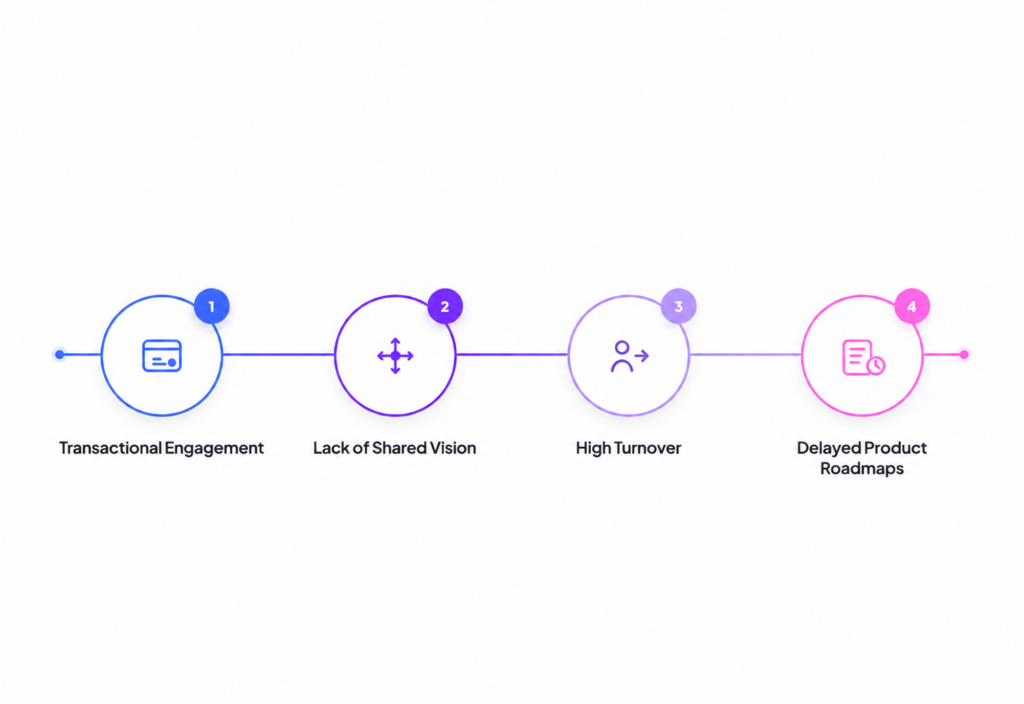
However, this flexibility comes at a severe cultural and operational cost. Independent contractors are, by definition, operating their own businesses. Their primary loyalty is to their revenue stream, not your product roadmap. The FTE vs. contractors tradeoff, when resolved in favor of contractors alone, leads to several critical vulnerabilities:
- High Churn Rates: Contractors are constantly open to the next highest bidder.
- Knowledge Drain: When a contractor leaves, the undocumented institutional knowledge of your codebase leaves with them.
- Security and Compliance: Enforcing strict data security protocols is inherently more difficult with temporary, non-integrated workers.
The progression of team instability often looks like this:
Analyzing the Legal and Financial Implications
Beyond the cultural aspects, the decision between FTEs and contractors carries significant legal and financial weight. The IRS and foreign labor ministries are increasingly aggressive in auditing companies that misuse the contractor classification.
The Risk of Worker Misclassification
If you hire a developer in LatAm as an “independent contractor,” but you dictate their working hours, provide their equipment, manage their daily tasks, and prohibit them from working for other clients, local labor laws may deem them a de facto employee.
This misclassification can lead to severe penalties, back taxes, and forced retroactive payment of local benefits, such as the aguinaldo or 13th-month salary common in many LatAm countries. The US Department of Labor has increasingly scrutinized contractor misclassification, and similar enforcement trends are active across many Latin American countries. Managing this risk requires airtight contracts and a deep understanding of local labor jurisprudence, something most US-based HR teams are not equipped to handle.
The True Cost of Churn
While contractors appear cheaper on a spreadsheet due to the lack of benefits and taxes, the hidden costs of churn often reverse that equation. Forbes estimates that replacing a senior software engineer can cost between 50% and 200% of their annual salary, when:
- Factoring in recruitment fees,
- Weeks of lost productivity during onboarding, and
- The drag on the rest of the team who must review the new developer’s code.
When evaluating the FTE vs. contractors decision, financial models must factor in the expected tenure of the engineer. An FTE model generally yields a much higher long-term ROI due to sustained productivity. A dynamic equally applicable when comparing direct hire vs. staffing agency models, where retention infrastructure makes a measurable difference in total engagement cost.
Cultural Alignment: The LatAm Reality
To succeed in the LatAm tech ecosystem, US companies must understand the cultural drivers of the talent pool. Latin America is home to one of the fastest-growing developer communities in the world, with Brazil, Argentina, Colombia, and Uruguay producing a growing share of senior engineering talent. These LATAM software engineers are highly sought after globally, they are not looking for temporary gig work; they are looking for careers.
The Desire for Stability
In regions that have historically experienced economic volatility, stability is a premium benefit. LATAM software engineers value long-term partnerships, clear career progression, and the feeling of being a core member of a product team.
When traditional staffing agencies treat these professionals as easily swappable resources, they fundamentally misalign with the engineer’s core desires. A developer who feels like a temporary outsider will never take true ownership of the product architecture. They will write code to meet the immediate spec, but they will not advocate for the long-term health of the system.
The most successful nearshore staff augmentation engagements are those where the boundary between “internal US team” and “external LatAm team” completely disappears.
The “Best of Both Worlds” Model: FTE Stability with Contractor Flexibility
The structural flaws of the traditional FTE vs. contractors binary have led to the rise of specialized employment models designed specifically for distributed, cross-border teams. At BEON.tech, we recognized that US companies need the compliance and agility of a B2B vendor contract, while the talent requires the stability, benefits, and cultural inclusion of an FTE.
How the Integrated Model Works
Our approach effectively shields the US client from international liability while providing a premium, localized employment experience for the engineer.
- Legal Shielding: Your company signs a standard US-based B2B services agreement with us. You do not need to establish foreign entities, navigate local labor laws, or worry about misclassification risks.
- Localized Employment: We employ the engineers locally, providing full compliance with their country’s labor laws. They receive localized payroll, private premium healthcare, equipment, and paid time off.
- Cultural Integration: The engineers work directly with your internal team, using your tools, attending your standups, and aligning with your engineering culture.
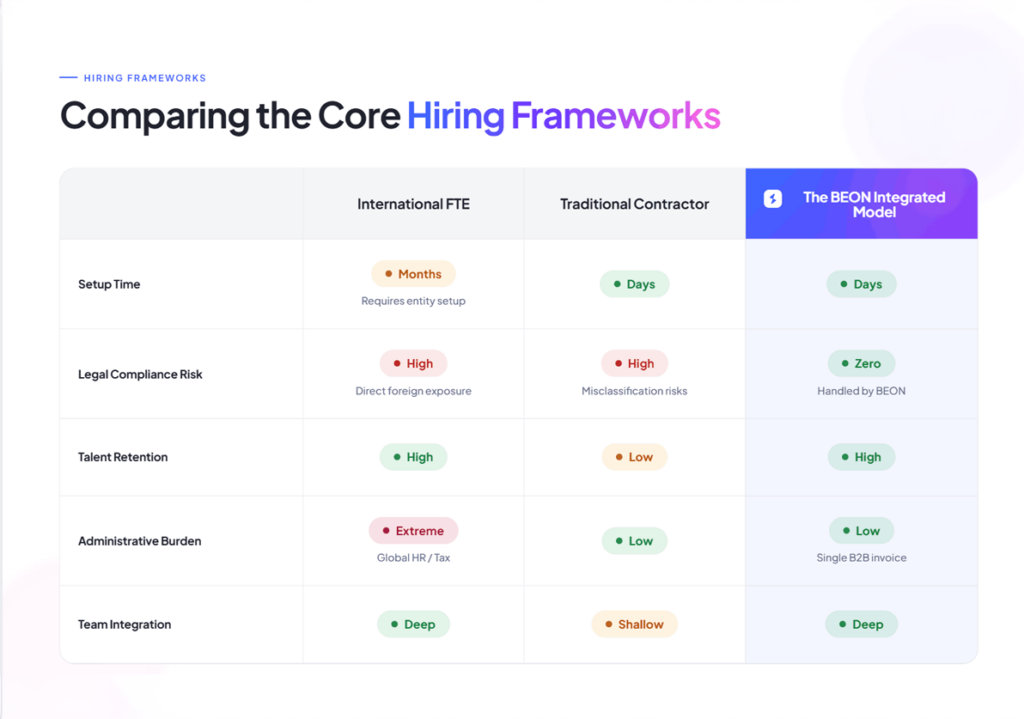
This model changes the fundamental nature of the FTE vs. contractors debate. By utilizing sophisticated employer of record structures tailored specifically for elite tech talent, companies can bypass the administrative friction entirely.
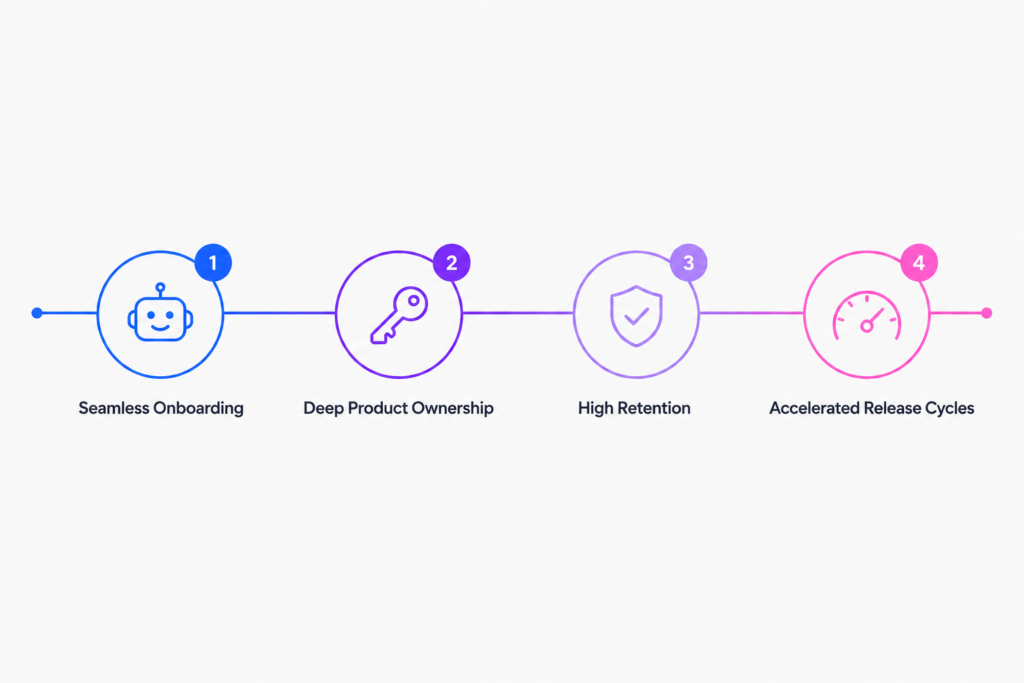
The operational workflow shifts to a much healthier paradigm:
Why Traditional Staffing Agencies Fall Short
The direct hire vs. staffing agency comparison reveals a critical gap in how most talent vendors operate. The standard agency model is built on volume: they maintain large databases of resumes, match keywords to job descriptions, and take a margin on the hourly rate.
These agencies rarely invest in the long-term career development of the engineer. They do not foster community, they offer minimal localized benefits, and they provide zero ongoing performance management. Consequently, the US client is left managing a vendor relationship rather than building a cohesive team.
This is precisely where nearshore staff augmentation diverges from the traditional staffing model. In long-term tech hiring, the infrastructure supporting the engineer is just as important as the engineer’s technical ability. Without a foundation of localized HR support, continuous learning stipends, and a sense of belonging, even the most talented developer will eventually burn out or leave for a better offer. Globant’s Integrated Report 2025 consistently highlights that career development infrastructure and team integration are the top retention drivers for tech talent in Latin America, factors that commodity staffing agencies consistently underinvest in.
Building a Resilient Future-Proof Team
The future of software engineering is fundamentally distributed. The competitive advantage belongs to the companies that can access the global talent pool without being bogged down by the legal and administrative weight of global operations.
By looking toward Latin America, US companies can find LATAM software engineers who:
- Operate in their time zones,
- Possess world-class technical skills, and
- Bring a resilient, problem-solving mindset to the table.
However, unlocking the full potential of this talent requires abandoning the outdated FTE vs. contractors debate. You do not have to choose between financial agility and team stability, and that’s precisely what BEON.tech was built to solve.
As a tech talent partner specialized in the LatAm market, BEON.tech handles the full weight of compliance, localized employment, and long-term retention, so your team can focus on shipping products. You get the cultural integration and ownership of an FTE, with the operational simplicity of a single B2B contract. No foreign entities, no misclassification risk, no revolving door of contractors.
Through a proven nearshore staff augmentation model, BEON.tech connects US engineering teams with pre-vetted, senior LATAM software engineers who integrate directly into your squads, using your tools, attending your standups, and committing to your roadmap for the long term.
Scale your team with BEON.tech and build the engineering organization your product deserves, without the administrative headache.
FAQs
What is the main difference between hiring an FTE vs. a contractor for a LatAm engineering role?
An FTE is fully integrated into your company’s structure — they receive local benefits, are subject to local labor laws, and carry long-term incentives aligned with your product. A contractor operates as an independent business, offering flexibility but with higher churn risk, shallower integration, and potential misclassification liability. For LATAM software engineers specifically, the FTE model tends to produce better retention and deeper product ownership, but comes with significant cross-border administrative complexity when managed directly.
What are the misclassification risks when hiring contractors in Latin America?
If you hire a developer as an independent contractor but control their hours, tools, and tasks — and restrict them from working for other clients — local labor authorities in countries like Argentina, Brazil, or Colombia may classify them as a de facto employee. This can trigger back taxes, retroactive benefit payments (including the aguinaldo or 13th-month salary), and legal penalties. The U.S. Department of Labor applies similar scrutiny domestically. Mitigating this risk requires airtight contracts and deep knowledge of each country’s labor jurisprudence.
Is nearshore staff augmentation the same as hiring contractors?
No. Traditional contractor arrangements are transactional — the developer manages their own taxes, benefits, and employment relationship. Nearshore staff augmentation through a partner like BEON.tech means the engineer is locally employed with full benefits and compliance handled on their behalf, while your company signs a straightforward B2B services agreement. You get the legal simplicity of a contractor engagement with the cultural integration and retention rates of a full-time hire.
How does the direct hire vs. staffing agency decision affect long-term team performance?
Direct hiring gives you full control over the employment relationship. However, it also requires managing international payroll, compliance, and benefits. For most US companies, that creates significant operational overhead. Traditional staffing agencies reduce that burden, but they often prioritize volume over quality. They also tend to invest less in engineer retention and career development. The strongest model for long-term performance sits between both options. A specialized tech talent partner manages employment infrastructure while keeping engineers integrated, motivated, and committed to your team.