It’s no secret that AI tools are reshaping how developers work. From automating boilerplate code to boosting daily productivity, artificial intelligence has evolved from a sidekick to a co-pilot — and in many cases, the pilot itself. The adoption of these tools is rapidly becoming the norm, with…
It’s no secret that AI tools are reshaping how developers work. From automating boilerplate code to boosting daily productivity, artificial intelligence has evolved from a sidekick to a co-pilot — and in many cases, the pilot itself. The adoption of these tools is rapidly becoming the norm, with usage rates ranging from 70% to 82% across countries such as the U.S., Brazil, India, and Germany, according to GitHub. And for good reason.
McKinsey reports that 65% of companies that have adopted AI have seen increased revenue in at least one business function, while 44% say it has reduced costs in those areas.
We asked a segment of our engineering community at BEON.tech — a network of thousands of top-tier Latin American developers — a simple yet revealing question: “Which coding assistant are you currently using?” The results shed light on which tools are gaining traction and which are quietly falling behind.
To complement the insights from this survey, we also hosted an internal webinar led by Damian Wasserman, co-founder of BEON.tech, where he explored how developers across the region are integrating AI into their daily workflows.
Throughout this post, we’ll bring in some of Damian’s key takeaways — and we’ll take things a step further by examining how these changes reflect the broader shift toward AI-first engineering.
Cursor Takes the Lead
With 29% of the votes, Cursor is the clear frontrunner among BEON.tech developers. Its seamless integration with code editors and focus on speed and accuracy make it a favorite for devs looking to speed up iteration without compromising code quality.
Cursor’s growing traction is consistent with wider industry trends. Damian highlighted Cursor’s ability to reduce friction in complex tasks, especially when switching between logic-heavy files. He also praised its collaboration features for distributed teams, aligning perfectly with modern, AI-first engineering workflows.
ChatGPT and GitHub Copilot: Still Strong Contenders
ChatGPT earned 19%, showing its value as a flexible, general-purpose AI assistant. From debugging to architectural decisions, developers trust it for more than just autocomplete.
GitHub Copilot, once the AI darling of coders, now trails slightly at 17%. It’s still a solid choice — especially for GitHub-heavy workflows — but the competition is heating up.
According to Damian, GitHub Copilot remains popular in enterprise environments because of its seamless integration with CI/CD pipelines and GitHub repos. However, its limited customizability compared to tools like Claude or Cursor may be pushing devs to explore new alternatives.
Claude Enters the Chat
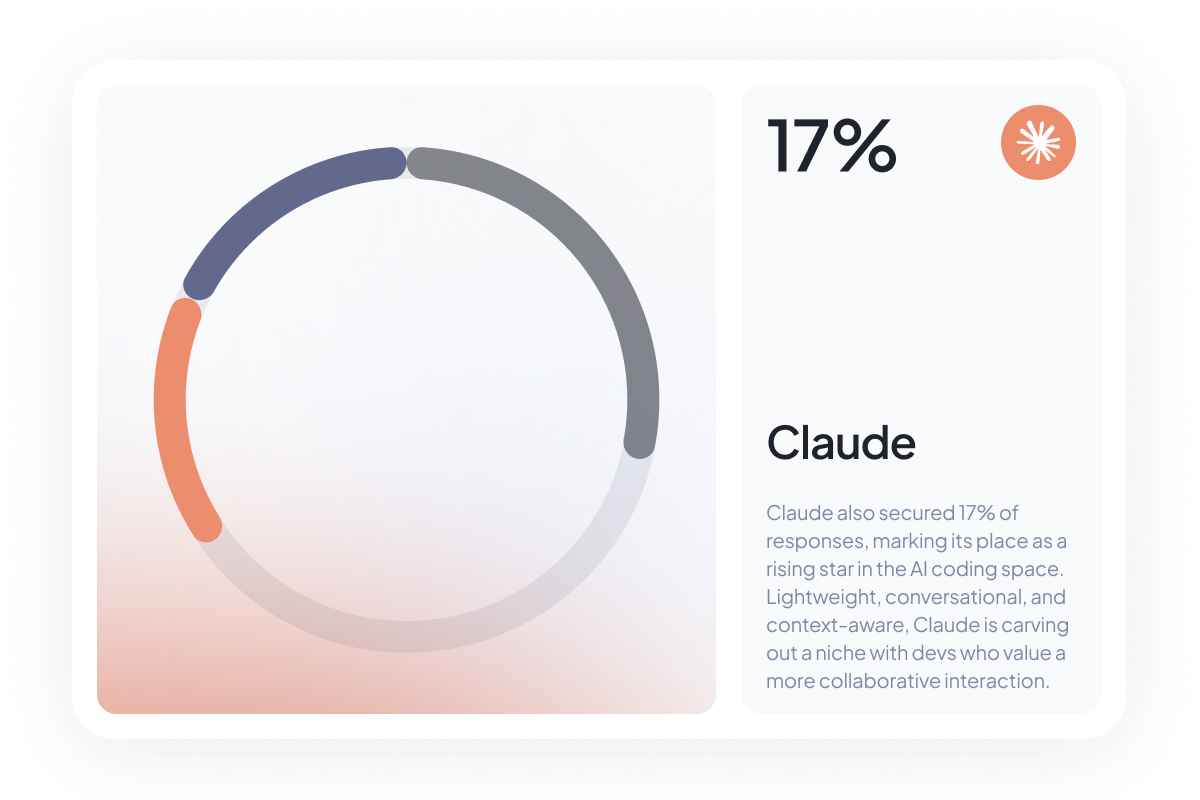
Claude also secured 17% of responses, marking its place as a rising star in the AI coding space. Lightweight, conversational, and context-aware, Claude is carving out a niche with devs who value a more collaborative interaction.
Its extended context windows and structured prompts make it ideal for pair programming — particularly when dealing with legacy codebases or massive monorepos.
Gemini and Claude Code: Niche but Growing
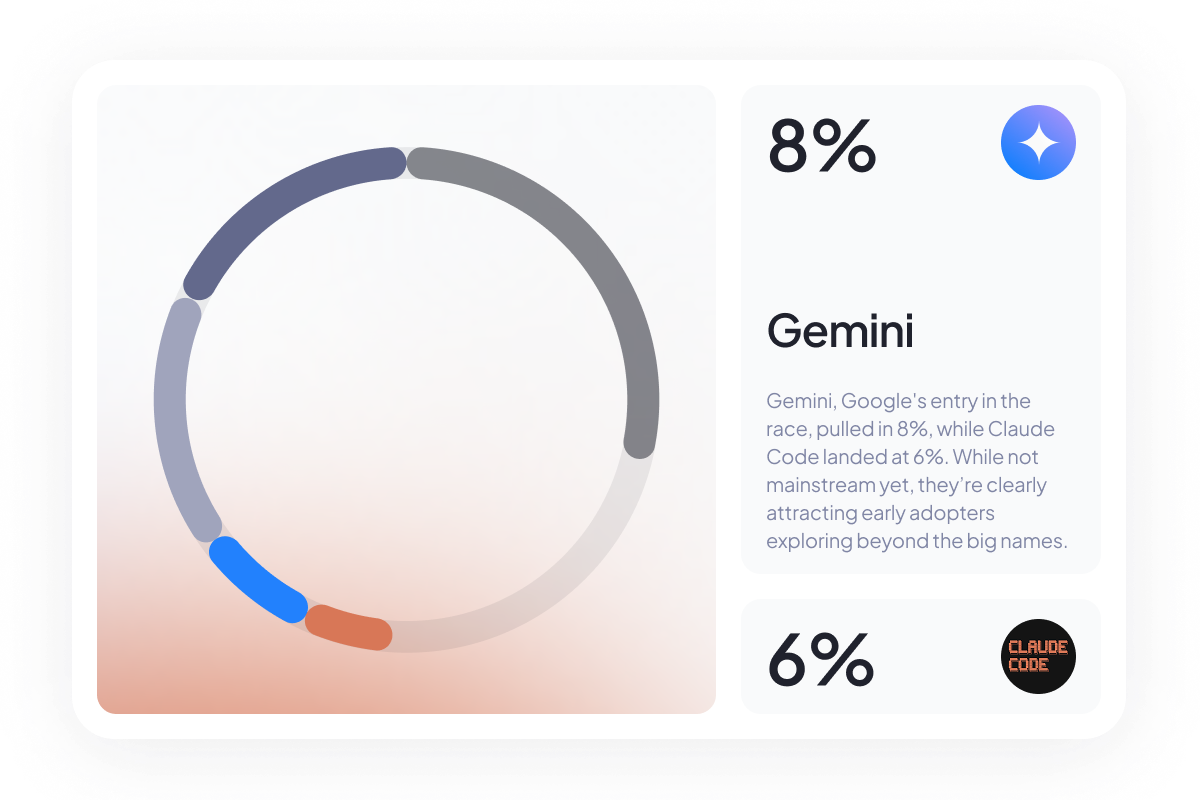
Gemini, Google’s entry in the race, pulled in 8%, while Claude Code landed at 6%. Though not yet mainstream, they’re attracting early adopters exploring alternatives outside the dominant players.
As Damian noted, Gemini is often preferred by Android developers within the Google ecosystem. Meanwhile, Claude Code’s coding-first UX and advanced summarization capabilities are quickly earning it a loyal following.
The Curious Cases: Tabnine and Windsurf
Tabnine and Windsurf each earned 2%, signaling low but present engagement. Whether these tools evolve or fade will depend on future innovation — or acquisition.
Damian touched on the ongoing consolidation of the AI tooling space. Windsurf, for example, recently caught attention after being acquired by Cognition (creators of Devin), but still hasn’t built meaningful traction.
One Lonely Dev
Just 1% of devs reported not using any AI assistant. That’s a powerful message on its own: in mid-2025, going AI-free is almost unheard of.
The AI Adoption Dilemma: What Does This Say About the Modern Tech Stack?
AI coding assistants are no longer optional. They’re becoming core to the daily workflows of top-tier engineers. Whether it’s refactoring, documentation, or pair programming, these tools are embedded in the way developers think, code, and collaborate.
Damian emphasized that this isn’t just about tooling — it’s about a cultural shift. Teams are adopting “AI-first workflows,” where code reviews, estimations, and testing are supported or initiated by assistants. This redefines what productivity means for devs.
He also underscored the rise of role-specific assistants (like Claude for architecture insights or Cursor for debugging) and how engineers are now stacking assistants — using multiple tools simultaneously to cover their entire dev flow.
From Engineering Managers to Hands-On Leads
Another shift Damian noted is how engineering management roles are evolving:
This reflects a growing industry preference for “doers” — highly-skilled, versatile individuals who can ship product and guide AI-driven workflows.
Damian Wasserman is the co-founder of BEON.tech, which he started in 2018 with Michel Cohen, and he leads the company's sales team. Since then he has spent his days connecting leading US companies with top-tier engineers from Latin America. He has always been drawn to two things at once: the technical work of making things run and the business side of building something new, and technology has been the bridge that lets him create more than he could build with his own two hands. After several years away from hands-on coding, AI brought him back over the past two years, and he says he is now several times more productive than before. Today he builds something new almost every day, from integrations and automations to AI skills he shares with the BEON.tech team so the company can lead the way in how engineering teams work with AI. A member of the Forbes Technology Council, Damian writes about nearshore software development, staff augmentation, hiring engineers in Latin America, and how AI is changing the way engineering teams are built.
A US software developer costs about $160K–$170K a year fully loaded; US freelancers charge $60–$100/hour. Compare freelance, full-time and nearshore costs.
Your app was running just fine. Until one day, users started showing up, and with them, the bottlenecks. The endpoint that worked perfectly now takes 10 seconds. And there you are, digging through logs, wondering where everything went wrong. The good news? You’re not alone. Optimizing software isn’t magic, but it’s also not luck. It’s…
In today’s microservices architecture, you might have several services in one repository, you even may have a monorepo with all your applications in a single place! But what if only a single service changed? What if a subset of them changed? In this tutorial, we’ll set up a GitHub Action that: Let’s dive in step-by-step!

 Argentina
  Brazil
  Mexico
  Colombia