
 Argentina
 Brazil
 Mexico
 Colombia

Platform engineering vs. DevOps is one of the most common questions engineering leaders ask once delivery starts to slow down as teams multiply. Many organizations already practice DevOps, yet they still see inconsistent pipelines, slow environment setup, and deployments that depend on a handful of specialists.
Is the answer more DevOps, a dedicated platform team, or a different set of hires? The short version: the two are not rivals. DevOps is an operating model built on shared ownership and automation. Platform engineering is a discipline that turns those practices into internal products developers can use on their own.
This guide explains how they differ, where they overlap, and how the roles compare, and it closes with a framework for deciding what your organization needs next.
DevOps Is the Model, Platform Engineering Is How You Scale It
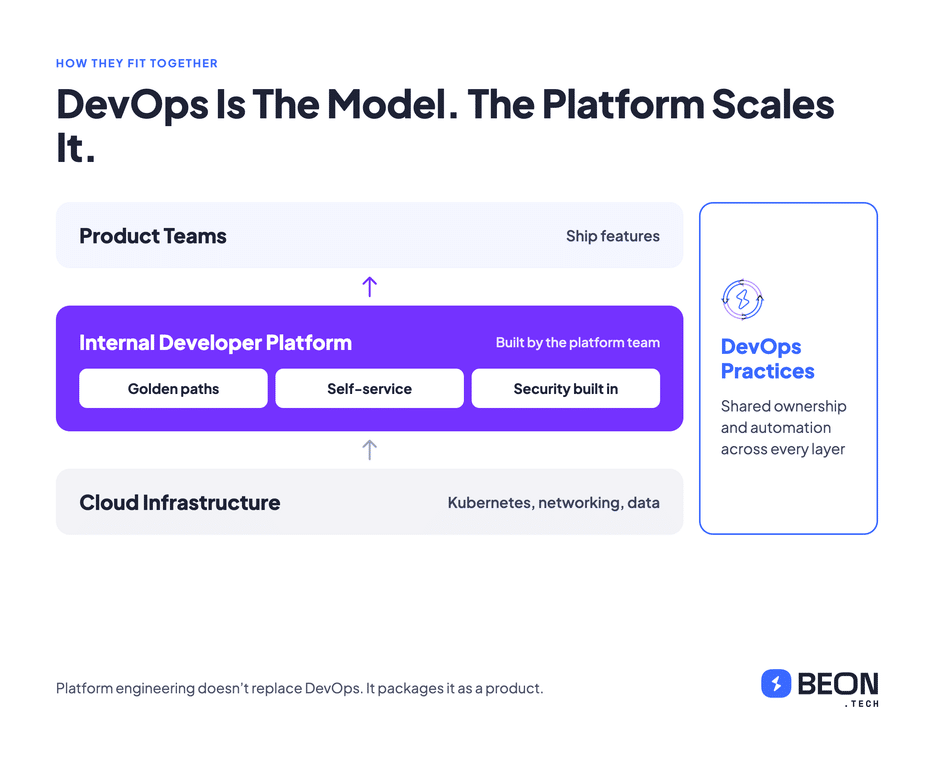
DevOps is a set of practices and a culture that brings developers and operations together, with shared responsibility for software from idea to production. Platform engineering is the practice of building and maintaining an internal developer platform (IDP) that makes those practices easy to follow consistently across many teams.
It’s the difference between the why and the how: DevOps is the reason teams need to collaborate and automate, and platform engineering is the way that automation becomes easy for everyone. Platform engineering is an extension of DevOps that supplies the standardized tools, services, and workflows development teams build on.
So if you are asking whether platform engineering replaces DevOps, the answer is no. A platform team does not make DevOps obsolete. It packages DevOps practices into products, so that every squad does not have to rebuild pipelines, environments, and security controls on its own.
What Is DevOps?
DevOps is a set of practices that brings the people who write code and the people who run it closer together. It is mainly a cultural and organizational change:
- Teams communicate better,
- Share responsibility for what they ship, and
- Automate as much of the path to production as they can.
The goal is to move software from idea to something customers can use, quickly and reliably.
DevOps grew out of agile thinking and a reaction to waterfall delivery, where long testing and approval queues slowed innovation and created bottlenecks between teams.
In a DevOps model, automation and short feedback cycles let teams move code to production quickly and keep improving it once it is live.
Typical practices include continuous integration and continuous delivery (CI/CD), infrastructure as code, monitoring, and incident response that developers and operations handle together.
Because DevOps depends on collaboration, cross-functional teams, and trust, it cannot be installed like a tool. DevOps tells you how teams should work together, but on its own it does not give every team the same paved road to follow.
What Is Platform Engineering?
Platform engineering is the practice of designing, building, and maintaining an internal developer platform that gives software teams a standardized, self-service way to build, deploy, and run their applications.
Platform teams treat that platform as a product and treat developers as their customers, which means they research needs, gather feedback, and iterate rather than hand down mandates.
The IDP is the tangible output: a curated set of tools, services, and documentation covering areas such as:
- Container orchestration
- Infrastructure as code
- CI/CD pipelines
- Environment provisioning
Its building blocks are golden paths, which are opinionated, well-documented templates and automation for common tasks. A developer who needs a new service or test environment follows the golden path instead of assembling infrastructure from scratch, and security, compliance, and reliability practices are already built in.
The point is to lower cognitive load. Developers should not need to be experts in networking, security, and Kubernetes to ship a feature.
Platform Engineering vs. DevOps: Side-by-Side Comparison
The table below summarizes the main differences between platform engineering and DevOps. Read it as a division of labor rather than a choice between two options, because most mature engineering organizations end up doing both.
| Dimension | DevOps | Platform engineering |
| What it is | A culture, methodology, and set of practices | A product-driven discipline that builds internal platforms |
| Core question | How do we work together and automate delivery? | How do we make delivery easy and consistent for every team? |
| Primary focus | Collaboration, shared ownership, automation | Developer experience, self-service, reduced cognitive load |
| Main output | Faster, more reliable delivery workflows | An IDP with golden paths, templates, and documentation |
| Who does the work | Product teams, operations, and DevOps engineers together | A dedicated platform team serving developers as customers |
| Security approach | Shift left: checks built into earlier stages of development | Shift down: controls embedded in the platform itself |
| Best fit | Any team that wants faster, more reliable delivery | Organizations where complexity and inconsistency are slowing many teams |
The two rows worth remembering are the core question and the main output. DevOps asks how people should work. Platform engineering asks what product would make that work easier, and then builds it.
DevOps vs. Platform Engineering: Where They Overlap and Where They Diverge
Both approaches share the same goals:
- Shorter time to release,
- Fewer delivery bottlenecks, and
- More reliable systems.
Both rely on automation, infrastructure as code, and CI/CD. When people ask about DevOps vs. platform engineering, this overlap is the source of the confusion, and it is why the terms are sometimes used as if they were interchangeable.
The divergence shows up in who carries the burden. A classic DevOps approach pushes more responsibility onto product teams, including security, testing, and operations.
This is often called shifting left, and it improves quality, but it can overload developers with work outside their usual scope. Platform engineering adds what Google calls shifting down: moving infrastructure and operational complexity off application developers and onto a platform team and the IDP.
In short, DevOps sets the expectation that teams own their software end to end. Platform engineering makes that expectation realistic once the number of teams, tools, and environments grows.
Platform Engineer vs. DevOps Engineer vs. SRE
The confusion over platform engineer vs. DevOps engineer is understandable, because the roles share skills in cloud infrastructure, automation, and CI/CD. The difference is in what each person is accountable for.
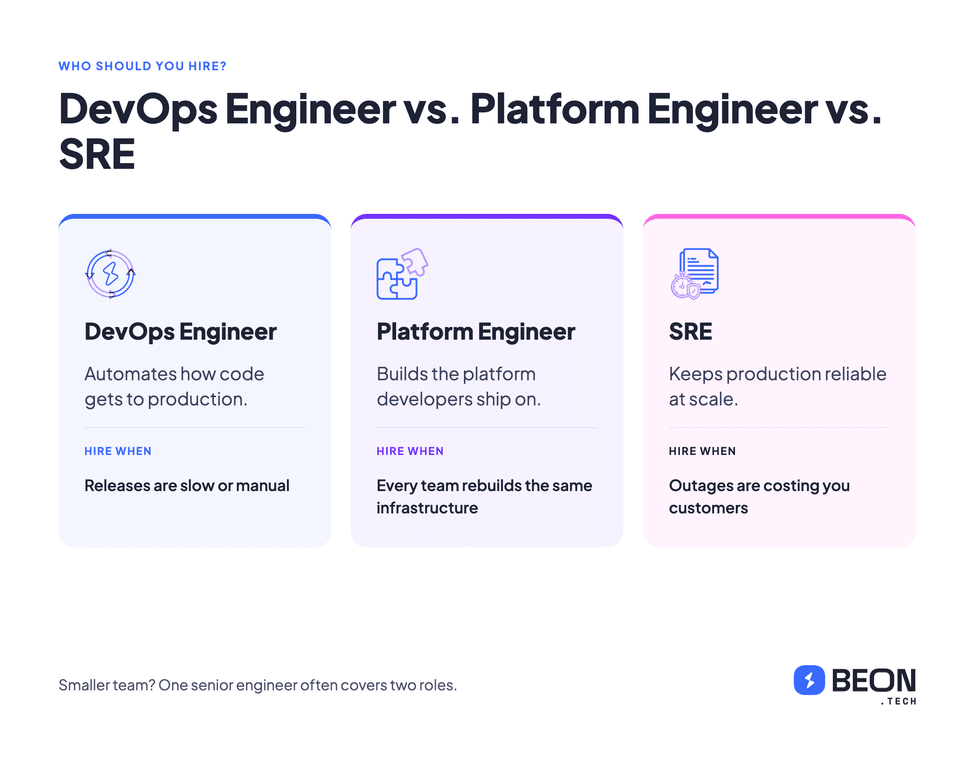
- A DevOps engineer bridges development and operations. Their work centers on automating build, test, and deployment processes, designing and maintaining CI/CD pipelines, and using infrastructure as code to provision environments consistently. They look continuously for bottlenecks in how software moves to production.
- A platform engineer approaches infrastructure with a product mindset. Their central responsibility is building and maintaining the IDP, a self-service layer where developers can provision environments, databases, and pipelines on their own. They turn high-level standards into reusable golden paths that hide the complexity of cloud networking and container orchestration, and they build access controls and compliance into the templates.
- A site reliability engineer (SRE) focuses on the reliability, performance, and scale of the systems that run in production. SRE teams build automation to protect infrastructure integrity and uptime. SREs and platform engineers share goals, but SRE concentrates on software reliability while platform engineering concentrates on the developer experience.
So is a platform engineer the same as a DevOps engineer? No. They overlap, and many people move between the two, but the first builds a product for internal developers while the second typically automates and improves the delivery process itself. In smaller teams one person may cover both, which is worth remembering when you write a job description.
When Do You Need Platform Engineering? A Decision Framework
The decision to build a platform is not driven by an arbitrary headcount. A platform becomes appropriate when the time developers spend on infrastructure outweighs the investment required to build and maintain the platform. A practical way to apply that idea is to match your situation to one of three paths.
- Improve your existing DevOps practices. If your applications are relatively straightforward and teams can manage their own infrastructure, simple automation and better collaboration are usually enough. Focus on shared goals, ownership, and basic CI/CD before adding structure. A platform team at this stage can be more overhead than value.
- Establish a platform engineering function. Consider this when complexity starts slowing the whole organization. Google points to three common signals: developers spend excessive time configuring and maintaining infrastructure instead of building features; security, operational, and deployment patterns vary across products, making support and audits difficult; and it takes days to spin up a new test or production environment.
- Add specialist capacity. If you know which path you need but lack the people to execute it, the constraint is skills and time, not strategy. This is the point to hire or augment with senior platform, cloud, DevOps, SRE, or infrastructure engineers, ideally to build the first golden paths alongside your in-house team.
A useful test is to ask your engineering managers three questions:
- How often do teams repeat the same infrastructure work?
- How long does it take a new service to reach production?
- How many deployments depend on one or two specialists?
If the answers point to repetition and dependency, you are likely past the point where improved DevOps habits alone will fix the problem.
Build, Buy, or Augment: Making the Platform Real
Once you decide a platform is warranted, the next question is how to get there. Most organizations do not build everything from scratch. Google Cloud describes IDPs built on managed cloud services, and Red Hat positions an enterprise developer portal built on the open source Backstage project.
In both cases, the team assembles and configures proven components, then shapes them into golden paths that fit its own workflows.
That makes the decision less about build versus buy and more about where you want your engineers to spend their effort. Buying or adopting managed components saves time on commodity infrastructure.
Building the golden paths and templates is where the platform becomes specific to your business, and it is where internal knowledge matters most.
The harder constraint is usually talent. Platform, cloud, and SRE skills are in demand, and a first platform team needs senior people who have done this before.
Choosing the Right Hiring Model
Once you decide a platform team is warranted, the next question is how to build it. You can hire in-house, outsource the work, or use IT staff augmentation. The right approach depends on how much control you need, how quickly you need specialized skills, and who will own the platform long term.
- Direct hiring makes sense when platform engineering is a permanent core capability. Internal engineers build institutional knowledge and maintain long-term ownership, but recruiting senior DevOps, cloud, and SRE talent can take time and drive up costs.
- Outsourcing works well when you want an external provider to manage a defined project or deliverable. It can accelerate implementation, but day-to-day priorities and execution may sit largely with the provider.
- IT staff augmentation lets you add experienced engineers to your existing team without committing to permanent hires. You retain control over architecture, priorities, and workflows while gaining specialized skills when you need them.
For platform engineering, staff augmentation can be particularly useful during the initial build. You might need a senior engineer to establish golden paths, a cloud specialist to automate infrastructure provisioning, or an SRE to improve observability and reliability.
Rather than hiring every role upfront, you can bring in the expertise required for each stage while your internal team retains ownership of the platform.
To make this model sustainable, integrate external engineers into your team’s workflows, document architectural decisions, and pair them with internal developers who will maintain the platform over time. That way, you accelerate delivery without sacrificing long-term knowledge or control.
Build Your Platform Team Faster with BEON.tech
Finding experienced platform engineers can be a bottleneck when you want to improve developer productivity. BEON.tech helps US companies connect with pre-vetted senior engineers from Latin America who work directly with their teams.