
 Argentina
  Brazil
  Mexico
  Colombia
You have probably seen the diagram: seven boxes stacked from Classical AI at the bottom to AGI at the top, with machine learning, deep learning, generative AI, and agentic AI in between.
The diagram is useful. It separates terms that are often blurred together in product conversations. But it also suggests a progression that does not exist in most production systems. You do not graduate from rules to machine learning, then unlock agents as the final level.
For engineers, the more useful question is practical: what does each layer look like in a codebase, what trade-offs does it introduce, and when is it the right tool?
This guide walks through all seven layers of AI from the bottom up, then turns the taxonomy into a decision framework you can use in a real project.
What the Seven-Layer Model Gets Right
The seven layers of AI describe related ideas, but they do not all describe the same kind of thing:
- Classical AI, machine learning, neural networks, deep learning, and generative AI describe techniques or model families.
- Agentic AI describes a system architecture.
- AGI describes a hypothetical capability.
That distinction matters. A team can combine several of these layers in one feature: deterministic validation, a classifier, embeddings for retrieval, a generative model, and a bounded tool-using loop. The result is not “a Layer 2 product.” It is a system with different components making different trade-offs.
Layer 7: Classical AI
What It Is
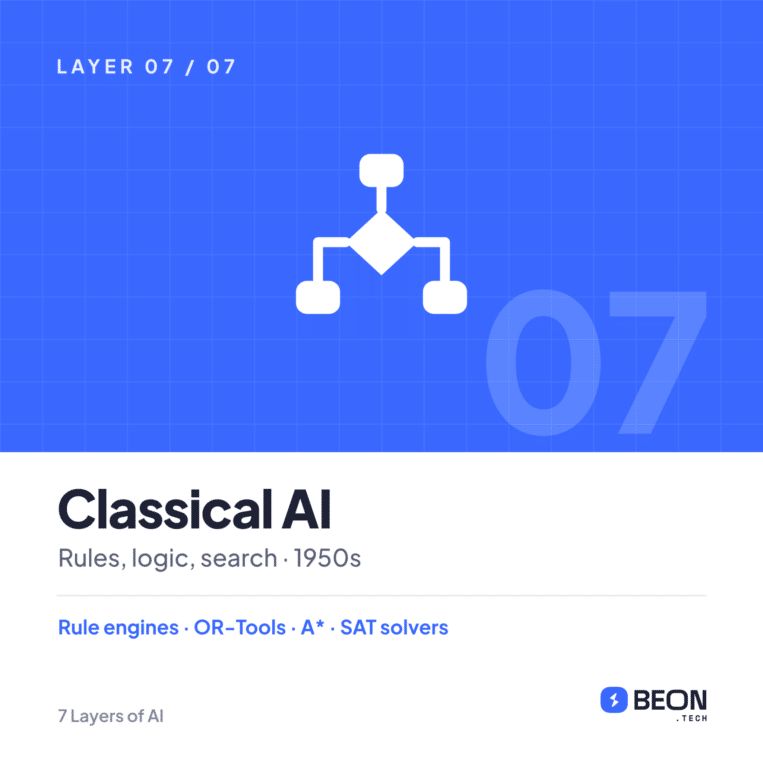
Classical AI, also called symbolic AI, represents knowledge explicitly through rules, logic, search, and constraints. The system executes instructions that people designed or formalized.
The field is often traced to the 1956 Dartmouth workshop, where researchers proposed studying “artificial intelligence” as a formal area of inquiry. Its most visible commercial era was the expert-system boom of the 1980s.
What It Looks Like in a Codebase
- A rule engine deciding which discount applies.
- A constraint solver such as Google OR-Tools building employee schedules.
- A* pathfinding in a game.
- A SAT solver helping resolve package dependencies.
- Alpha-beta search in a chess engine.
- A linter enforcing known rules.
The Engineering Judgment
This layer never disappeared. In many products, it was renamed “business logic.” Classical AI is still the right choice when the problem has hard constraints, deterministic outputs, and audit requirements. Nobody wants a language model deciding whether a wire transfer clears when the policy can be expressed and checked directly.
One common taxonomy mistake is placing decision trees in this layer. A hand-written decision tree can be symbolic, but a machine-learning decision tree is learned from data. The implementation, not the shape of the diagram, determines which category it belongs to.
Layer 6: Machine Learning
What It Is
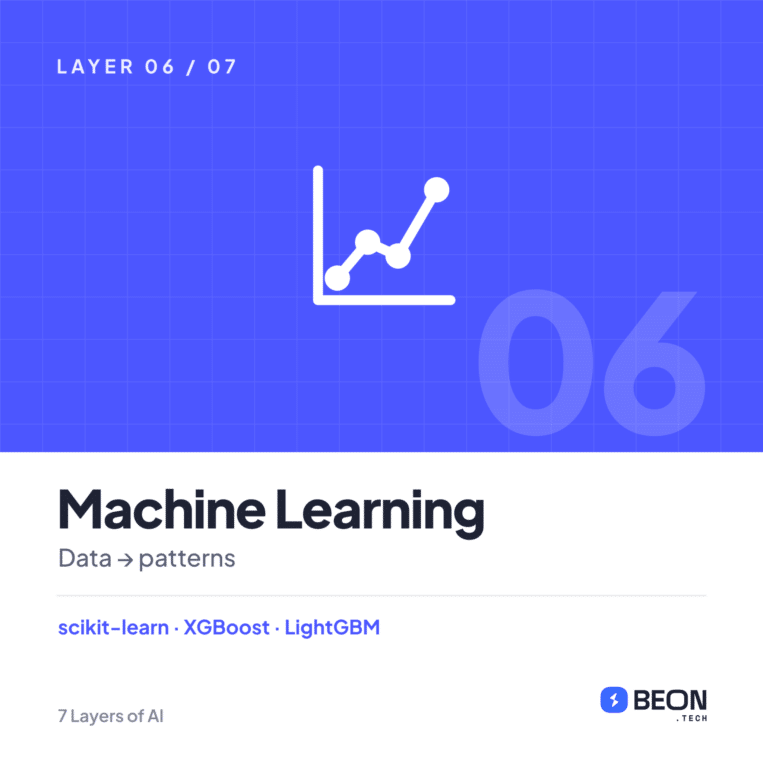
With classical AI, engineers write the rules. With machine learning, engineers provide examples and an algorithm learns parameters that map inputs to outputs.
The system can then estimate churn risk, detect fraud, classify support requests, forecast demand, or segment customers without requiring every rule to be written by hand.
What It Looks Like in a Codebase
- scikit-learn pipelines.
- XGBoost or LightGBM models.
- Logistic regression for scoring.
- Gradient-boosted trees for fraud detection.
- K-means for segmentation.
- Feature engineering and train/validation/test splits.
- Cross-validation, confusion matrices, and drift monitoring.
The Engineering Judgment
For tabular business data, gradient-boosted trees remain a strong baseline. They are fast to train, relatively inexpensive to serve, and often easier to explain than a larger neural model. That makes “we need an LLM” a poor starting assumption for many prediction problems. If the input is structured, the output is a score or label, and you have representative historical examples, a conventional machine-learning model may be the better system.
This is also where production concerns become unavoidable: data leakage, class imbalance, distribution drift, and training-serving skew. Moving to a higher layer does not remove those problems. It can make them harder to observe.
Layer 5: Neural networks
What It Is
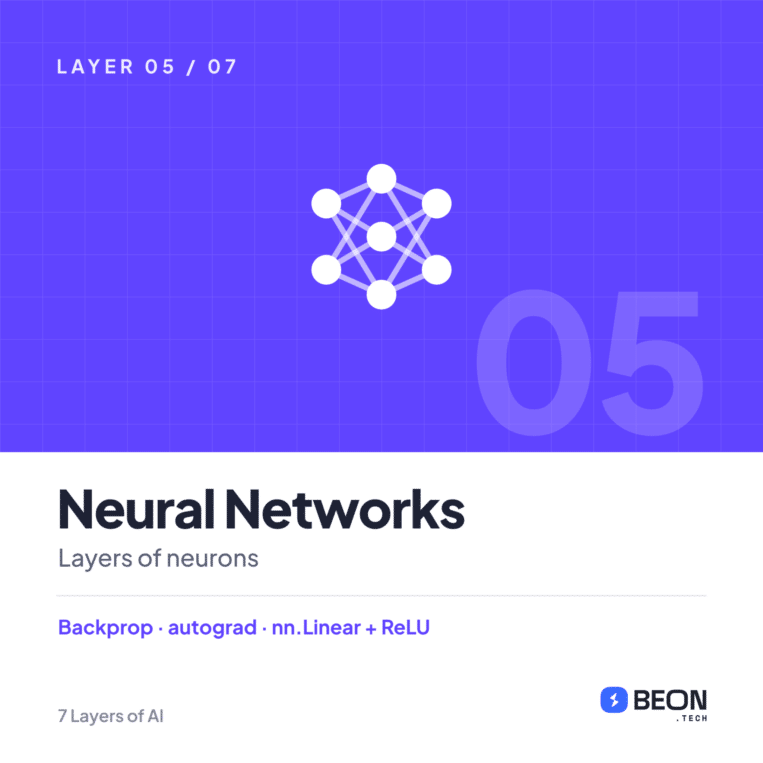
A neural network is a parameterized function made from layers of AI of weighted sums and nonlinearities. Training adjusts the weights so the function reduces a defined loss over examples.
This is the point where the hierarchy is mostly accurate: neural networks are a subset of machine learning.
What It Looks Like in a Codebase
nn.Linear(...)
nn.ReLU()
loss.backward()
Around those operations, you will find an automatic differentiation engine, an optimizer, data loaders, and an evaluation loop. PyTorch’s autograd documentation provides a concise explanation of the mechanism.
The Engineering Judgment
There is no separate kind of magic here. The core loop is matrix multiplication, a nonlinearity, repetition, and an update in the direction that reduces error.
Everything above this layer adds scale, architecture, data, and system design. Understanding that helps engineers reason about AI systems without treating them as fundamentally unknowable.
Layer 4: Deep learning
What It Is
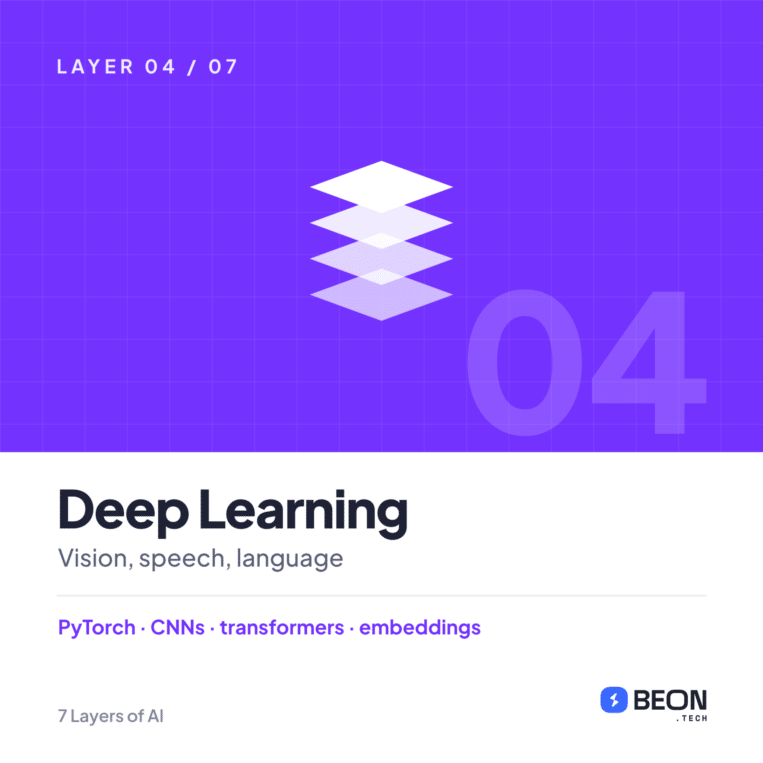
Deep learning uses multi-layer neural networks to learn representations from data. Instead of relying entirely on hand-crafted features, the model learns useful features as part of training.
The 2012 AlexNet result accelerated deep learning’s adoption in computer vision. The 2017 Transformer architecture then reshaped sequence modeling and became the foundation for many current language and multimodal systems. The original paper, “Attention Is All You Need”, remains the key reference.
What It Looks Like in a Codebase
- PyTorch or another deep-learning framework.
- Convolutional neural networks for some vision tasks.
- Transformers for language and other sequence problems.
- Pretrained checkpoints from Hugging Face.
- LoRA and other parameter-efficient fine-tuning methods.
- Embeddings and an approximate-nearest-neighbor index.
Embeddings deserve special attention. An encoder paired with a vector database can power semantic search, deduplication, clustering, and recommendations without generating any text. The same retrieval architecture is at the core of AI-powered document search, where embeddings connect a user’s question with the most relevant passages in a knowledge base.
The Engineering Judgment
Deep learning is not synonymous with generative AI. A model that classifies a support ticket, ranks a feed, or scores a transaction may be discriminative: it predicts a label or value rather than creating new content.
That distinction is operationally important. A team that needs classification may reach for a chat model because it is visible and easy to demo, even though a smaller model could be faster, cheaper, and easier to evaluate.
Layer 3: Generative AI
What It Is
Generative AI produces new content such as text, images, audio, or code. For large language models, the core training objective is next-token prediction over a large corpus, followed by post-training that shapes the model’s behavior.
What It Looks Like in a Codebase
- A request to an inference endpoint.
- A context window and token budget.
- Temperature and sampling controls.
- Streaming responses.
- Prompt caching to reduce repeated cost.
- Retrieval-augmented generation, where embeddings retrieve context for a generative prompt.
- Structured output validated against a JSON schema.
- An evaluation set that tests quality over time.
Structured output is particularly useful in production. It turns an open-ended response into a typed object that the rest of the application can validate and handle. The relevant implementation will vary by model provider; the principle is the same: define the contract and validate it at the boundary.
The Engineering Judgment
Generative AI changed the economics of software by making natural language a practical input format and unstructured text a usable data source. It did not repeal engineering. A generative feature is a network call to a probabilistic third-party service. It has latency variance, token costs, rate limits, outages, and failure modes that may return confident prose instead of a stack trace.
Treat it like an unreliable external API. Add timeouts, retries where safe, fallbacks, observability, cost controls, and evaluations. “It looked good when I tried it” is a demo result, not a test suite.
These concerns become more demanding in banking AI systems handling governance, fraud, and compliance, where sensitive data raises the cost of failure.
Layer 2: Agentic AI
What It Is
Agentic AI is not a new model family. It is a system pattern: a generative model sits inside a loop with tools, memory, and a stopping condition. The model proposes the next action, the surrounding software executes it, and the result returns to the loop.
At its simplest, the architecture looks like this:
while not finished:
    decision = model(context, available_tools)
    result = execute(decision)
    context = update(context, result)
What It Looks Like in a Codebase
The difficult parts are usually around the model:
- Tool definitions and permission boundaries.
- A protocol such as the Model Context Protocol for exposing capabilities.
- Retry and backoff behavior.
- Sandboxing for filesystem or shell access.
- Idempotency keys so a retry does not double-charge a customer.
- Tracing so a run can be reconstructed.
- Token, cost, and wall-clock budgets.
- Human approval for irreversible actions.
The Engineering Judgment
This is the biggest structural flaw in the stacked diagram: agentic AI is not a more advanced model sitting above generative AI. It is an application architecture built on top of a generative model.
The model supplies flexible language-based decision-making. The harness supplies permissions, state, retries, safety, and error handling. That is good news for backend engineers: distributed-systems instincts transfer directly. Prompt experimentation alone does not replace system design.
Layer 1: AGI
What It Is
Artificial general intelligence is a hypothetical system with broad, human-level competence across domains, including tasks it was not specifically trained to perform.
There is no universally accepted definition, benchmark, or timeline.
What It Looks Like in a Codebase
Nothing. No one is deploying an agreed-upon AGI system today.
The Engineering Judgment
AGI belongs on a diagram about the history of an ambition, not on the same deployment diagram as a vector index or a rule engine.
Putting it in the same visual language encourages roadmaps that skip the hard middle: “and then it becomes smart enough to solve the rest.” A more durable approach is to build around capabilities you can test today and keep the architecture flexible enough to replace models as they improve.
That is the useful version of future-proofing: clear interfaces, observable behavior, bounded permissions, and replaceable components.
What The Stack Metaphor Hides
The layers of AI are not a build order.
A production AI system may combine deterministic validation, a conventional classifier, embeddings for retrieval, a generative model, and a bounded tool-using loop. Choosing one layer as the identity of the product can lead a team to use the wrong tool with great conviction.
Higher does not mean better. It usually means more flexibility, less predictability, and more cost. Each step upward can trade determinism for capability. The engineering skill is knowing which trade-off you are making and refusing to make it by accident.
How to Choose the Right Layer
Start with the problem, not the fashionable tool.
| Question | Likely starting point |
|---|---|
| Can I write the rule and must the result be deterministic? | Classical AI and explicit business logic |
| Do I have labeled examples and need a prediction or score? | Conventional machine learning |
| Do I need to learn features from complex data? | Neural networks or deep learning |
| Do I need to compare meaning across documents, queries, or items? | Embeddings and retrieval |
| Do I need to produce language, code, images, or audio? | Generative AI |
| Does the task require multiple steps whose order is not known in advance? | Agentic architecture, with strict bounds |
| Am I planning around broad human-level intelligence? | Reframe the requirements around testable capabilities |
The best architecture may use several answers at once. The goal is not to reach the highest layer. The goal is to solve the problem with the smallest amount of unpredictability your product can tolerate.
The Practical Lesson for AI Engineering Teams
The seven-layer model is useful because it gives engineering teams a shared vocabulary for discussing AI. Its real value, however, comes from applying that vocabulary to concrete product decisions rather than treating the layers of AI as a maturity ladder.
The strongest AI products are usually composites. They use rules where rules are reliable, learned models where examples are available, embeddings where meaning matters, generative models where content must be produced, and agentic loops only when the workflow truly needs them.
The practical lesson is simple: choose the lowest layer that solves the problem well, and move upward only when the added flexibility justifies the extra uncertainty, cost, and operational work. That judgment, not the ability to use the newest mode, is what turns an AI idea into a dependable product.
If you are an engineer looking for opportunities to work with BEON, register on the BEON engineering platform and create your profile so our team can consider you for future roles that match your experience.
FAQs
What are the seven layers of AI?
The commonly cited model includes Classical AI, machine learning, neural networks, deep learning, generative AI, agentic AI, and AGI. The list is a practical taxonomy, not an industry-standard hierarchy.
Is agentic AI a type of AI model?
Usually, no. Agentic AI describes an architecture in which a model uses tools, state, and a control loop to complete a task. The underlying model is often generative AI.
Is deep learning the same as generative AI?
No. Deep learning is a broad family of multi-layer neural-network techniques. Generative AI is a use of models that produce new content. Deep-learning systems can classify, rank, retrieve, or generate.
When should a team use classical AI instead of an LLM?
Use explicit rules, search, or constraint solving when requirements are known, outputs must be deterministic, and decisions need to be audited. An LLM is useful when the input or output requires flexible language understanding or generation.
Do all AI systems need agents?
No. Many valuable systems are a single classifier, an embedding-based search flow, a constrained generative call, or a deterministic workflow. Add an agent loop only when the task genuinely requires dynamic multi-step action.
What should engineers monitor in a generative AI feature?
Monitor latency, errors, token usage, cost, rate limits, output validity, quality evaluations, and safety failures. Also define what happens when the model times out, returns invalid data, or produces an answer the product cannot trust.
Building a team that works with these tools? BEON.tech helps US companies hire senior AI engineers from Latin America who work in your time zone.