
 Argentina
 Brazil
 Mexico
 Colombia

AI has reached almost every step of hiring. It writes job posts, finds candidates, screens résumés, schedules interviews and drafts outreach, often faster than any recruiter could. For tech teams that need senior engineers quickly, that speed is hard to ignore.
But AI also creates new problems: screening models that filter out strong candidates, applicants who don’t trust automated decisions and laws that now regulate how these tools are used.
This guide covers how to use AI in recruitment for tech roles: where it helps, where it falls short, how to split the work between AI and people, and what to check before you roll it out.
How AI Is Used in Recruitment Today
AI in recruitment has moved from experiments to daily work. 37% of companies are integrating generative AI into their hiring processes, up from 27% a year earlier, and recruiters who use it report saving about 20% of their workweek, according to LinkedIn’s Future of Recruiting report.
Today, AI shows up at almost every stage of tech recruiting:
- Job descriptions: drafting and rewriting posts for clarity and inclusive language.
- Sourcing: searching profiles in natural language instead of rigid keyword filters.
- Screening: ranking applicants against the skills the role needs.
- Outreach and scheduling: personalizing messages and booking interviews automatically.
- Onboarding: tailoring training plans to each new hire’s role and experience.
The time recruiters save goes back into higher-value work, like deeper candidate conversations and skills assessments.
Where AI Helps Most in Tech Hiring
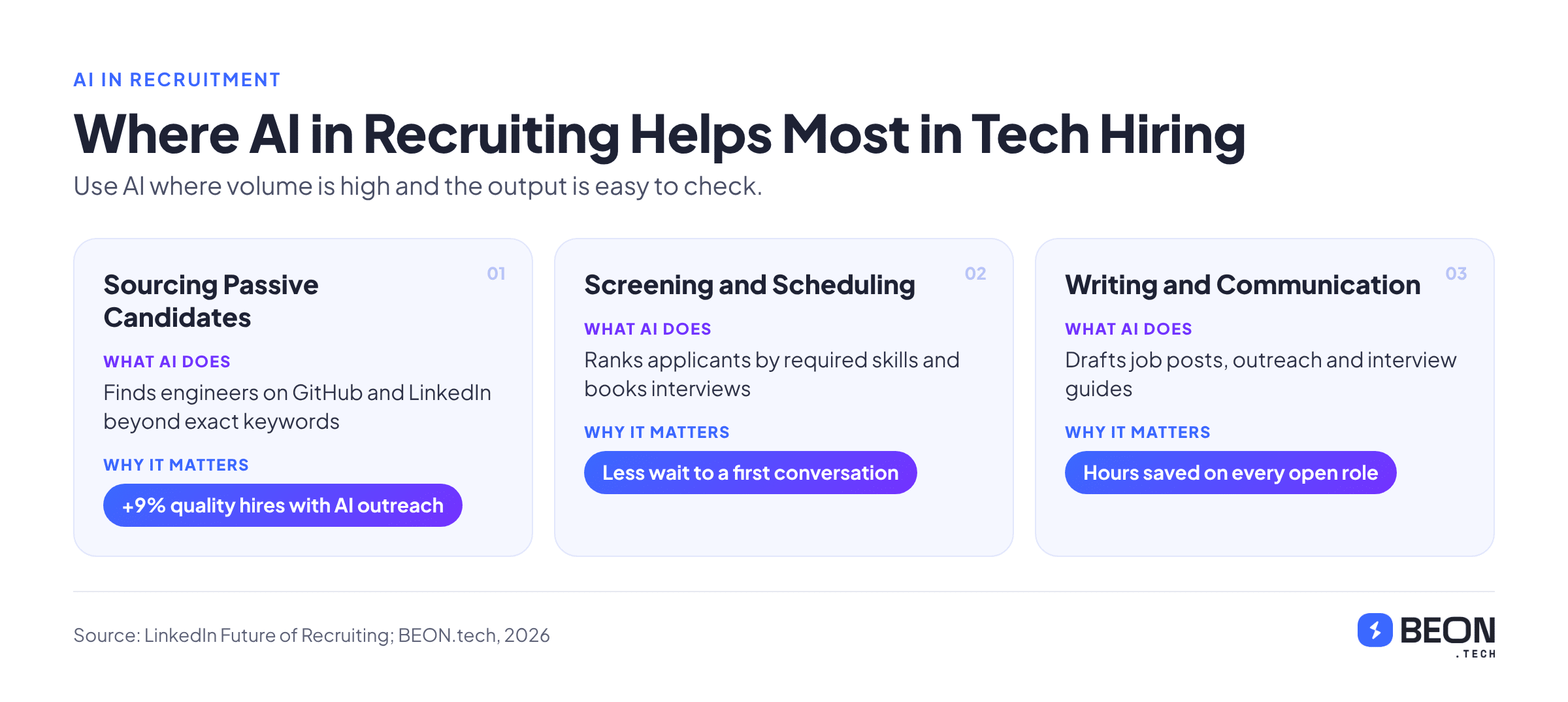
AI adds the most value in the high-volume, repetitive parts of the process, where speed matters and the decisions are easy to check.
Sourcing Passive Candidates
Most senior engineers aren’t looking for a job. AI search finds them across GitHub, LinkedIn and technical communities, and it can surface people whose experience fits the role even when their profile doesn’t use the exact keywords. Personalized outreach also pays off: recruiters who rely heavily on AI-assisted messaging are 9% more likely to make a quality hire, according to LinkedIn.
Screening and Scheduling
For roles with hundreds of applicants, AI can rank résumés against required skills and handle the back-and-forth of booking interviews. That shortens the time between application and first conversation, when strong candidates are most likely to drop out.
Writing and Communication
Job posts, outreach messages, rejection emails and interview guides are all faster to draft with AI. Choosing the right AI recruitment tools for tech hiring depends on which of these tasks takes most of your team’s time.
Where AI Falls Short
The same automation that saves time can cost you good hires if it makes the wrong decisions. These are the main limits:
- It can’t judge technical depth. A résumé match says little about how someone debugs a production issue or reviews code they didn’t write.
- It can repeat old biases. Models trained on past hiring decisions can filter out strong candidates with unusual backgrounds.
- Candidates don’t fully trust it. Only 26% of job applicants believe AI will evaluate them fairly, according to Gartner.
- Candidates use AI too. Of the engineers who reached BEON.tech’s technical interview in 2026, 79% already used AI in their coding workflow. Automated tests can’t tell whether someone understands the code they submit.
That last point is why the technical stage still needs people. A live conversation with a senior engineer is the most reliable way to evaluate software engineers who already work with AI every day.
How to Use AI in Recruiting: AI vs. People
The teams that get the most out of AI split the work clearly. AI handles scale and data; people handle judgment and relationships:
| Let AI handle | Keep with people |
|---|---|
| Drafting job descriptions and outreach | Defining the role with the hiring manager |
| Sourcing and first-pass screening | Technical interviews and live coding |
| Interview scheduling and reminders | Assessing communication and team fit |
| Summarizing interview notes | Final hiring decisions |
| Reporting on funnel metrics | Offers, negotiation and closing |
Candidates also feel the difference. Knowing that a person makes the final call makes them more likely to trust the process and accept the offer.
5 Steps to Bring AI Into Your Hiring Process
- Start with low-risk tasks. Let recruiters try AI on job posts and outreach before it touches screening decisions.
- Keep a person on every decision. AI can recommend a shortlist, but a recruiter or engineer should approve who moves forward.
- Audit for bias. Compare who the tool filters out with who you would have advanced, and adjust the criteria.
- Protect candidate data. Check where each tool stores résumés and interview recordings, how long it keeps them and whether it moves data across borders.
- Train recruiters on both sides. Teach the tools and the skills AI can’t replace, like advising hiring managers and building relationships with candidates.
Legal Considerations When You Hire Developers in Latin America
When a US company uses AI to recruit software developers in Latin America, two sets of rules can apply: the data protection laws of the candidate’s country, and the rules where your company runs its hiring process.
- Data protection in the candidate’s country. Brazil’s LGPD, Argentina’s Personal Data Protection Law, Colombia’s Law 1581 and Mexico’s federal data protection law regulate how candidate data is collected, stored and transferred abroad.
- The right to a human review. Brazil’s LGPD lets people ask for a review of decisions made solely by automated processing, which matters if an AI tool screens candidates out on its own.
- Consent and transparency. Across the region, the baseline is to tell candidates what data you collect, why, and whether AI is part of the evaluation.
- US rules where you operate. Some US cities and states regulate automated hiring tools, like New York City’s Local Law 144 or Colorado’s automated decision-making law from 2027. Check whether they cover your process.
Working with a partner that employs engineers locally moves most of this work off your plate, since the partner handles candidate data and employment in each country. Laws change often, so confirm the details with your legal team before you deploy a tool that screens or ranks candidates.
How BEON.tech Combines AI and Human Vetting
We use AI where it’s strongest and people where it matters. Mara, our AI recruiting platform, handles sourcing across our network of Latin American engineers and finds matching profiles in seconds.
Every candidate then goes through human-led vetting: a live English and soft-skills interview, and a technical interview with live coding run by senior engineers. That combination is why the shortlists clients receive are a close fit: one in three candidates we submit gets hired.
Conclusion: Use AI for Speed, People for Judgment
AI in recruitment works best as an assistant, not a decision-maker. Use it to source, screen and schedule faster, and keep people in charge of technical evaluation, team fit and offers. Teams that draw that line clearly hire faster without losing the candidates or the trust they need.
If you’d rather combine both without building the process yourself, BEON.tech’s IT recruitment services pair AI sourcing with human-led vetting, with profiles of senior Latin American engineers within 24 hours.