
 Argentina
 Brazil
 Mexico
 Colombia

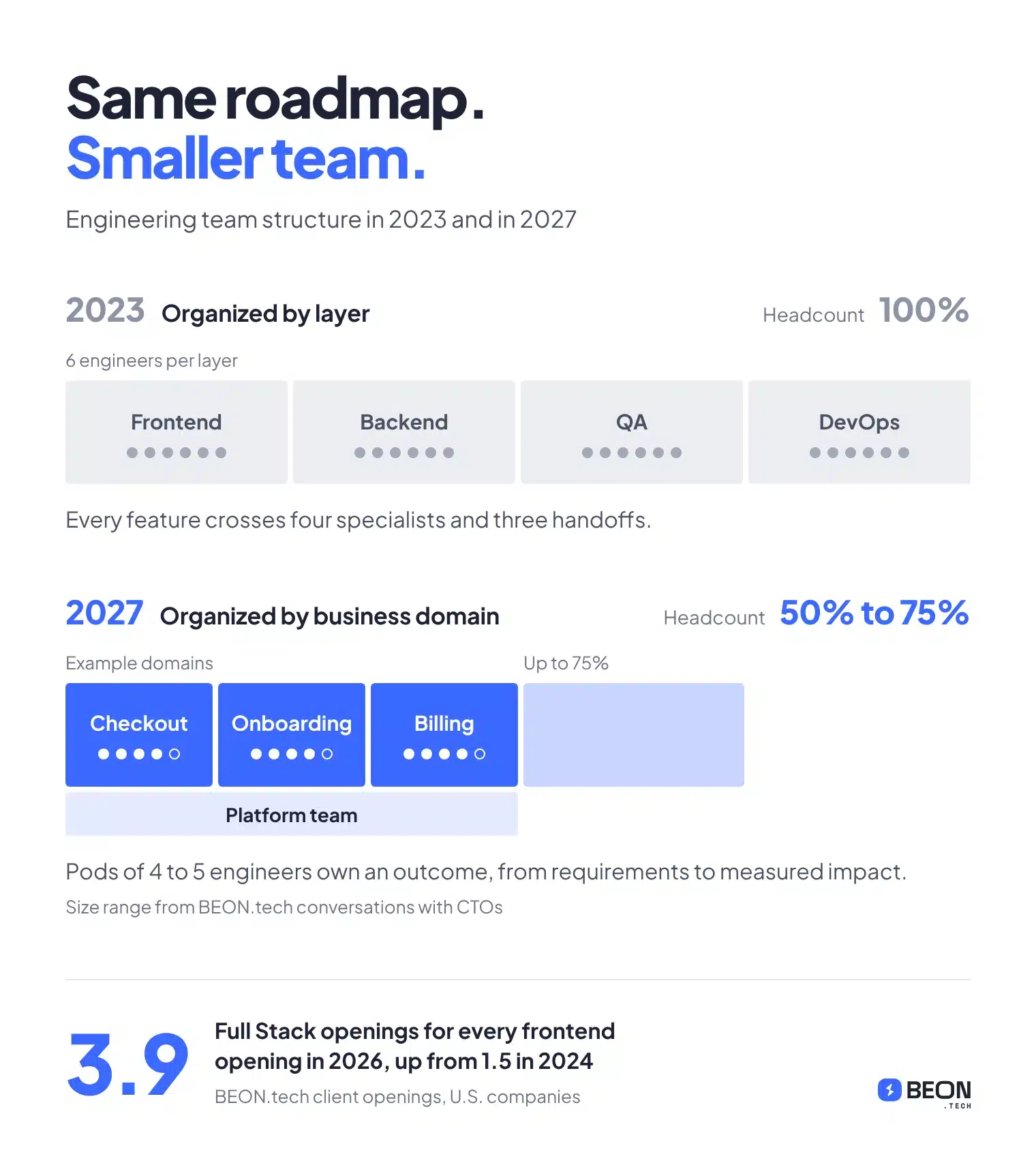
Put yourself in a CTO’s seat three years ago and design the engineering team for your roadmap. Call its size X. Now design the team for that same roadmap today. Most CTOs we talk to land somewhere between 0.5X and 0.75X.
That gap is the story of 2027. The engineering team structure most companies run today was designed for a world that no longer exists, and the next twelve months are about restructuring it. The broader data points the same way: Gartner expects 60% of organizations to adopt smaller software engineering teams by 2029, up from 15% in 2026, with typical teams of four or five people.
Companies that started this work around mid-2026 are already partway through. Below is how we see the restructure: what changes, how to run it, and how to handle the hardest part, the people who don’t make the transition.
Smaller teams, more teams
A smaller team per company does not mean fewer engineering jobs overall. The jobs are moving.
Established companies are trimming teams that were sized for 2023. Carta’s data shows that average headcount at Series B startups fell from 53 to 45 between 2023 and 2025, and the median seed-stage startup now has four employees. At the same time, a second group of companies is building its first team. These are companies that never built software because the cost of entry was too high. At 0.5X, the math works, and they are hiring.
Gartner makes the same call: AI is fueling demand for more software engineers, and smaller teams are not meant as a cost-cutting tactic. What changes is who gets hired. Stanford’s Digital Economy Lab found that employment of workers aged 22 to 25 in AI-exposed jobs sits 19% below where it would be had it kept pace with less-exposed peers, mostly because of fewer hires. Experienced workers show no comparable gap. We cover what this means for engineering careers in the future of software engineering with AI.
So the question for a CTO is what shape the team needs to be, and who fits that shape. Any cut follows from that answer.
Four roles are becoming one
Three years ago, teams were organized by layer: frontend, backend, QA, and infrastructure or DevOps. Each layer had its own specialists, and work moved between them through handoffs.
Those roles are merging. An engineer working with AI tools can now carry a feature across the interface, the service behind it, the tests and the deployment. Gartner describes the same convergence inside its “tiny teams,” and it continues a shift we first traced in AI-driven software development.
We see it in the openings U.S. clients send us. In 2024 and 2025 they asked for about 1.5 Full Stack engineers for every frontend specialist. In 2026 the ratio is almost 4 to 1, and frontend roles fell from 15% of all openings to 5%.
The handoffs were where most of the headcount went, and they are the first thing to disappear. That is why the 0.5X team is a different team, built from a different profile, and why cutting the old one in half doesn’t produce it.
There is a catch. Google’s DORA research found that AI acts as an amplifier: it raises delivery throughput, and AI adoption still correlates with lower software delivery stability. When one engineer owns the whole path to production, that engineer also owns the quality bar.
End-to-end now starts at the business
“End-to-end” used to mean frontend through backend through infrastructure. In 2027 it starts earlier and finishes later. The consolidated role takes on skills that used to sit outside engineering, product thinking first among them. It builds on the case for generalist software engineers, with one addition: depth in a business domain. The engineer we see succeeding on a restructured team:
- Knows the business. Understands how the company makes money and what its customers need.
- Goes deep on a domain. Owns one area of the product instead of one layer of the stack.
- Acts before the ticket exists. Spots what is broken or missing and proposes the fix.
- Owns the full cycle. Captures requirements, aligns the approach with company strategy, then runs research, planning, execution, deployment and quality.
- Measures impact. Checks whether what shipped moved the number it was meant to move.
| The 2023 team | The 2027 team | |
|---|---|---|
| Organized by | Layer: frontend, backend, QA, DevOps | Business domain |
| Unit of work | A ticket | A business outcome |
| Scope of one engineer | One layer of the stack | Requirements through measured impact |
| Size for the same roadmap | X | 0.5X to 0.75X |
Engineering team structure for 2027: organize by domain
The structure that fits this profile follows the business, not the stack. Four pieces make it work.
- One pod per business domain. Each pod owns an outcome, such as checkout, onboarding or billing, from requirements to measured impact.
- Four or five people per pod. Mostly end-to-end engineers, with product and design shared across pods.
- A tech lead who still builds. With fewer handoffs to coordinate, spans get wider. We see managers leading 12 to 14 people instead of four to eight.
- A platform team underneath. CI/CD, environments, observability, access management and AI tooling live in one place. Pods don’t rebuild them, and offboarding has a single place to close access.
For how this structure evolves as headcount grows, from seed to Series D, see our guide to scaling engineering teams.
How to restructure your engineering team in three steps
Start with the people, then the org chart. The restructure runs in three steps, in this order.
- Audit the team against the new profile. For each engineer, ask how much of the consolidated role they already cover. Who has moved beyond their original layer? Who has picked up business and domain skills? Who is still waiting for a ticket?
- Train before you redesign. With a flexible team and the right leaders, most engineers adapt. Give them the tools, the domain context, and a fair window with clear expectations. Measure against KPIs you set up front, not against impressions.
- Redesign where training did not work. Not everyone is ready to expand their scope this far, even with AI behind them. When someone has had the support and the time and is still not productive in the new shape, keeping them in the seat is unfair to them and to the rest of the team.
Step three is the one leaders postpone. It also decides whether the restructure works, because a 0.5X team has no room to carry a role that no longer exists.
Offboarding is where a restructure goes wrong
A redesign usually means some offboardings. Done carelessly, they cost more than the roles they remove. These are the risks we plan for, and each one gets sharper on a consolidated team.
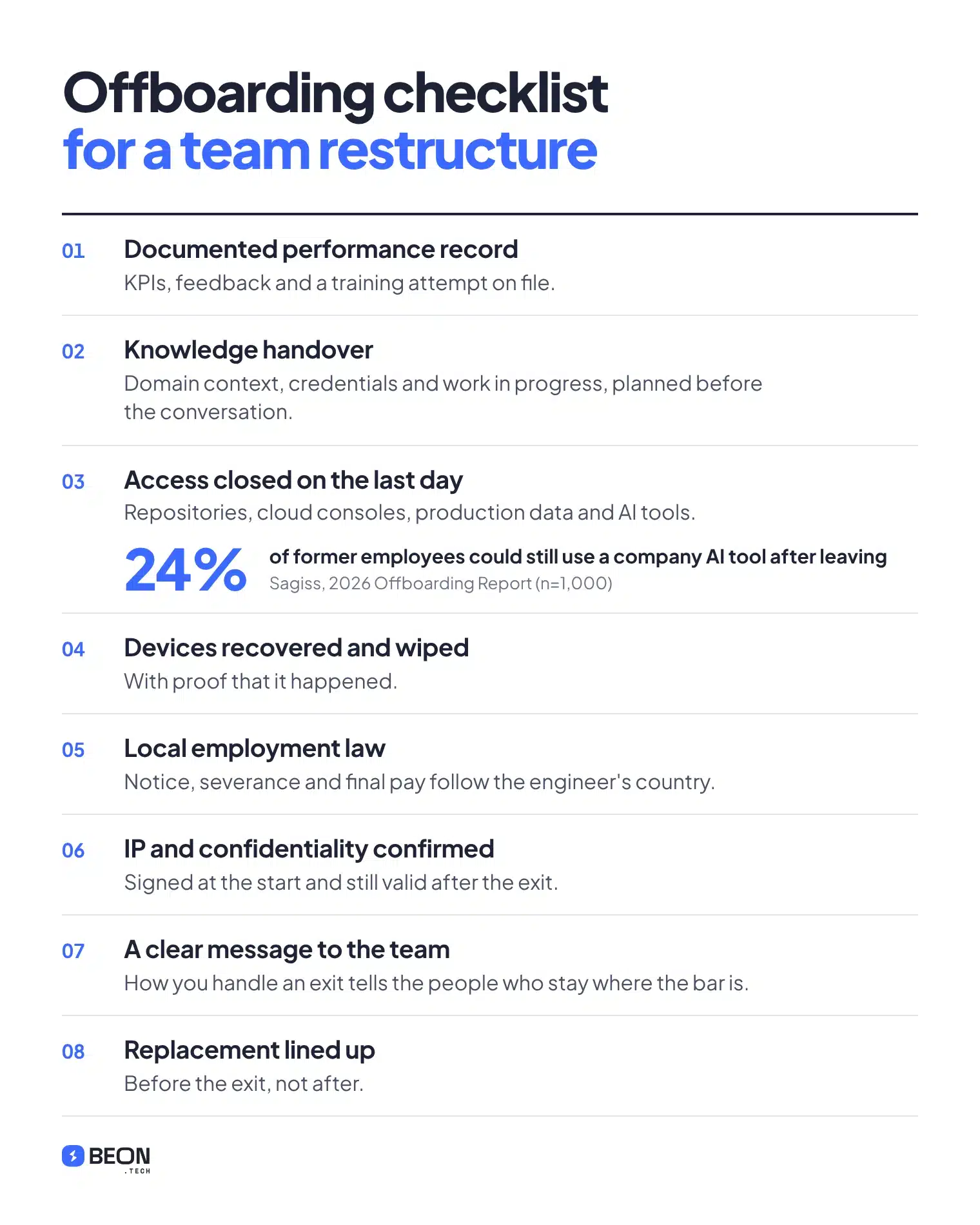
- A decision with no record behind it. An exit should close a documented performance process, with KPIs, feedback and a training attempt on file. Without that record, the decision looks arbitrary to the engineer, to the team and to anyone who reviews it later.
- Knowledge that walks out. One end-to-end engineer now holds what four specialists used to share. Plan the handover of domain context, credentials and work in progress before the conversation happens.
- Access left open. An end-to-end engineer touches more systems, and more systems means more accounts to close. In a September 2026 Sagiss survey of 1,000 former U.S. employees, 87% of those who used seven or more work accounts said at least one still worked after they left, and 24% could still use a company AI tool after leaving. Repositories, cloud consoles, production data and AI tooling accounts all need to close on the last day.
- Devices and data. Company laptops hold code and customer data. Recover and wipe every device, and keep proof that it happened.
- Local employment law. Notice periods, severance and final pay follow the engineer’s country, not yours. Getting this wrong across a distributed team turns one exit into a legal problem.
- Intellectual property. Confirm that IP assignment and confidentiality terms were signed at the start and survive the exit.
- The people who stay. The remaining team watches how an exit is handled. A respectful, well-explained process tells them the bar is real and fair. A sloppy one tells your best engineers to start looking.
- The gap. On a small team, one empty seat is a large share of capacity. Line up the replacement before the exit.
This is why we wrote The Nearshoring Protocol™. It defines the performance process that comes before any exit, under our Talent Experience Management™ framework, and a single offboarding workflow under Governance & Security. That workflow is our employee offboarding checklist for access, devices, payroll and documentation. If you are about to run an offboarding, read that module first.
Rebuilding: find the new profile, then land it properly
Every seat you redesign has to be filled by someone who fits the 2027 shape. Two things decide whether that works.
Vetting for the consolidated role. A stack-specific coding test won’t find the engineer described above. You need to see how a candidate reasons about a business problem, how they work with AI tools, and whether they know when not to use them. Don’t expect the job description to cover it: only 13% of the openings clients sent us in 2026 mention AI coding tools, LLMs or agents, so the interview has to test it. I wrote about what to look for when hiring engineers in my Forbes Technology Council column. The short version: look past raw output, at technical judgment, systems thinking, and whether a candidate can verify what AI produces. Our process for finding this profile is the first module of the Protocol, Recruitment & Vetting, and the stage-by-stage detail is in How to Evaluate Software Engineers.
Onboarding for ownership. An engineer expected to own a business domain needs more than repo access on day one. They need the context: who the customers are, which metrics matter, what the company is trying to do this year. The mechanics are in Onboarding & Equipment, and the first three months are laid out in our 90-day developer onboarding plan.
What 2027 asks of engineering leaders
The team you would design today is smaller than the one you have, and it is made of a different kind of engineer. Closing that gap is the job for 2027.
Most of your people can make the move if you audit honestly and train seriously. Some will not, and how you handle those exits will shape the team that remains. The companies that come out ahead will run the restructure as a process with defined steps, from vetting to offboarding.
If you are restructuring a team for 2027 and want to compare notes, book a discovery call with BEON.tech.