
 Argentina
 Brazil
 Mexico
 Colombia

Reviewed October, 2026 · BEON.tech publishes this guide and is one of the companies listed. No company paid to be included, and the methodology is at the end.
The best DevOps staff augmentation companies in 2026 fall into four groups.
| Group | Companies | What they offer |
|---|---|---|
| Nearshore firms in Latin America | BEON.tech, ClickIT, BairesDev, Revelo | Full-time DevOps, platform and SRE engineers whose working hours overlap with U.S. teams |
| DevOps specialists | MeteorOps, Opsfleet | Senior engineers on flexible or fractional terms |
| Talent networks | Toptal, Lemon.io | Individual contractors |
| U.S. staffing firms | KORE1, Insight Global | Contract and contract-to-hire engineers, including onsite roles |
Which one is right depends on where you want the engineer to sit, and on who carries the pager.
That second part matters more than most vendor pages admit. DevOps is the role where staff augmentation agreements fail most quietly. The questions that matter tend to surface at 3 a.m.:
- Who is on call?
- Who holds production credentials?
- What happens to your runbooks when the engineer moves on?
This guide compares 10 companies on those questions, along with model, price and client reviews.
DevOps staff augmentation companies compared
| Company | Primary model | Talent location | Published pricing (Oct 19, 2026) | On-call stance (as published) | Best for |
|---|---|---|---|---|---|
| MeteorOps | DevOps specialist: embedded staff aug, advisory, projects | Not stated (HQ Israel, per Clutch) | Not published; hours bank from 40 hours | On-call priced as a specialist profile | A named senior engineer on flexible terms |
| Opsfleet | Fractional “DevOps as a Service” | Not stated (HQ Israel, per Clutch) | Not published | Not stated | AWS-first teams without DevOps leadership |
| BEON.tech | Nearshore staff augmentation | Latin America | Senior “$6,000–$8,000 per month,” all-inclusive | On-call rotations listed as a service; on-call expectations covered at intake | Full-time engineers at a flat monthly cost |
| ClickIT | Nearshore staff aug plus DevOps consulting | Mexico and LatAm | Senior “US$7,000 to $9,000 per month” (page dated 2022) | “Usually on an on-call schedule” | AWS-heavy teams wanting Mexico-based engineers |
| BairesDev | Nearshore staff aug, teams, outsourcing | Latin America | Not published | Not stated | DevOps inside a larger nearshore team |
| Revelo | Nearshore talent platform | Latin America | Senior “$7,200–$10,700” per month all-in; 14-day trial | “Own the on-call rotation alongside your team” | Published monthly pricing, month-to-month terms |
| Toptal | Freelance network | Global | Not published (Clutch lists $100–$149/hr) | Not stated | A senior freelance specialist for a defined project |
| Lemon.io | Freelance marketplace | Europe and LatAm | Average “$61/hr” ($61–$80) | Not stated | Startups needing a freelancer quickly |
| KORE1 | U.S. IT staffing (contract, C2H, direct) | Not stated (U.S.-based firm) | “$85 to $140 an hour” | Client keeps primary; contractor shadows first | Contract-to-hire with transparent conversion fees |
| Insight Global | U.S. IT staffing (contract, C2P, direct) | U.S. offices, plus Canada, UK, India, Colombia | Not published | Not stated | Volume or onsite contract staffing |
Staff augmentation, managed DevOps or contract staffing?
People use these terms as if they meant the same thing. They don’t. Each one puts responsibility in a different place.
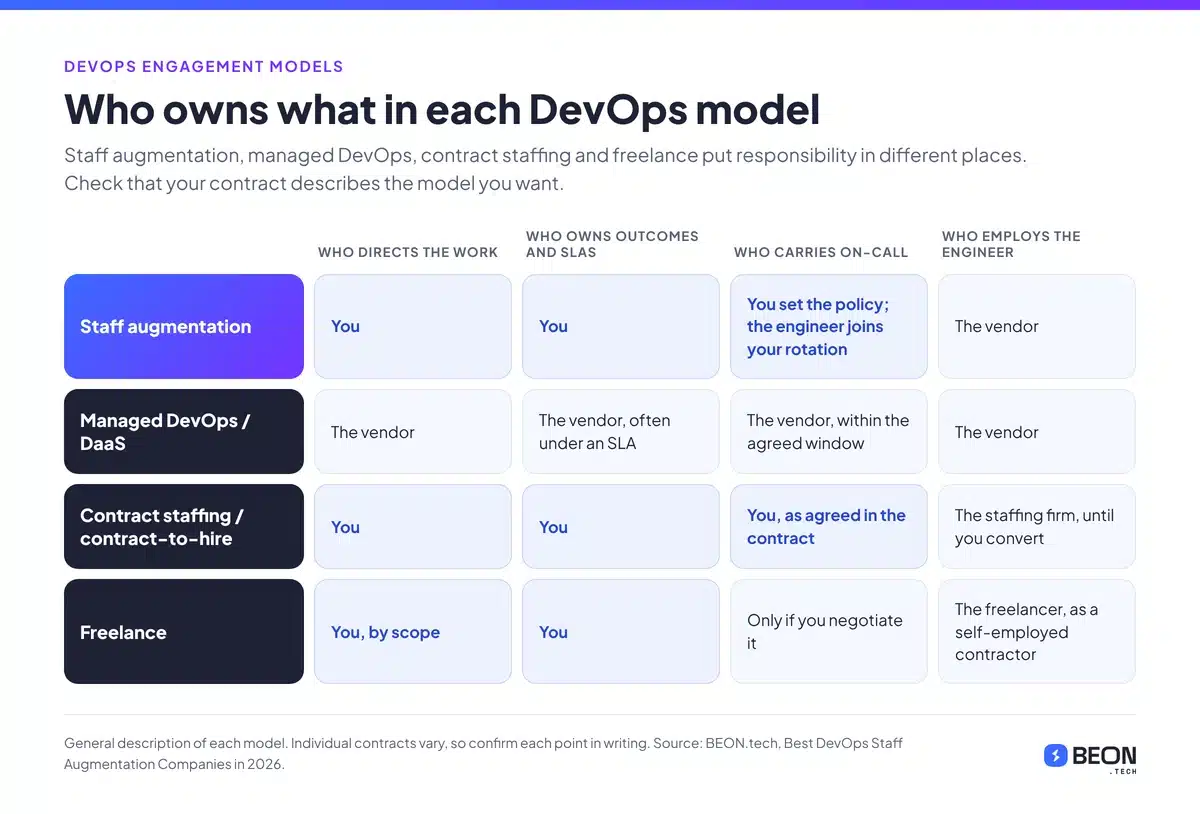
DevOps staff augmentation. An engineer joins your team and takes direction from your engineering leaders. You keep the outcomes, the architecture decisions and the on-call policy. The vendor handles employment, payroll and replacement. It works best when you already have a platform roadmap and simply need more hands to execute it.
Managed DevOps, or DevOps as a Service. The vendor owns defined outcomes, often under a service-level agreement. That could mean keeping pipelines green, running your Kubernetes platform or answering incidents within a set window. You manage a vendor relationship, not a person. It suits companies that don’t have DevOps leadership in-house.
Contract staffing and contract-to-hire. This is classic DevOps staffing. A staffing firm places a contractor for a fixed term, sometimes with an option to convert them to your payroll for a fee. This route makes sense when you need U.S.-based or onsite engineers, or want to work with someone before committing to a hire.
Freelance. You get an independent contractor, often part time and with other clients. It’s quick for a cloud migration or an infrastructure audit. Continuity is the weak point.
Several companies below sell more than one of these models. Before you sign, make sure the contract describes the model you actually want. Our comparison of staff augmentation vs. managed services goes deeper on the trade-offs.
The companies, grouped by model
DevOps specialists
MeteorOps
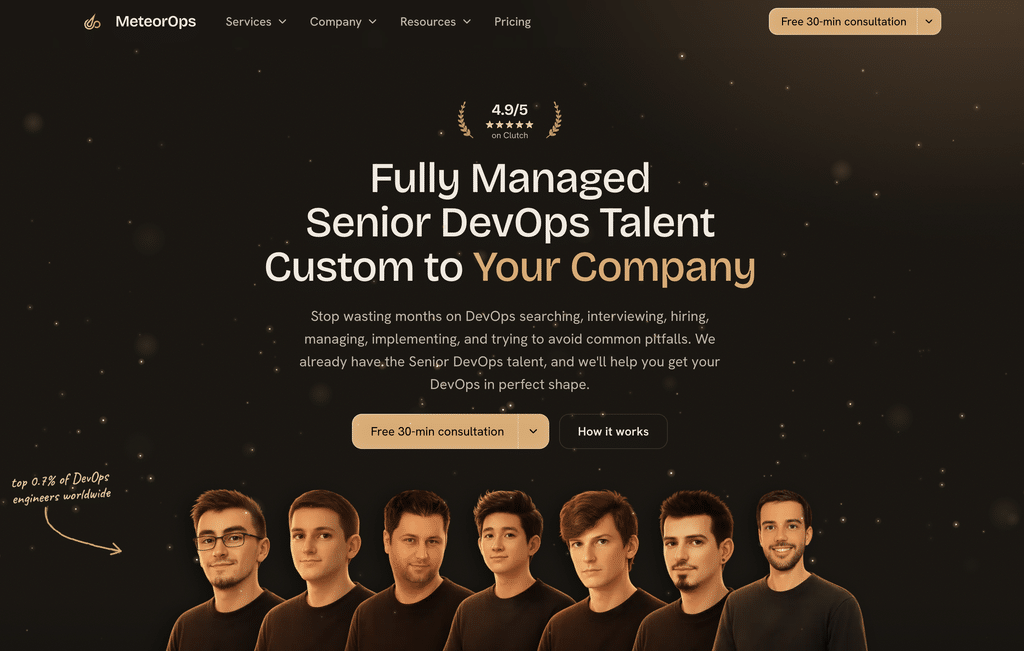
MeteorOps sells three hourly models:
- Advisory consulting.
- “Embedded Staff Augmentation”: a named engineer, billed monthly.
- Project work: drawn from an hours bank.
It advertises “no retainer, no lock-in.” Its pages cover Kubernetes, Terraform and Argo CD across the three major clouds, with separate pages for FinOps and SOC 2 work. The company publishes its acceptance funnel: seven engineers accepted out of 1,000 applicants.
Clients rate MeteorOps 4.9 from 13 reviews on Clutch and most often describe it as timely and professional. The single improvement we saw requested was more proactive recommendations. What the site leaves out is where its engineers are based and how they’re employed. Rates aren’t published either, and on-call is priced separately.
Opsfleet
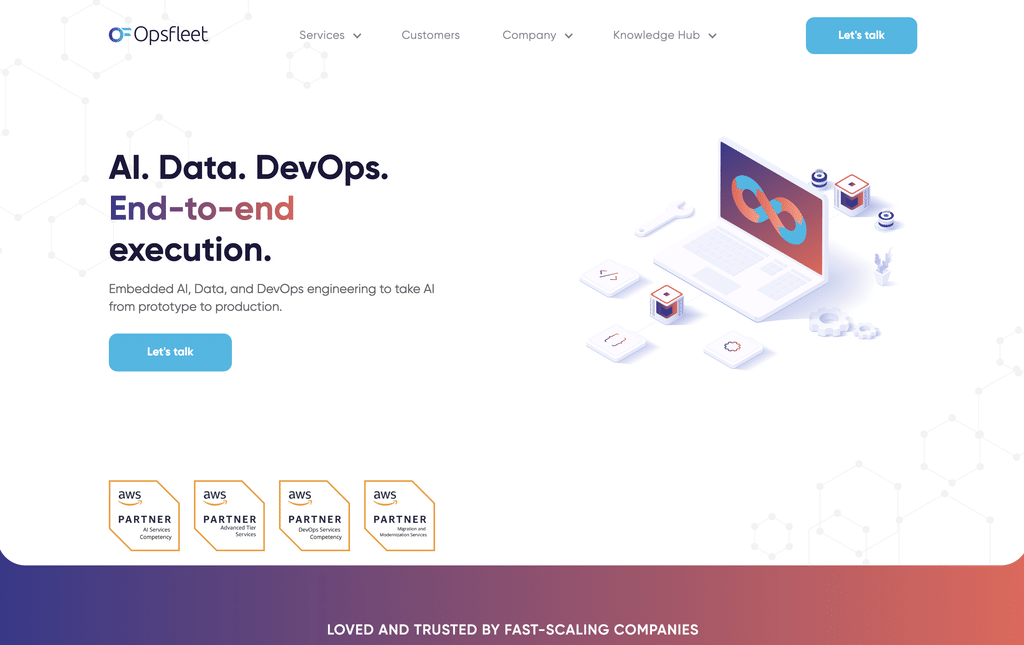
Opsfleet offers what it calls “DevOps as a Service”: a dedicated team lead plus an experienced DevOps engineer working inside your stack. Packages can shrink to “support-only” when things are quiet. That makes it closer to a fractional, managed model than to classic staff augmentation. The company is AWS-first and claims AWS Premier Tier Services Partner status, which you can verify in AWS’s partner directory.
There were no Clutch reviews when we checked. The site mentions “90+ engineers,” while Clutch lists two to nine employees, so ask for references and for who staffs after-hours support.
Nearshore staff augmentation in Latin America
BEON.tech
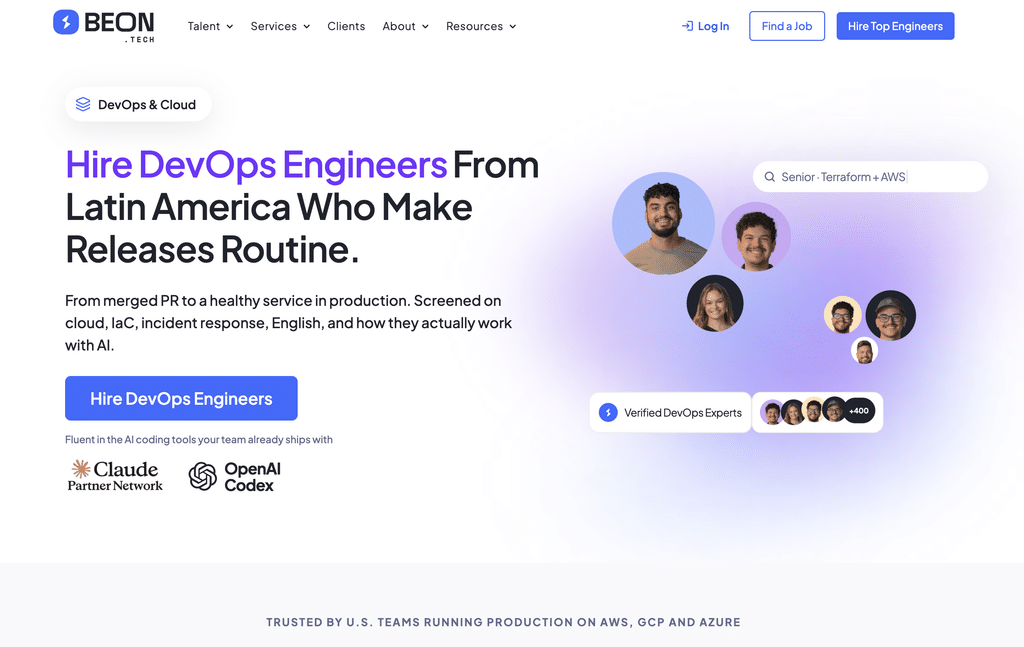
BEON.tech, the publisher of this guide, places full-time DevOps, platform, cloud and SRE engineers from Latin America into U.S. teams. It handles employment, payroll, benefits, equipment and compliance. Each engineer works with a Talent Experience Manager™ focused on retention.
BEON.tech publishes its DevOps vetting funnel:
- English and culture stage: 30% of engineers who enter the process clear it.
- Technical interview: 47% of those who reach it pass. It’s a single senior-led session with three parts:
- debugging a broken deployment or Terraform repo
- an architecture discussion
- a review of AI-generated Terraform and Helm for blast radius and cost
Shortlists arrive with the interview scorecard and the recording. BEON.tech says 88% of the engineers it places are still on the team after a year.
Senior engineers cost “$6,000–$8,000 per month,” all-inclusive, with no recruitment or replacement fees. The pricing page notes that a senior DevOps engineer from Brazil “reaches $8,000/month.” On Clutch, BEON.tech scores 4.9 from 70 client reviews. In the Tessitura engagement, its engineers containerized major portions of the client’s platform as part of a larger team build.
Best for U.S. teams that want full-time DevOps engineers working U.S.-aligned hours at a predictable cost. See BEON.tech’s DevOps engineers, and confirm the overlap hours for the engineer’s country and the on-call terms in writing.
ClickIT
ClickIT is based in Mexico and sells DevOps staff augmentation alongside DevOps consulting and AWS managed services. It covers EKS, AKS and GKE, Terraform, the common CI/CD tools and SRE roles. It also supports HIPAA, PCI, ISO 27001 and SOC 2 work, and its page says its engineers are “usually on an on-call schedule.”
The rate bands are published and “include benefits, taxes, and perks”: senior engineers at “US$7,000 to $9,000” a month and mid-level at US$6,000 to $7,500. That page is dated 2022, so ask for current numbers.
ClickIT has the most DevOps-specific review base on this list. Seven of the ten Clutch reviews we read (4.9 from 55) involved DevOps, CI/CD or AWS work. Reviewers praised communication and quality. A few mentioned slow proposal follow-up, or engineers who could have pushed back more.
BairesDev
BairesDev offers staff augmentation, dedicated teams and full outsourcing, and promises DevOps engineers “in your time zone.” Its DevOps page lists the expected stack: AWS, Azure and GCP, Kubernetes, Terraform and Pulumi, CI/CD, observability and security scanning. SRE, on-call and compliance aren’t mentioned, and neither are prices.
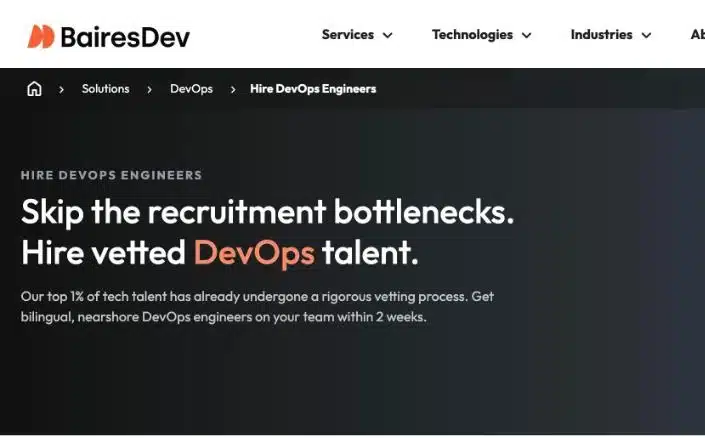
On Clutch it scores 4.9 from 63 client reviews. Reviewers credit talent quality and how well engineers fit into client teams. A few mention early churn or having to nudge the hiring process along. None of the reviews we read covered a DevOps-only engagement. Ask about minimum engagement size and the DevOps-specific vetting steps, which aren’t published.
Revelo
Revelo places pre-vetted Latin American engineers individually or as squads, on month-to-month terms with no cancellation penalty. Its DevOps page is unusually concrete about on-call. It mentions SLO dashboards, runbooks, IaC drift detection and secrets handling, and its list of responsibilities includes “own the on-call rotation alongside your team.”
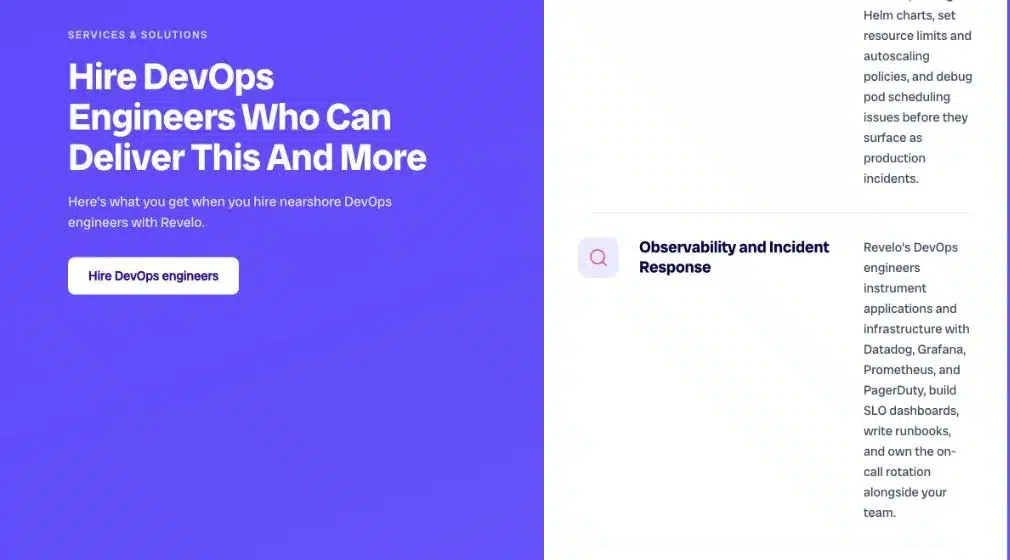
Pricing is published as all-in monthly bands: senior engineers at “$7,200–$10,700,” with a 14-day risk-free trial. One detail matters for on-call planning. Revelo’s FAQ says it acts as agent of record for independent contractors, with payroll through PEO infrastructure, so ask how after-hours work is compensated under that arrangement. Client reviews are thin: one on Clutch, and the G2 reviews we read came from talent.
Talent networks and marketplaces
Toptal
Toptal supplies freelance DevOps and SRE engineers on hourly, part-time or full-time terms, and also sells managed projects. It publishes a five-stage screening funnel that ends at the “top 3%,” claims matches in under 24 to 48 hours and offers a trial of up to two weeks. Rates aren’t published, though its Clutch profile lists a self-reported $100 to $149 an hour.
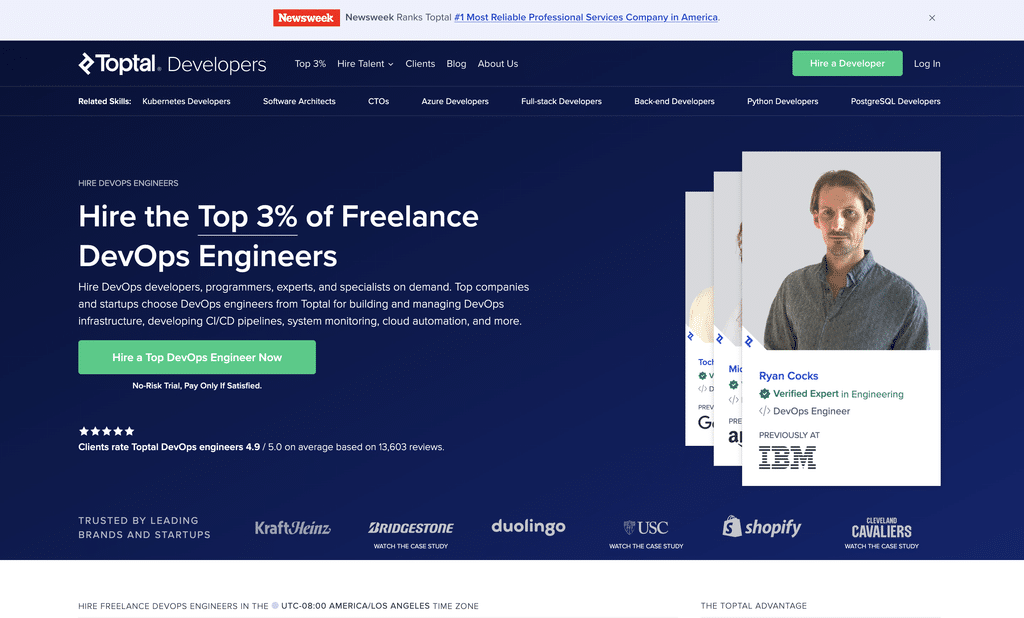
Clients rate Toptal 4.8 from 53 reviews on Clutch, and price was the most consistent complaint in the ones we read. One DevOps-specific review described a cloud migration that cut infrastructure spend roughly in half, while still scoring cost 3.5 out of 5. Time-zone overlap and on-call continuity have to be negotiated person by person.
Lemon.io
Lemon.io offers freelance DevOps engineers from Europe and Latin America, either full time at 40 hours a week or on contract. It publishes an average senior rate of “$61/hr,” within a range of $61 to $80. It offers a paid trial of up to 20 hours and promises two or three matched candidates within 24 to 48 hours.

Its Trustpilot score is 4.5 from 272 reviews, and the ones we read were positive about matching speed. On Clutch it effectively has one review. If a European profile catches your eye, check how many hours actually overlap with your team.
U.S. IT staffing firms
KORE1
KORE1, based in Irvine, California, adds senior DevOps engineers through monthly contract “capacity blocks,” contract-to-hire or direct hire. Its pricing is the most transparent on this list.
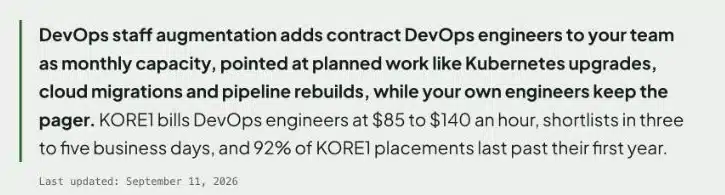
- Billing: DevOps engineers bill at “$85 to $140 an hour,” which KORE1 puts at roughly $14,700 to $24,200 a month.
- Conversion fees: 20% of first-year base salary before 800 billable hours, 15% after that, and none from hour 1,040.
KORE1’s on-call guidance is also the most concrete we found. The augmented engineer shadows a full rotation before taking secondary, and the client keeps primary. Clutch shows 4.9 from five reviews. The site doesn’t say where its engineers are based, so ask.
Insight Global
Insight Global is a large U.S. staffing firm with more than 70 offices. It places DevOps engineers, SREs and cloud engineers on contract, contract-to-permanent or direct-placement terms, including onsite and hybrid roles. It says it typically screens candidates “in 24-48 hours,” promises a DevOps developer “in 14 days or less,” and tells clients “Don’t pay a dime until you hire.” Rates aren’t published, and there were no Clutch reviews when we checked.
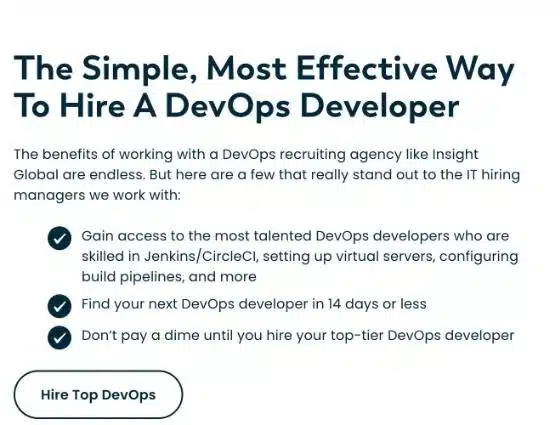
The DevOps page describes recruiter screening rather than a technical assessment. Ask how candidates are tested on infrastructure work before you see them.
Not included. Turing’s DevOps hiring page now shows an AI expert-network page with no DevOps content. We also found no client-facing DevOps offering page for Smoothstack or Motion Recruitment.
Put on-call, access and offboarding in the contract
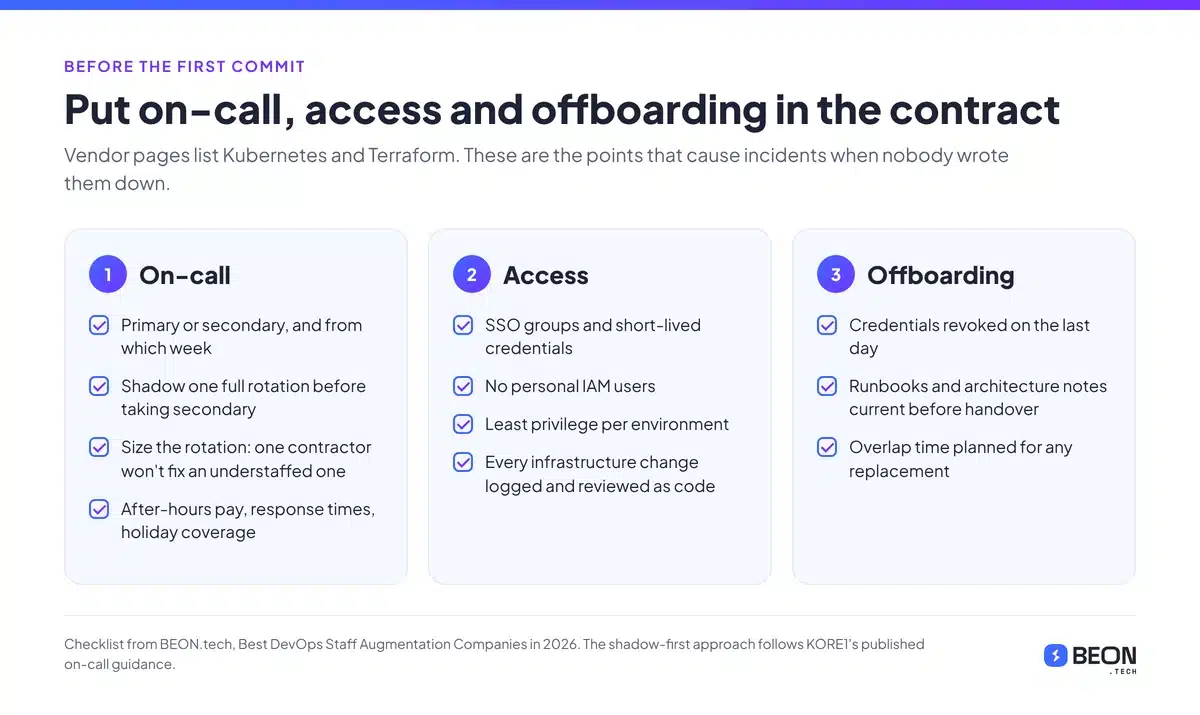
Every vendor page lists Kubernetes and Terraform. Almost none of them covers the parts that actually cause incidents. Settle these points in writing before the engineer’s first commit.
On-call
- Decide whether the augmented engineer will be primary or secondary on call, and from which week.
- KORE1’s approach is a sensible default: shadow one full rotation first, then take secondary.
- Size the rotation honestly. Adding one contractor won’t fix an understaffed one. KORE1 cites the Google SRE book’s floor of eight engineers for a sustainable single-site rotation.
- Agree on after-hours pay, response times and holiday coverage. Public holidays in Latin America and Europe don’t match U.S. ones. If you need dedicated reliability work, our page on site reliability engineers covers what that role adds.
Access
- Use SSO groups and short-lived credentials. Don’t create personal IAM users.
- Grant least privilege per environment.
- Log every infrastructure change.
- Require reviewed pull requests for anything written as code.
Offboarding
- Revoke credentials on the last day, not the week after.
- Make sure runbooks and architecture notes are current before handover.
- Plan any replacement with overlap time between the two engineers.
Our guide to what to put in a staff augmentation contract has the full checklist.
How to vet a DevOps engineer, whichever vendor you use
Every DevOps résumé lists the same tools. A short live exercise separates people who operate them from people who understand them.
Give the candidate something broken: a failing deployment, a pod stuck in CrashLoopBackOff, or a Terraform plan that would quietly destroy a production database. Then watch how they narrow down the cause. Ask how they’d structure environments and pipelines for several teams, and what they’d deliberately leave out. Because many teams now draft Terraform and Helm with AI tools, have them review a generated change for blast radius, security and cost. Finally, ask for a two-line incident update written for non-engineers while the incident is still open.
Define the profile first, though. A platform engineer, an SRE and a cloud migration specialist are three different hires, and our DevOps engineer job description helps you tell them apart.
How much DevOps staff augmentation costs in 2026
Start with the U.S. benchmark. Levels.fyi reports median total compensation of $154,500 for DevOps engineers in the U.S., with the 25th percentile at $120,000, the 75th at $190,000 and the 90th at $228,000. Glassdoor puts median total pay at $146,000 a year. The Bureau of Labor Statistics doesn’t track DevOps separately; its May 2025 median for software developers was $135,980. All three were checked October 19, 2026.
Here is what the companies above publish:
| Company | Published rate | Notes |
|---|---|---|
| KORE1 | $85–$140/hr (about $14,700–$24,200 a month, per KORE1) | U.S.-based staffing firm |
| Toptal | Not published (Clutch lists $100–$149/hr, self-reported) | Freelance |
| Lemon.io | $61/hr average ($61–$80) | Freelance, Europe and LatAm |
| Revelo | $7,200–$10,700/mo, senior, all-in | Latin America |
| ClickIT | $7,000–$9,000/mo, senior (page dated 2022) | Mexico and LatAm |
| BEON.tech | $6,000–$8,000/mo, senior, all-inclusive | Latin America |
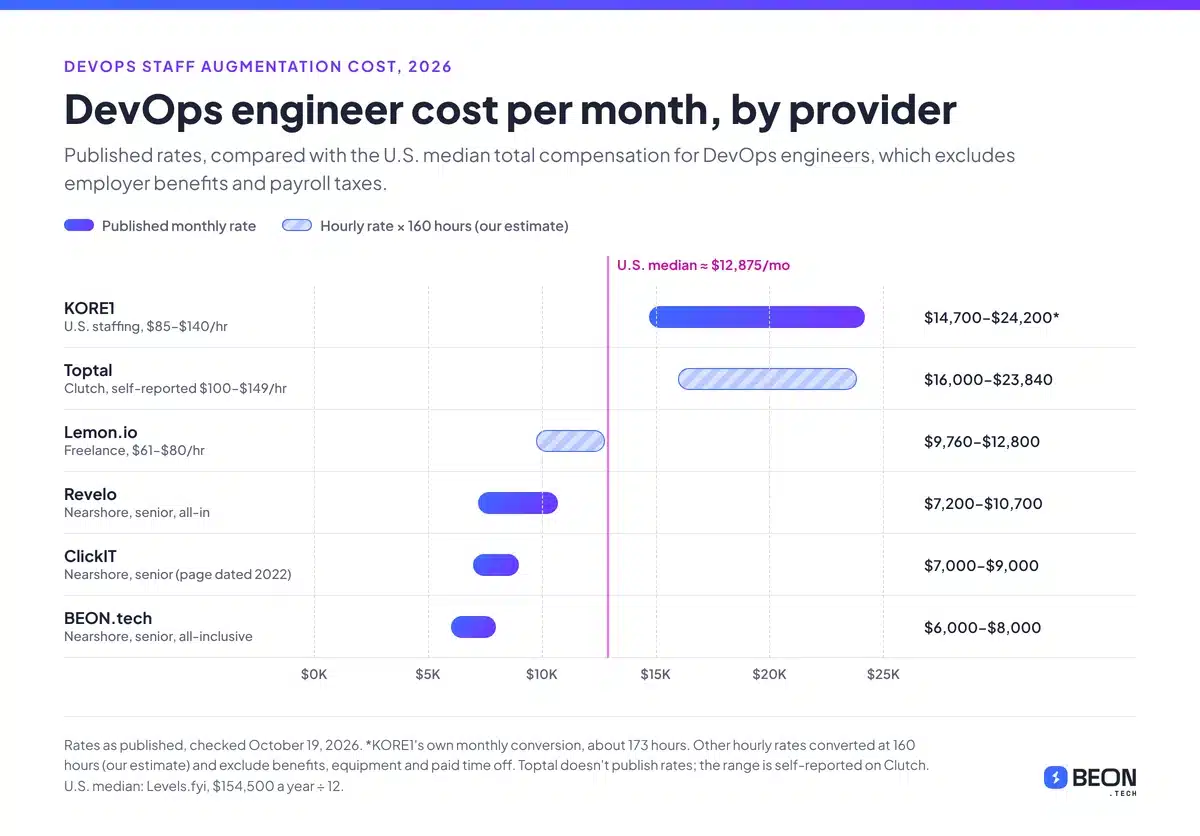
Two cautions when you line these up. First, an hourly rate multiplied by monthly hours isn’t the same thing as an all-inclusive monthly rate. KORE1’s own monthly figures, for instance, assume about 173 hours. Ask whether benefits, equipment, paid time off and replacement are included. Second, after-hours and on-call coverage is often billed separately, so ask for it by name.
How we evaluated these companies
We included only companies with a current, explicit DevOps offering page, and excluded those whose pages no longer describe one. For each company, the model, capabilities, on-call stance and pricing come from its own pages. Reputation comes from Clutch, G2 and Trustpilot, where we read review text and noted when reviewers were talent rather than clients. Every check was made on October 19, 2026.
The companies are grouped by model rather than ranked. Clutch lists minimum project sizes of $50,000 or more for several of them, including BEON.tech, BairesDev and Toptal. Those minimums describe project engagements and may not apply to individual placements. BEON.tech publishes this guide and is described with the same criteria and sources as the others.
FAQ
What Is DevOps Staff Augmentation?
Is Staff Augmentation or Managed DevOps the Better Choice?
How Much Does DevOps Staff Augmentation Cost?
Can an Augmented DevOps Engineer Be on Call?
The bottom line
The right choice depends on what you need:
- A full-time DevOps engineer working your hours at a predictable cost: compare the nearshore firms.
- Senior, flexible or fractional capacity: a DevOps specialist will fit better.
- U.S.-based or onsite engineers, or a trial before you hire: a U.S. staffing firm.
Whichever you choose, settle on-call, access and offboarding before the engineer touches production.
If full-time DevOps engineers from Latin America fit your team, book a discovery call with BEON.tech and review profiles together with their interview scorecards. For a broader view across roles, see our roundup of LatAm staff augmentation companies.