
 Argentina
 Brazil
 Mexico
 Colombia

An Employer of Record (EOR) is a company that legally employs workers in another country on your behalf. It handles payroll, taxes, benefits and local labor law, while you manage the person’s day-to-day work. It’s the fastest way to hire full-time employees abroad without opening a legal entity there.
For US tech companies hiring in Latin America, an EOR solves the legal side of hiring. It doesn’t find, vet or retain engineers for you. At BEON.tech, we talk with engineering leaders every week who start by looking for an EOR and realize they also need help with the hiring itself.
In this guide, we explain how an EOR works, what it costs, how it compares with a PEO, contractors and staff augmentation, and when each option makes sense.
What Is an Employer of Record (EOR)?
An Employer of Record is a third-party organization that becomes the legal employer of your workers in a given country. The EOR signs the employment contract, runs payroll and assumes the legal obligations of an employer, while your company directs the work.
In practice, the worker joins your team, uses your tools and reports to your managers. The EOR only appears on the legal and administrative side: contracts, salaries, taxes, benefits and, if needed, termination.
How Does an Employer of Record Work?
Hiring through an EOR usually follows four steps:
- You find the candidate. You source, interview and choose the person you want to hire.
- The EOR signs the contract. It issues a local employment contract that complies with the country’s labor law.
- The EOR runs payroll and benefits. Every month, it pays the salary, withholds taxes, makes social security contributions and manages benefits.
- You manage the work. The employee works for you full time, and you invoice the EOR for salary, employer costs and its fee.
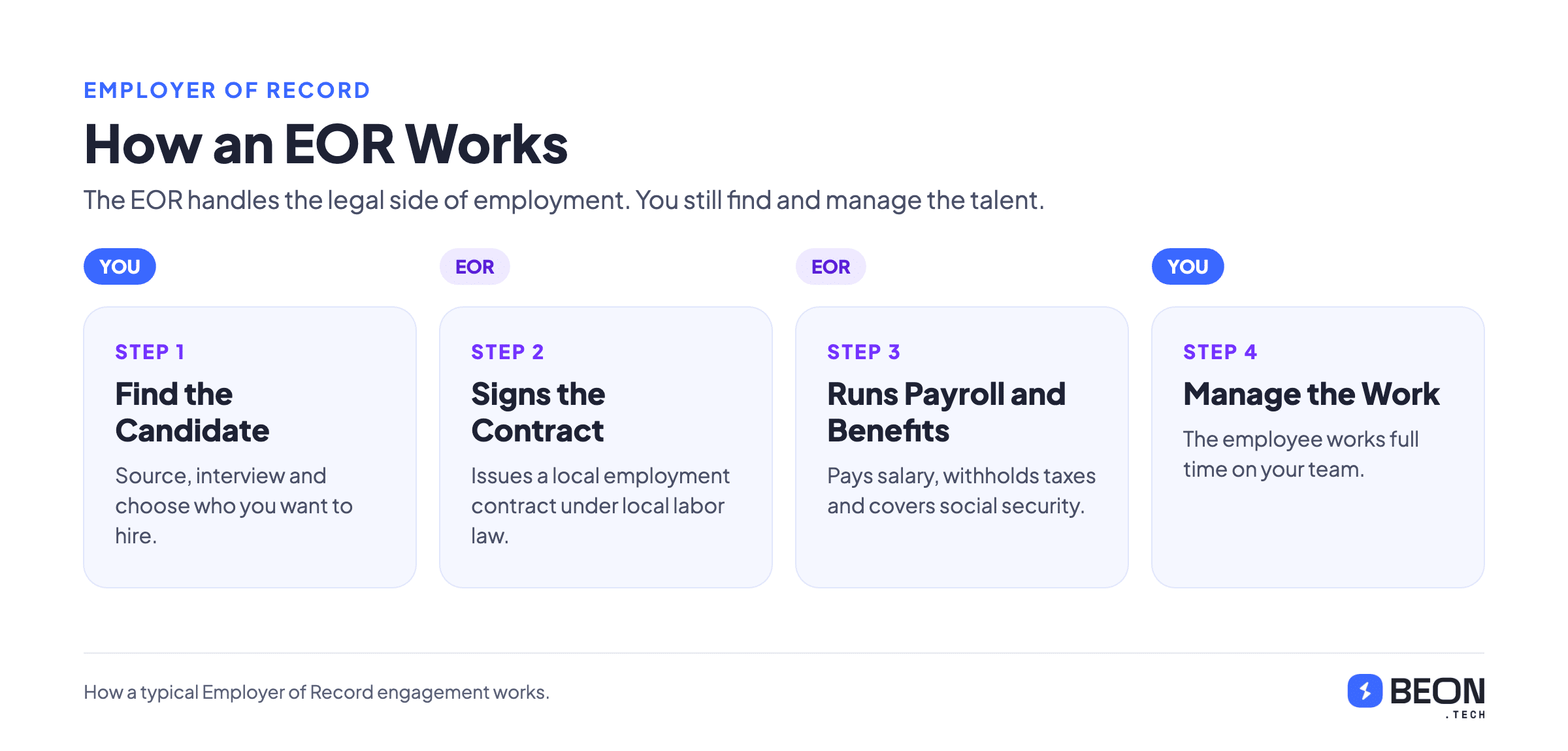
The first step is the one most companies underestimate. An EOR makes hiring legal, but it doesn’t make it easier to find and vet senior engineers.
What an EOR Handles and What You Still Own
An EOR takes on the employer’s legal responsibilities:
- Local employment contracts.
- Payroll processing and tax withholding.
- Social security and mandatory benefits.
- Compliance with local labor law.
- Paid leave, terminations and offboarding.
Your company still owns everything related to the work itself:
- Sourcing, interviewing and selecting candidates.
- Onboarding, daily management and performance.
- Career growth, engagement and retention.
- Equipment, tools and access to your systems.
That split matters when you compare an EOR with other hiring models. With an EOR, finding the right engineer is still your job.
Benefits of Using an EOR in Latin America
For US companies hiring a few people in the region, an EOR offers five clear advantages:
- Compliance with local labor law. Each Latin American country has its own rules on contracts, benefits and terminations, and the EOR applies them for you.
- No legal entity needed. Opening a subsidiary takes months and involves legal, accounting and tax setup costs. An EOR lets you hire in weeks instead.
- Local expertise. EOR providers know each market’s employment practices, which speeds up contracts, onboarding and payroll.
- Flexibility to test new markets. You can hire in a country without a long-term commitment and scale up or down as your plans change.
- A path to your own entity. If your team grows, you can open an entity later and transfer employees from the EOR to it.
How Much Does an Employer of Record Cost?
The cost of an EOR has two parts: the EOR’s service fee and the mandatory employer contributions of each country.
EOR service fees are usually a flat monthly amount per employee. Budget providers start around $199, while most of the largest platforms list $599 to $699 per month. On top of that, you pay the employer costs that local law requires, which in Latin America typically add about 30% to 50% to the base salary:
| Country | Extra employer cost (approx.) | Main obligations |
|---|---|---|
| Brazil | About 50% | Social security (INSS, 20% with no cap), FGTS severance fund (8%), work accident insurance, third-party contributions, 13th salary and vacation bonus |
| Argentina | About 40%–50% | Social security and health insurance (24%–26.4%), labor risk insurance and the 13th salary (aguinaldo) |
| Mexico | About 30%–40% | IMSS social security, INFONAVIT housing fund (5%), retirement savings, state payroll tax, aguinaldo and vacation premium |
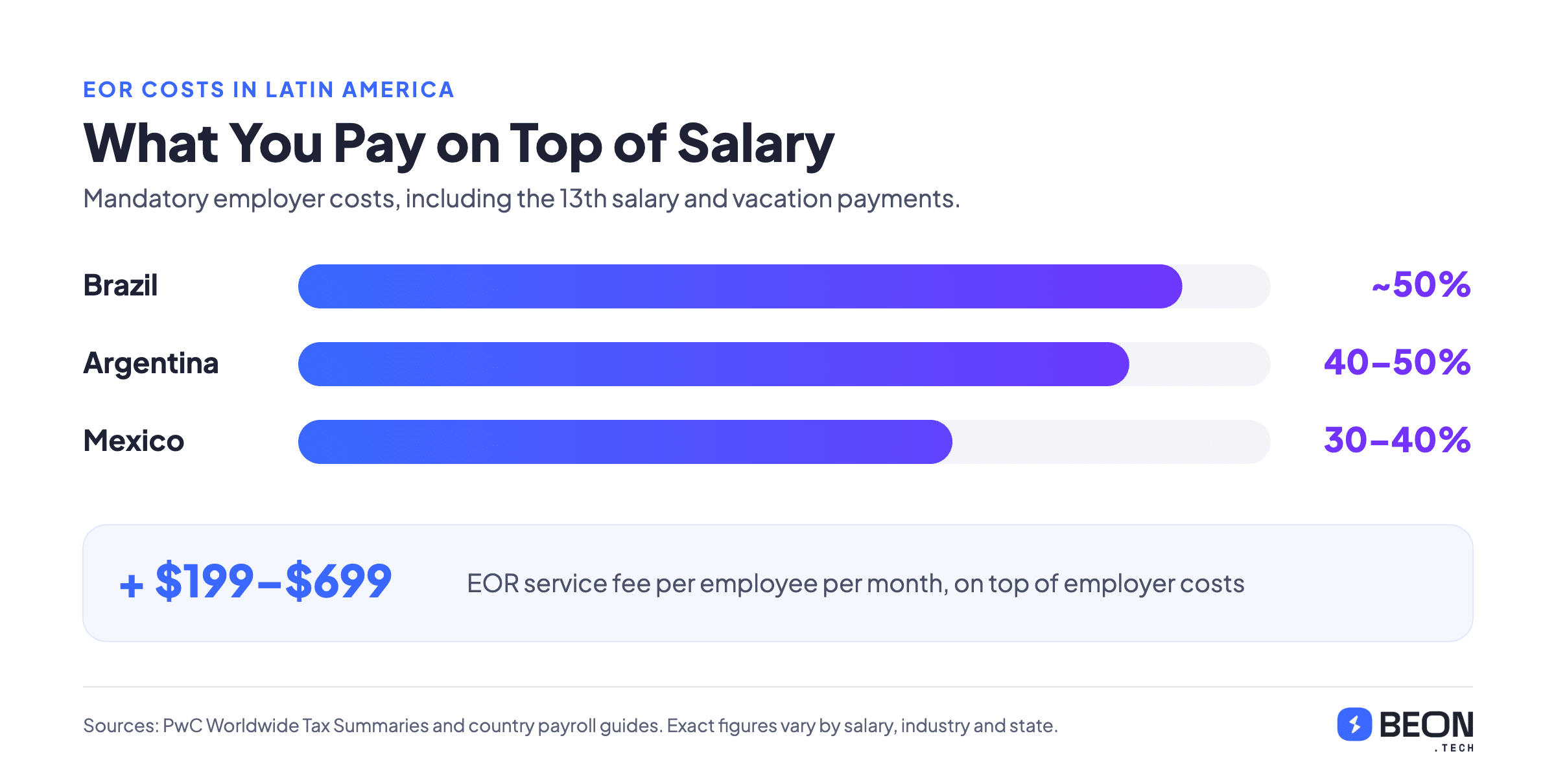
The statutory contribution rates come from PwC Worldwide Tax Summaries, and the totals add the mandatory 13th salary and vacation payments. They don’t include equipment, recruiting or the time your team spends hiring, and the exact figure changes with salary level, industry and, in Mexico, the state.
EOR vs. PEO vs. Contractors vs. Staff Augmentation
An EOR is one of four common ways to work with engineers in other countries. Each one shifts who carries the legal risk and who does the hiring:
| Model | Who employs the worker | Who finds and vets talent | Best for |
|---|---|---|---|
| Employer of Record (EOR) | The EOR | You | Hiring specific people abroad without an entity |
| PEO | You and the PEO (co-employment) | You | Companies that already have a local entity |
| Independent contractors | Nobody, they are self-employed | You | Short, defined projects |
| Staffing agency (recruitment only) | You, or an EOR you hire separately | The agency | Filling roles when you already have a way to employ people |
| Staff augmentation | The staffing partner | The staffing partner | Building engineering teams fast, with vetting included |
The main difference between an EOR and a PEO is the legal entity: a PEO requires you to have one in the country, while an EOR doesn’t. That’s why the PEO vs. EOR decision usually depends on how established you already are in a market.
Some companies combine the two halves: a staffing agency finds the candidates and an EOR employs them. Staff augmentation brings both into one model, with one partner and one contract for sourcing, vetting, employment and retention.
When Does an EOR Make Sense?
An EOR is a good fit when you already know who you want to hire and only need a legal way to employ them:
- You found the candidate yourself and need to make them a full-time employee abroad.
- You’re testing a new country before deciding whether to open an entity.
- You need full-time employees, not contractors, for compliance or retention reasons.
- You’re hiring a few people in several countries, where opening entities wouldn’t pay off.
If you also need help finding and vetting engineers, an EOR covers only half the problem. Comparing EOR with traditional hiring models helps you see which costs and responsibilities stay with your team.
Risks and Limitations of Using an EOR
An EOR removes most of the legal risk of hiring abroad, but it doesn’t remove every limitation:
- You still carry the hiring risk. If the person isn’t the right fit, the EOR doesn’t replace them.
- Costs grow with the team. Fees and employer contributions scale with every new hire.
- Retention isn’t part of the service. Engagement, growth and career paths remain your responsibility.
- Some situations still need local advice, like protecting intellectual property or long-term operations in one country.
The alternative many companies try first, hiring everyone as independent contractors, carries its own risk. When a contractor works like a full-time employee, it can count as misclassification. The IRS explains how it separates contractors from employees in the US, and Latin American countries apply similar tests under their own labor laws.
EOR vs. Staff Augmentation for Tech Teams in Latin America
For tech teams, the real comparison is often EOR vs. staff augmentation. An EOR handles employment. Staff augmentation handles employment and the hiring itself.
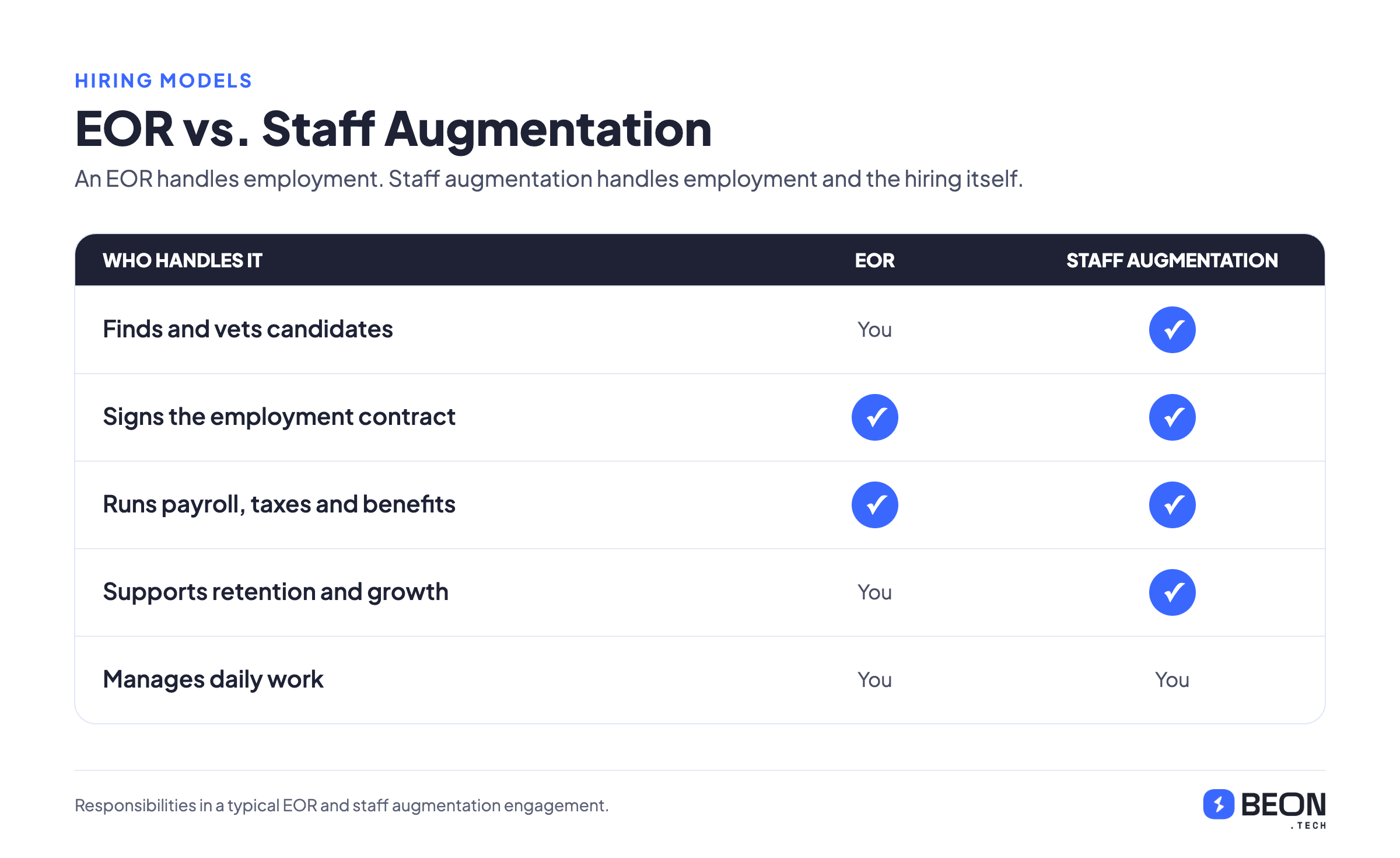
With staff augmentation, the partner sources and vets engineers, employs them under local law, runs payroll and benefits, and supports retention over time. You still manage the engineer’s daily work, just as you would with an EOR. At BEON.tech, a senior engineer costs $6,750–$9,100 a month, all-inclusive, with compliance, payroll, benefits and equipment covered.
That’s why many US companies that hire Latin American developers skip the EOR step: when you don’t have the candidates yet, a partner that finds and employs them saves months of hiring work.
Do You Need an EOR or a Staffing Partner?
If you already have the person you want to hire, an EOR is usually enough. It gives you a legal, compliant way to employ them without opening an entity.
If you still need to find senior engineers, an EOR solves only the paperwork. A staffing partner handles the search, the vetting, the employment and the retention in one model.
Need to build your engineering team in Latin America? Learn how IT staff augmentation with BEON.tech gets you pre-vetted engineers on your team in under two weeks, with compliance included.