
 Argentina
 Brazil
 Mexico
 Colombia

An AI engineer builds and runs the AI features inside a product. They take models that already exist, like large language models, and turn them into features that work reliably in production: a support assistant, a document search tool, an agent that completes tasks inside your app.
That makes the role different from a machine learning engineer, who trains and tunes models, and from a data scientist, who analyzes data to answer business questions. At BEON.tech, we vet AI engineers for US engineering teams every week, and the strongest ones are the engineers who think like product developers first.
In this guide, we cover what an AI engineer does day to day, how the role compares with similar ones, which skills matter most, and how to tell when your team needs one.
What Is an AI Engineer?
An AI engineer is a software engineer who specializes in building applications on top of AI models. Most of their work is integration, not research: connecting models to your data, your product and your users, and making sure the result is accurate, fast, safe and affordable.
The role has grown fast. AI engineer was the fastest-growing job title in the US in LinkedIn’s Jobs on the Rise 2026 report, as companies moved from AI experiments to AI features their customers use every day.
What Does an AI Engineer Do Day to Day?
An AI engineer’s work goes from choosing the right model to keeping it reliable once real users depend on it. These are the responsibilities you’ll see in almost every AI engineering role:
- Integrating models into the product: connecting LLM APIs or open-source models to your backend, your frontend and your existing services.
- Designing prompts and context: structuring the instructions, examples and data the model receives so it answers consistently.
- Building retrieval pipelines: setting up retrieval-augmented generation (RAG) so the model answers with your own documents and data, not only with what it learned in training.
- Building agents and tool use: letting the model call APIs, query databases or complete multi-step tasks inside your app.
- Evaluating quality: creating test sets and metrics to measure accuracy, catch hallucinations and compare models before each release.
- Running AI in production: monitoring cost, latency and errors, and adjusting the system as usage grows.
- Protecting data and users: adding guardrails against prompt injection, data leaks and unsafe outputs.
One of the most important decisions an AI engineer makes is how to adapt a model to your use case. Choosing between RAG, fine-tuning and agents changes the cost, the accuracy and how much data your team needs to prepare.
AI Engineer vs. ML Engineer vs. Data Scientist
The three roles work with AI, but they solve different problems. Hiring the wrong one is one of the most common mistakes companies make when they start building with AI. Each one works at a different level of the layers of an AI system, from data and models to the product your users see.
| AI engineer | ML engineer | Data scientist | |
|---|---|---|---|
| Main focus | Building products on top of existing models | Training, tuning and deploying models | Analyzing data to answer business questions |
| Typical output | AI features in production, like assistants, search and agents | Trained models and ML pipelines | Insights, forecasts and experiments |
| Core skills | Software engineering, LLM APIs, RAG, evaluation | Statistics, model training, MLOps | Statistics, SQL, data analysis |
| When to hire | You want to ship AI features to users | You need custom models trained on your data | You need better decisions from your data |
If your goal is to add AI features to a product, you usually need an AI engineer first. An ML engineer becomes necessary when off-the-shelf models aren’t enough and you need to train your own.
Skills to Look For in an AI Engineer
A strong AI engineer is a strong software engineer first. The AI-specific skills only pay off when they sit on top of solid engineering habits.
Technical skills:
- Python, and often TypeScript, for backend and integration work.
- Experience with LLM APIs and open-source models.
- Frameworks for retrieval and agents, like LangChain or LlamaIndex, and vector databases.
- Evaluation methods to measure quality and catch regressions.
- Cloud infrastructure and deployment for production systems.
- Security practices for AI, including prompt injection and data privacy.
Product and team skills:
- Product sense to decide where AI adds value and where it doesn’t.
- Clear communication about what a model can and can’t do.
- The judgment to pick the simplest solution that works.
The tools change every few months, so the AI engineer tech stack matters less than how fast a candidate learns and evaluates new tools.
When Does Your Team Need an AI Engineer?
Not every team needs a dedicated AI engineer on day one. These are the signals that it’s time to hire one:
- AI is on your product roadmap, not just in internal experiments.
- Your prototypes work in demos but fail with real users, because of inconsistent answers, slow responses or high costs.
- Your developers spend more time debugging prompts than building features.
- You need AI to work with your own data, like documents, tickets or product content.
- Customers or compliance teams ask how your AI handles data and errors.
If you’re still exploring whether AI fits your product, an experienced developer with AI skills may be enough. Once AI becomes part of what you sell, you need someone who owns it, or a team built around AI engineering.
How AI Engineers Fit Into Your Engineering Team
AI engineers rarely work alone. They sit inside the product team, close to backend engineers, designers and product managers, and they often work with other AI roles as the team grows:
- ML engineers train or fine-tune models when off-the-shelf ones aren’t enough.
- MLOps engineers build the pipelines and infrastructure to deploy and monitor models at scale.
- AI architects design how AI fits into the overall system and set standards across teams.
- Forward deployed engineers work directly with customers to adapt AI products to their workflows.
For most companies, the first hire is an AI engineer, and the other roles come later. A forward deployed engineer usually joins once the product is already in customers’ hands.
AI Engineering Talent in Latin America
Latin America has become one of the main sources of AI engineering talent for US companies. In 2026, more than 24,000 engineers entered BEON.tech’s hiring pipeline, and 79% of those who reached our technical interview already used AI tools in their coding workflow. Claude Code was the tool candidates mentioned most.
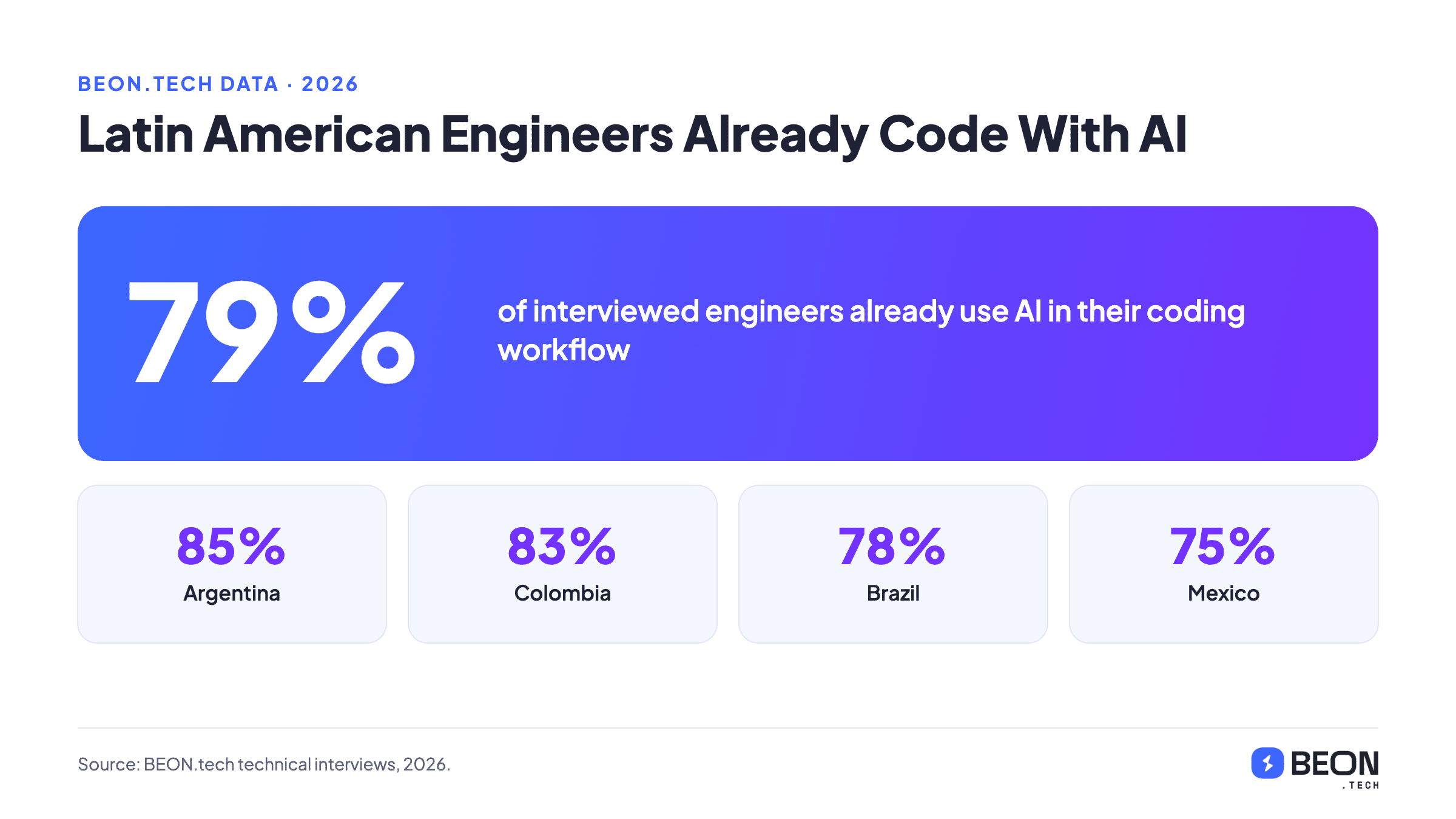
Argentina and Colombia led the region, with 85% and 83% of candidates using AI. Because these engineers work in US time zones, they can join daily standups, pair with your team and iterate on AI features in real time, which is why nearshore AI talent is a practical option for teams that want to move fast without US-level costs.
Is It Time to Add an AI Engineer to Your Team?
If AI is part of your product roadmap, the answer is probably yes. An AI engineer is the person who turns models into features your customers can trust, and the gap between a demo and a reliable product is where most AI projects stall.
Ready to build your AI team? Hire AI engineers from Latin America through BEON.tech, and get pre-vetted, AI-native profiles within 24 hours.