
 Argentina
 Brazil
 Mexico
 Colombia

An engagement model defines how you get engineering capacity: who employs the engineers, who directs their work, who owns the result and how you pay. The seven most common are staff augmentation, dedicated teams, project-based outsourcing, contract-to-hire, managed services, consulting and freelancers, with in-house hiring as the baseline.
The short answer: if you already have a team that ships and a roadmap that keeps changing, staff augmentation gives you the most control per dollar. If you need a full unit with its own lead, look at a dedicated team. If the scope is fixed and has a clear end, project-based outsourcing fits.
This guide compares each model by control, yearly cost and risk, based on how BEON.tech structures these engagements with US engineering teams every week.
What Is an Engagement Model in Software Development?
Think of an engagement model as the operating system of a working relationship. It answers a few practical questions:
- Who writes the tickets and sets priorities.
- Who reviews the code and owns the result.
- Who is accountable when a deadline slips or an engineer leaves.
- What happens, and what it costs, when priorities change.
The answers change with the model, and so does the price. A model that works for a one-off build can slow down a product team that ships every week, and the reverse is also true.
7 Engagement Models Compared
The table shows the main trade-offs at a glance, with in-house hiring as a reference point.
| Model | Who directs the work | Pricing | Main risk | Best for |
|---|---|---|---|---|
| Staff augmentation | You | Monthly rate per engineer | Needs managers with time to lead | Adding capacity to a team that already ships |
| Dedicated team | The partner’s lead, with your goals | Monthly rate per team | Knowledge builds up outside your team | A new product or workstream |
| Project-based outsourcing | The vendor | Fixed price or time and materials | Change requests are slow and costly | A defined build with a clear end |
| Contract-to-hire | You | Monthly rate during the contract | Strong candidates may prefer a permanent offer | Testing a new role |
| Managed services | The vendor | SLA-based fee | Low visibility and hard to switch | Stable, non-core functions |
| Consulting | The consultants | Hourly or per engagement | Knowledge leaves with them | A decision or a plan |
| Freelancers | You | Hourly or per task | Availability and misclassification risk | Short, self-contained tasks |
| In-house hire | You | Salary, benefits and recruiting | Slow to hire, and retention is on you | Core, long-term roles |
Types of Engagement Models in Software Development
The first four models cover most product teams. The last three solve more specific needs.
Staff Augmentation
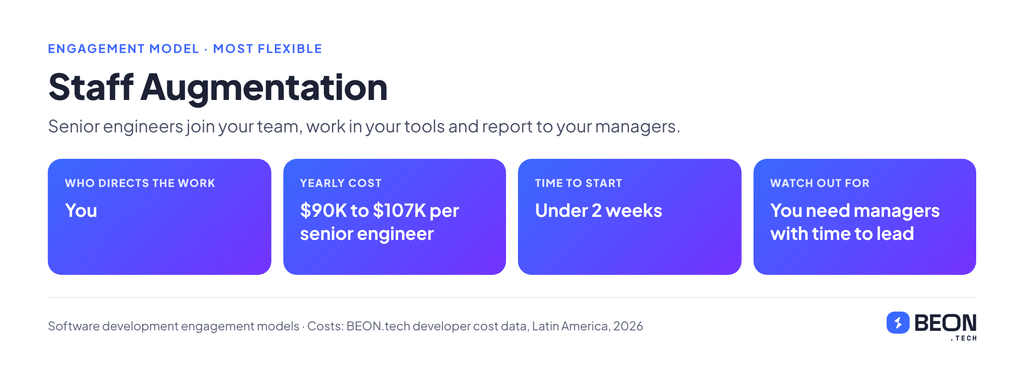
With staff augmentation, you add external engineers to your own team. They work in your tools, follow your processes and report to your managers. The partner recruits them, employs them and handles payroll, benefits, compliance and replacement.
- Benefits: you keep full control of priorities and code, add senior engineers in under two weeks, and scale the team up or down as the roadmap changes.
- Drawbacks: you need managers with time to lead, and loose processes become visible quickly.
- When to use it: when you have a clear roadmap, a working engineering culture and more work than people.
It’s the most flexible model for teams that already ship. At Healthie, for example, BEON.tech engineers added through staff augmentation assess and route tickets from every other team across the platform, working as part of the company’s own engineering organization.
Dedicated Team
A dedicated team is a group of engineers the partner assembles for your company, usually with a lead who manages delivery day to day. You set goals and review progress, and the team decides how to get there.
- Benefits: you get a working unit, not just individuals, which suits new products when you don’t have the leadership to staff a team from scratch.
- Drawbacks: you have less say over daily decisions, and knowledge can build up in the partner’s team instead of yours.
- When to use it: when you need to open a new workstream and don’t have the managers to run it yet.
A dedicated development team also scales well. At a much larger size, the same idea becomes an offshore development center.
Project-Based Outsourcing
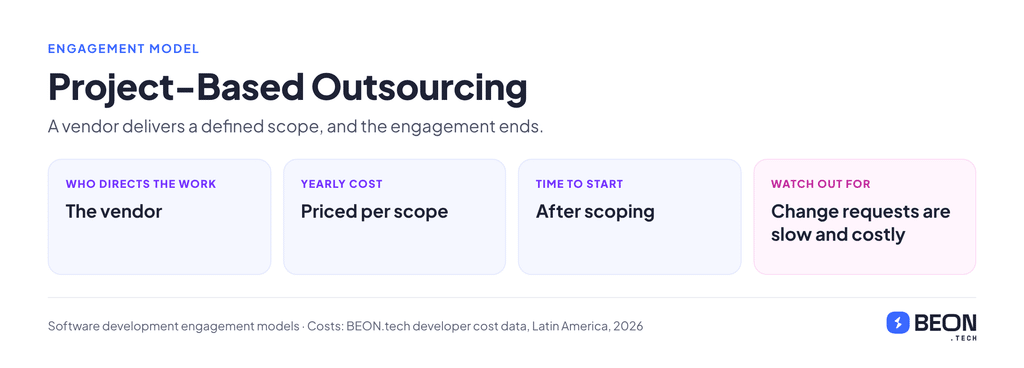
In a project-based model, the vendor takes a defined scope and delivers it. Pricing is usually fixed, or billed on time and materials against an estimate. Once the work ships, the engagement ends.
- Benefits: costs are predictable when the scope is stable, and your team stays focused on its own roadmap.
- Drawbacks: changes are slow and expensive once the contract is signed, you have little visibility into how the code is built, and the knowledge leaves when the vendor does.
- When to use it: for builds with clear requirements and a clear finish line, like a marketing site or an internal tool.
The key difference with staff augmentation is what you buy: staff augmentation vs. outsourcing comes down to buying capacity versus buying an outcome.
Contract-to-Hire
Contract-to-hire is a temporary contract with the option of a permanent offer at the end. The engineer works on your team for a trial period, and the company decides afterward whether to make the role permanent.
- Benefits: you see real work before you commit to a permanent role.
- Drawbacks: the terms of the final offer need to be clear from day one, and some strong candidates prefer a stable role from the start.
- When to use it: when the role is new and you’re unsure about the long-term fit.
For roles you already know you’ll need long term, staff augmentation usually gets you there faster, without a trial period or a hiring process to manage at the end.

Managed Services
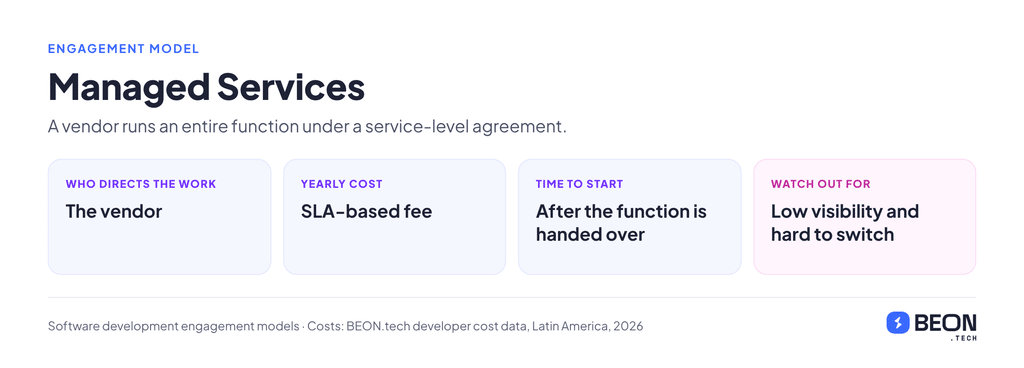
With managed services, a vendor takes ongoing responsibility for a function, like infrastructure, support or QA, under a service-level agreement. You pay for the service and its results, not for specific people.
- Benefits: predictable costs and no need to manage the work yourself.
- Drawbacks: little control over how the work is done and who does it, and switching vendors can be hard.
- When to use it: for stable, well-defined functions that aren’t core to your product.
The difference with adding engineers to your team is mostly about control: staff augmentation vs. managed services comes down to who owns the day-to-day decisions. For testing specifically, QA outsourcing is a common middle ground.
Consulting
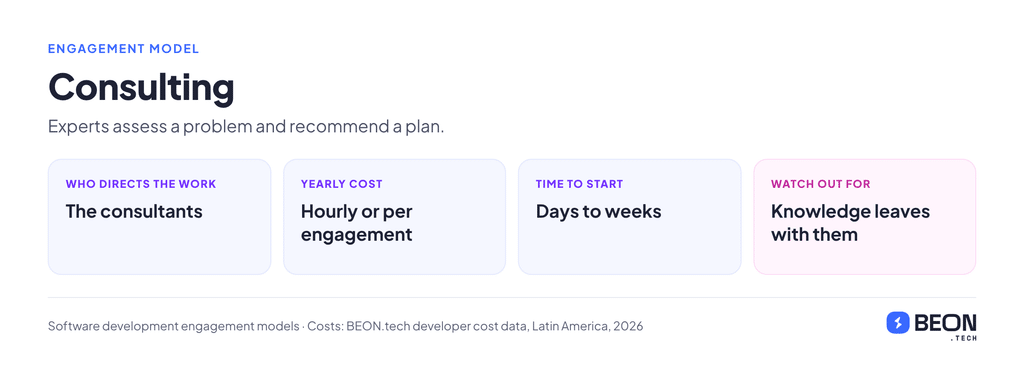
A consulting engagement brings in experts to assess a problem and recommend a solution, like an architecture review, a cloud migration plan or an AI strategy. Some consultants also implement, but the core value is advice.
- Benefits: fast access to specialized expertise for a specific decision.
- Drawbacks: high hourly rates, and the knowledge often leaves with the consultants.
- When to use it: when you need a decision or a plan, not ongoing delivery capacity.
Teams often confuse the two, but staff augmentation vs. consulting is a choice between someone who advises and someone who builds with you.
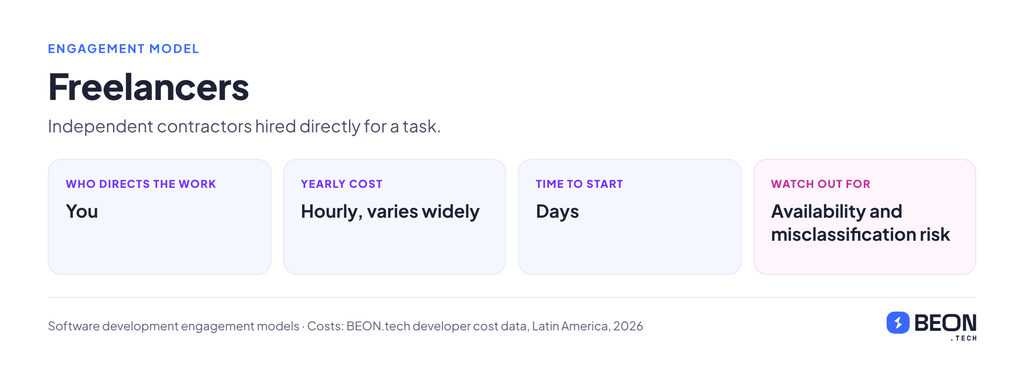
Freelancers
Freelancers are independent contractors you hire directly for a task or a period of time, usually through a marketplace or your own network.
- Benefits: fast to start, flexible and good for small, well-defined tasks.
- Drawbacks: they rarely work exclusively for you, availability can change without notice, and long-term arrangements can create misclassification risk.
- When to use it: for short, self-contained work that doesn’t need deep context on your product.
For product work that lasts months, the comparison between a dedicated engineer and a freelancer shows why senior developers increasingly prefer stable roles.
Engagement Model vs. Location: Onshore, Nearshore and Offshore
The engagement model and the location are two separate decisions. Staff augmentation can be onshore, nearshore or offshore, and so can a dedicated team or a project. The model defines control and accountability; the location defines cost, time zone overlap and how easily the team collaborates in real time.
For US teams that work in sprints, nearshore engineers in Latin America share most of the workday, which is why the choice between nearshore and offshore is often decided by overlap hours, not by rate alone.
Pricing Models: Fixed Price, Time and Materials and Monthly Rates
Besides the engagement model, the contract defines how you pay. Any model can use one of these three structures:
| Pricing model | How it works | Best for | Main risk |
|---|---|---|---|
| Fixed price | One price for an agreed scope | Small builds with stable requirements | Change requests are slow and expensive |
| Time and materials | You pay for hours worked at an agreed rate | Projects with evolving requirements | Costs can grow without clear tracking |
| Monthly rate per engineer or team | A fixed monthly fee per person or team | Ongoing product work | Paying for capacity you don’t use if priorities drop |
Fixed price only works when the scope truly is fixed. For product teams that iterate every sprint, a monthly rate is usually more predictable than it looks, because it removes change requests and renegotiations.
Staff Augmentation vs. Direct Hire
Direct hiring gives you a permanent employee, but it takes longer, requires a local entity or an Employer of Record abroad, and leaves recruiting, payroll, retention and replacement with your team.
Staff augmentation gets a senior engineer working in under two weeks, with employment and compliance handled by the partner. For most roles, it gives you a long-term engineer on your team with less risk and overhead than a direct hire. The trade-offs of IT staff augmentation vs. direct hire depend mostly on how fast you need the role filled and who you want carrying the retention risk.
If you want to hire engineers abroad directly, an Employer of Record (EOR) handles the legal employment for you. You still own recruiting, vetting, retention and replacement. That’s the main difference with staff augmentation: with an EOR, if an engineer leaves, you start over.
How Much Does Each Model Cost per Year?
The fairest comparison is the total yearly cost of having one senior engineer working on your product. These are typical figures for 2026:
| Model | Estimated yearly cost | What’s included |
|---|---|---|
| Staff augmentation (Latin America) | $90,000 to $107,400 per senior engineer | Recruiting, vetting, payroll, benefits, compliance, equipment and replacement |
| Dedicated team (Latin America) | $360,000 to $429,600 for four senior engineers | A team working as a unit around your goals |
| Contract-to-hire | A similar monthly rate during the contract | The engineer’s work during the trial period |
| Freelancers | Varies widely by rate and hours | Only the hours worked; vetting, coordination and gaps are on you |
| US in-house hire | About $232,000 in year one | Salary, benefits and recruiting; equipment and ramp-up come on top |
| Project-based, managed services and consulting | Varies by scope, SLA or engagement | Priced per deliverable or service, not per engineer |
The Latin America figures come from BEON.tech’s developer cost calculator for senior backend, full stack, DevOps and data roles in Mexico, Colombia, Brazil and Argentina. Specialized roles like AI engineers or Ruby on Rails developers can reach about $126,600 a year.
The US figure starts from the BLS median salary for software developers of $135,980 in May 2025. Wages make up 68.5% of total compensation for full-time private industry workers, according to the BLS Employer Costs for Employee Compensation report for June 2026, which brings salary and benefits to about $198,500. A recruiter fee of about three months’ salary adds roughly $34,000.
Hidden Costs and Risks by Model
The rate is only part of the cost. These are the expenses that rarely show up in a proposal:
| Model | Hidden cost | Who absorbs it |
|---|---|---|
| In-house hire | Months of recruiting, ramp-up and a new search if the hire leaves | You |
| Freelancers | Vetting, coordination, gaps when they take another client, misclassification exposure | You |
| Project-based outsourcing | Change requests, plus handoff and knowledge transfer at the end | You |
| Consulting and managed services | Dependence on the vendor’s know-how and the cost of switching | You |
| Dedicated team | Re-onboarding if the partner rotates people | Shared |
| Staff augmentation | Your managers’ time to lead | You; recruiting, replacement and retention are on the partner |
The biggest hidden cost in any model is turnover. Losing a senior engineer six months in means restarting recruiting and ramp-up. That’s why the replacement and IP terms in your contract matter as much as the rate.
How to Choose: Five Common Scenarios
| If your situation is… | The model that usually fits |
|---|---|
| You have a team that ships and a roadmap bigger than your headcount | Staff augmentation |
| You’re opening a new product line and have no manager to run it | Dedicated team |
| You need a defined build with fixed requirements and a clear end date | Project-based outsourcing |
| You want to run QA, support or infrastructure without managing it | Managed services |
| You plan a 50+ engineer operation abroad that you’ll eventually own | Build-operate-transfer or an offshore development center |
If more than one row fits, start with the one that describes your biggest bottleneck today. Most companies end up combining models over time, one workstream at a time.
Which Engagement Model Should You Choose?
Choosing an engagement model comes down to two questions: who will lead the engineers day to day, and whether your scope is fixed or still evolving. The answers point to the right model more reliably than the rate does, because the most expensive mistake isn’t paying too much per hour. It’s picking a model that doesn’t match how your team works.
For most US product teams, the answer is staff augmentation. They already have a roadmap, a process and managers; what they lack is senior capacity. Staff augmentation adds it in under two weeks, keeps the work under your direction and costs less than half of a US in-house hire in year one. It’s also the easiest model to adjust: you can start with one engineer and add three more after a funding round.
If you’re opening a new workstream and have no one to lead it, a dedicated software development team gives you a complete unit with its own lead. If the scope is fixed and has a clear end, a project-based contract is the simpler choice.
Ready to add senior engineers to your team? IT staff augmentation with BEON.tech gets pre-vetted engineers from Latin America working in your stack in under two weeks, with recruiting, payroll, compliance and replacement included.