
 Argentina
 Brazil
 Mexico
 Colombia

AI agents have moved from demos to daily work. They triage support tickets, reconcile invoices, write and test code, and coordinate recruiting workflows, often with little human input between the request and the result.
For business leaders, the question is no longer whether agents work, but where they pay off and how to adopt them without wasting budget. Many agent projects stall because the use case was vague, the costs grew faster than expected or nobody defined what the agent was allowed to do.
This guide covers what agentive AI is, how AI agents work, the use cases where they deliver the most value in 2026 and how to adopt them in your business.
What Is Agentive AI?
Agentive AI, more often called agentic AI, refers to AI systems that pursue a goal on their own instead of answering a single prompt. An AI agent can plan the steps of a task, use tools and data to complete them, check its own results and adjust along the way.
Three things set agents apart from earlier automation:
- They handle unpredictable work. Rule-based automation breaks when something unexpected happens; agents adapt to new inputs and situations.
- They take instructions in plain language. Teams can describe a workflow instead of coding every step, which opens automation to non-technical staff.
- They use your tools. Agents can work across applications, databases and APIs, and coordinate with other agents.
In practice, that means AI shifts from supporting employees to working alongside them on whole tasks.
How AI Agents Work
Most AI agents for business follow the same four-step loop:
- A request starts the work. A user describes the goal in natural language, and the agent asks clarifying questions if the request is ambiguous.
- The agent plans and delegates. It breaks the goal into subtasks and assigns them to specialized subagents or tools.
- It works with your systems. Agents read and write data in your applications, often through standard connectors.
- It refines and delivers. The agent checks its output, asks for feedback when needed and completes the action, from sending an email to updating a record.
Those connections are getting easier to build. The Model Context Protocol, an open standard for connecting AI applications to tools and data, now has more than 10,000 published servers, so agents can plug into common business systems without custom integrations for each one.
Agentic AI Use Cases for Business
AI agents deliver the most value in workflows that are frequent, multi-step and easy to check. These are the use cases where companies are seeing results:
Software Development
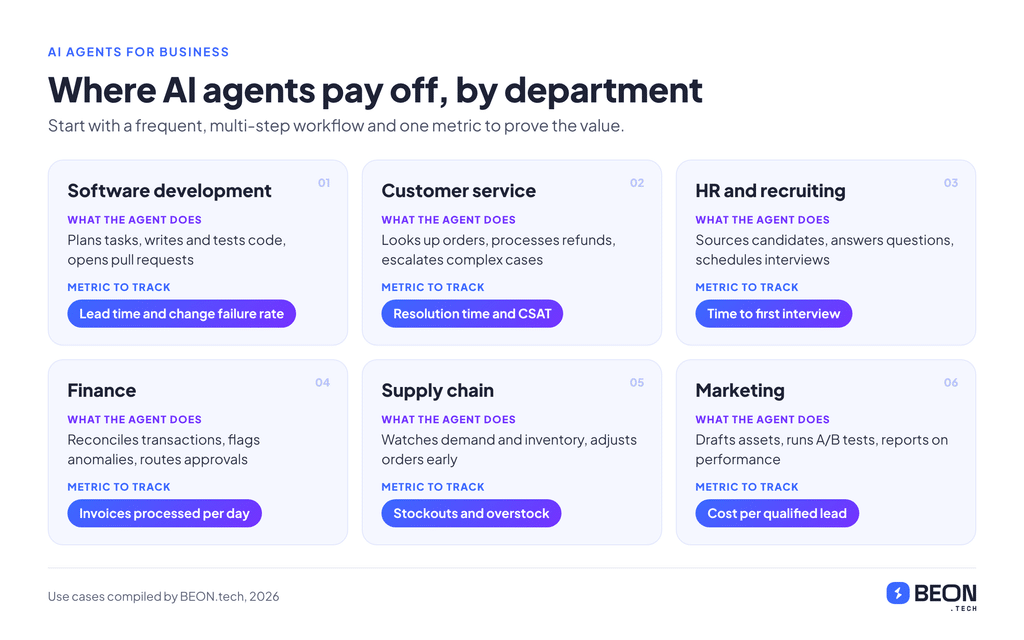
Coding agents are the most mature example. In an April 2026 Stack Overflow survey, 59% of developers used AI agents at work, and agents now plan tasks, write and test code, and open pull requests for engineers to review. They also help modernize legacy systems by documenting old code and proposing updates. How AI in software development changes each stage of the lifecycle shows where agents fit best.
Customer Service
Support agents go beyond answering FAQs. They look up orders, process refunds, update accounts and escalate complex or sensitive cases to people, with full context from the CRM. That leaves human teams free for the conversations that need judgment.
HR and Recruiting
Agents source candidates, answer their questions, schedule interviews and prepare onboarding plans. At BEON.tech, Mara, our AI recruiter, matches job descriptions with vetted engineers, reaches out to candidates and keeps hiring managers updated, before our human-led technical vetting takes over.
Finance
Finance agents reconcile transactions, flag anomalies, prepare reports and route approvals, while keeping a clear record of every step for audits.
Supply Chain
Agents watch demand signals, inventory and logistics data, and can adjust orders before shortages or overstock happen.
Marketing
A team of agents can draft campaign assets, run A/B tests and report on performance across CRMs, ad platforms and analytics tools, with people setting the strategy and approving what goes live.
Why Many AI Agent Projects Fail
Not every agent project pays off. Gartner expects over 40% of agentic AI projects to be canceled by the end of 2027, and estimates that only about 130 of the thousands of vendors selling “agentic” products offer real agent capabilities. The most common reasons:
- Costs grow faster than value. Every agent step uses compute, and loops without limits get expensive.
- The business case is unclear. Projects that start from the technology instead of a specific problem rarely show results.
- Risk controls are missing. Agents with broad access to data and systems can make costly mistakes fast.
Setting rules early, for access, approvals and monitoring, avoids most of these problems. An AI risk management framework gives you a starting point for those rules.
How to Adopt AI Agents in Your Business
- Start with one workflow. Choose a frequent, well-defined task with a clear metric, like ticket resolution time or invoices processed per day.
- Define what the agent can do. Set which systems it can access, which actions need approval and when it must hand off to a person.
- Keep people in the loop. Review agent output closely at first, then reduce oversight as results prove reliable.
- Track cost and value together. Measure compute spend next to time saved and errors avoided, not usage alone.
- Build the right team. Agents need engineers who can design workflows, connect systems, evaluate output and keep costs under control.
That last step is often the bottleneck. Knowing what an AI engineer does helps you scope the role before you start hiring.
The Real Cost of Implementing AI Agents
Licensing a tool is the smallest part of the budget. Most of the cost sits in:
- Data preparation and integration with internal systems
- Security, compliance and access controls
- Compute and inference costs that grow with usage
- Ongoing evaluation, monitoring and improvement
- Engineers with AI experience, who are in short supply and expensive in major US tech hubs
That talent gap is why many companies build their AI teams with nearshore engineers. Senior, AI-fluent engineers from Latin America cost about half a comparable US hire and work in the same or close time zones, which makes daily collaboration on agent projects practical.
Start Small, Measure, Then Scale
AI agents for business can take on real work across engineering, support, finance and operations. The companies that get value from them start with one clear workflow, set rules for what agents can do, measure cost against results and invest in the team that builds and runs them.
If you need engineers who can design and ship AI agents, BEON.tech’s AI engineering team connects you with senior, AI-fluent engineers from Latin America who work in US time zones.