
 Argentina
 Brazil
 Mexico
 Colombia

An engagement model is the agreement that defines how you work with an external engineering partner. It sets who directs the work, who owns the result, how you pay, and how easily you can change course. Pick the wrong one and even great engineers will struggle. Pick the right one and the partnership mostly runs itself.
This guide compares the four models engineering teams use most. They are staff augmentation, dedicated teams, project-based outsourcing, and contract-to-hire. We also show how each one stacks up against hiring in-house.
What is an engagement model?
Think of it as the operating system of a vendor relationship. It answers a few practical questions. Who writes the tickets? Who reviews the code? Who is accountable when a deadline slips? And what happens when you need two more engineers next quarter, or two fewer?
The answers change with the model. So does the price. That is why the choice deserves more thought than most teams give it.
Engagement models compared
The table below shows the trade-offs at a glance. In-house hiring is included as a reference point.
| Staff augmentation | Dedicated team | Project-based | Contract-to-hire | In-house hire | |
|---|---|---|---|---|---|
| Who directs the work | You | Partner, with your goals | Partner | You | You |
| Who owns the result | You | Shared | Partner | You | You |
| Time to start | 2 to 4 weeks | Depends on team size | After scoping | 2 to 4 weeks | Often several months |
| Pricing | Monthly rate per engineer | Monthly rate per team | Fixed price or time and materials | Monthly rate, then salary | Salary plus benefits and recruiting |
| Flexibility | High | Medium | Low once scoped | Medium | Low |
| Best for | Adding capacity to a team you already run | A new product or workstream | A defined build with a clear end | Testing a role before a permanent hire | Core, long-term roles |
Time to start for in-house hiring varies widely by role and market. The staff augmentation and contract-to-hire timelines reflect BEON.tech averages.
Types of engagement models in software development
Staff augmentation
With staff augmentation, you add external engineers to your own team. They work in your tools, follow your processes, and report to your managers. The partner recruits them, employs them, and handles payroll, benefits, and compliance.

Benefits. You keep full control of priorities and code. You can add people in weeks instead of months. And you can scale the team up or down as the roadmap changes.
Drawbacks. You need managers with time to lead. If your processes are loose, new engineers will feel it quickly.
When to use it. Choose staff augmentation when you have a clear roadmap, a working engineering culture, and more work than people. For a full explanation of the model, read what is staff augmentation.
Dedicated team
A dedicated team is a group of engineers the partner assembles for your company. It usually includes a lead who manages delivery day to day. You set goals and review progress, and the team decides how to get there.
Benefits. You get a working unit, not just individuals. It suits new products, where you may not have the internal leadership to staff a team from scratch.
Drawbacks. You have less say over daily decisions. Knowledge can concentrate in the partner’s team instead of yours.
When to use it. Choose a dedicated team when you need to open a new workstream and don’t have the managers to run it yet. At a larger scale, the same model becomes an offshore development center.
Project-based model
In a project-based model, the partner takes a defined scope and delivers it. Pricing is usually fixed, or billed on time and materials against an estimate. Once the work ships, the engagement ends.
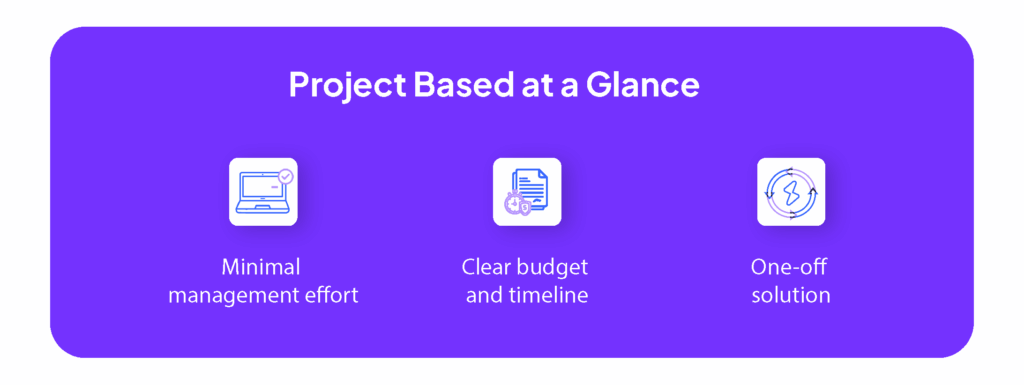
Benefits. Costs are predictable when the scope is stable. Your team stays focused on its own roadmap.
Drawbacks. Changes are slow and expensive once the contract is signed. You have little visibility into how the code is built, which can hurt maintenance later.
When to use it. Choose project-based outsourcing for builds with clear requirements and a clear finish line, such as a marketing site or an internal tool. For a broader view, read our software development outsourcing guide.
Contract-to-hire model
Contract-to-hire starts as staff augmentation and can end as a permanent hire. The engineer works on your team through the partner for a trial period. If both sides are happy, you convert them to a direct employee.
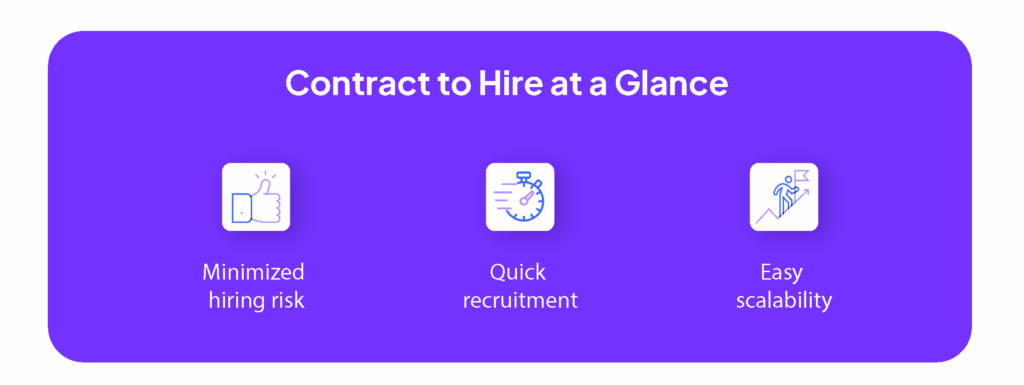
Benefits. You see real work before you commit. The engineer gets to know your team too, which lowers early turnover.
Drawbacks. Conversion terms and fees need to be clear from day one. Some strong candidates prefer a permanent offer from the start.
When to use it. Choose contract-to-hire when the role is new, when you are unsure about the long-term fit, or when you want to build a permanent team gradually. See how it works in practice on our contract-to-hire page.
Staff augmentation vs. outsourcing
This is the comparison teams ask about most. The short version is that staff augmentation sells capacity and outsourcing sells an outcome. We cover it in depth in staff augmentation vs. outsourcing.
With staff augmentation, the engineers are part of your team. You decide what they build and how. With outsourcing, a vendor decides how to deliver what you asked for, and you judge the result. The first gives you control and asks for management time. The second saves management time and asks you to give up control.
Many teams use both. They augment the core product team and outsource side projects with fixed scopes. For a related comparison, read staff augmentation vs. managed services.
How much does each model cost?
Prices vary by region, seniority, and role, so compare like with like. Here is what BEON.tech charges for senior, full-time engineers from Latin America in 2026.
| Role (senior, full-time) | Monthly rate (USD) |
|---|---|
| Backend, Node.js, TypeScript or Java | $6,300 to $7,900 |
| Full stack, Node.js and React | $6,300 to $7,800 |
| DevOps or platform | $6,800 to $8,500 |
| Data engineer | $6,300 to $8,100 |
| QA automation | $6,000 to $7,300 |
| Tech lead or software architect | $7,900 to $9,500 |
The same rates apply whether you add one engineer through staff augmentation or several as a dedicated team. Every contract includes a Talent Experience Manager, PTO and national holidays, a co-working allowance, a new MacBook Pro, an internet stipend, and medical insurance.
Project-based work is priced differently, usually as a fixed fee per scope. In-house hires cost the most per head. The median US software developer earned $135,980 in May 2025, according to the Bureau of Labor Statistics, before benefits and recruiting fees. For a detailed breakdown, see nearshore software development rates.
How to choose the right model
Start with three questions.
- Do you have managers with time to lead new engineers? If yes, staff augmentation or contract-to-hire will give you the most control. If no, look at a dedicated team.
- Is the scope fixed or evolving? A fixed scope with a clear end fits project-based outsourcing. An evolving roadmap fits the other three.
- Do you want these people on your team long term? If you are sure, hire in-house or use contract-to-hire. If you are not, staff augmentation keeps your options open.
Most growing companies end up with a mix. The core team is in-house, with augmented engineers adding capacity and the occasional project outsourced. What matters is choosing on purpose, one workstream at a time.
For one-to-one comparisons, read IT staff augmentation vs. direct hire, staff augmentation vs. consulting, FTE vs. contractors, and EOR vs. traditional hiring models.
Why staff augmentation works for most product teams
Most engineering leaders we work with already have a roadmap, a process, and a team that ships. What they lack is people. Staff augmentation fills that gap without changing how the team works.
It is also the easiest model to adjust. You can start with one engineer, add three more after a funding round, and convert a strong contributor to a permanent role later. No other model offers that range with so little friction.
FAQ
What are engagement models in software development?
They are the agreements that define how a company works with an external engineering partner. The most common are staff augmentation, dedicated teams, project-based outsourcing, and contract-to-hire.
What is the difference between staff augmentation and outsourcing?
With staff augmentation, engineers join your team and you direct their work. With outsourcing, a vendor delivers an agreed outcome and manages the team itself.
Which engagement model is cheapest?
Project-based pricing can look cheapest for small, fixed scopes. For ongoing product work, nearshore staff augmentation usually costs less than in-house hiring while keeping you in control.
Can you switch engagement models mid-project?
Yes, and many teams do. A common path is to start with staff augmentation and convert key engineers through contract-to-hire. Moving from project-based to staff augmentation is also common once the scope stops being fixed.
Find the right model for your team
BEON.tech offers staff augmentation, dedicated teams, and contract-to-hire with senior engineers from Latin America. We will help you choose the model that fits your roadmap and budget. Explore IT staff augmentation.